

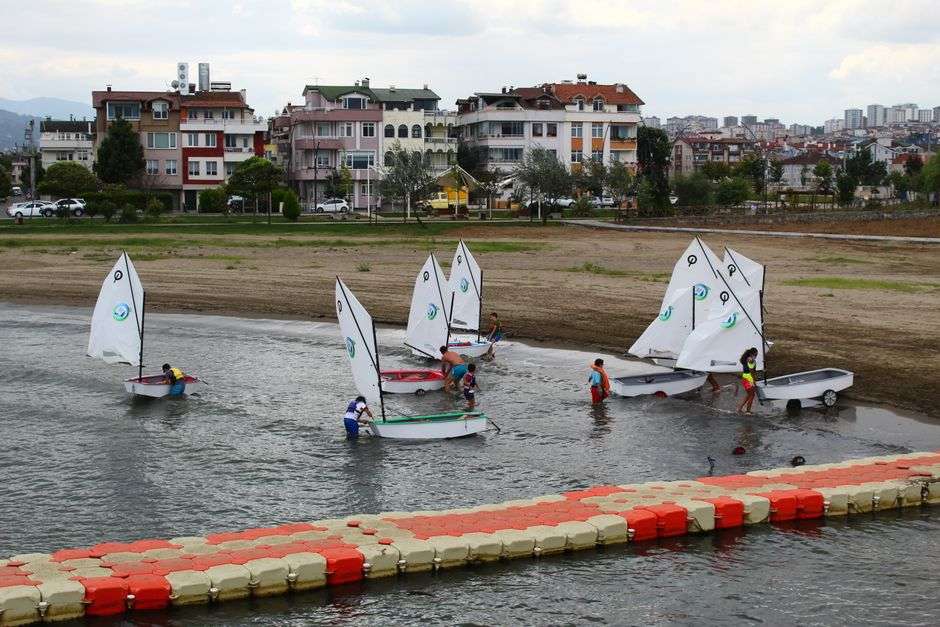
Three hundred kids, one bay: how Fairhope built one of the Gulf Coast’s busiest youth sailing programs
Registration for the Fairhope Yacht Club’s summer sailing camps opened in February. The Bay Buddy session for 5-, 6- and 7-year-olds — capped at 40 children — filled within an hour and a half. By the time the season ended in early August, 300 kids had come through the program’s four two-week sessions on Mobile Bay.
Sailing camp has been a fixture at the Fairhope Yacht Club for at least the half century that many Eastern Shore families have lived there. What has changed under program director Holly Murray, now in her tenth year at the helm, is the scale and reach of the operation — from beginner camps to high school race teams to a national championship trial that brought the youth sailing world to Fairhope.
The director who came up through the race course
Murray grew up in Long Beach, Mississippi, learned to sail as a child and started racing sailboats at 18. Before Fairhope, she directed programs at well-known Gulf Coast clubs: the Long Beach Yacht Club and Pass Christian Yacht Club on the Mississippi Coast, and the Southern Yacht Club in New Orleans. In Fairhope she has built a program that spans nearly every age a young sailor can be.
Beyond the summer camps, Murray coaches four high school sailing teams — Fairhope, Bayside Academy, St. Michael’s and Bayshore Christian. The teams race in FYC-owned 420s and sail multiple regattas throughout the year. She also runs clinics for advanced Optimist sailors and Green Fleet sailors working their way into competition.
The little boats doing the heavy lifting
Anyone who has watched the bay in summer has seen the Optimists — the small pram-style boats that look like toys but are the worldwide standard for teaching sailors under 16. An Opti is 7 feet 9 inches long, weighs 77 pounds, and carries three air-filled flotation bags that keep it afloat even when swamped, making it a forgiving first boat for young children. The first day of camp includes a capsize drill, where students learn to right the boat themselves.
The program’s credibility showed last April, when FYC hosted the U.S. Optimist National Team Trials — the event that decides which American sailors represent the country in international competition. Roughly 250 sailors, parents and coaches from across the country spent the event week in Fairhope, a significant showcase for a town of Fairhope’s size.
Safety first, joy a close second
Murray is direct about the responsibility of putting large numbers of children on open water. Counselors complete a 40-hour certification course through the US Sailing Association, demonstrated both online and on the water. Every child passes a swim test before sailing and wears a life vest and shoes at all times. When summer squalls build over the bay, Murray tracks lightning with a dedicated app and pulls students off the water when a strike registers 20 miles out. “I err on the side of caution,” she says.
The payoff, she argues, goes well beyond boat handling. Students like the 7-year-old Birmingham grandson of one Eastern Shore grandparent — who begged to enroll after watching sails on the bay — come away with points of sail, wind reading, knot tying, on-the-water safety and, less measurably, resilience, independence and problem-solving. And then there is the simplest benefit: the sheer joy of being outside on the water.
From Optis to college sailing
The pathway is deliberate: learn to sail, learn to race, then deepen racing knowledge through tactics and strategy. High school sailors can become junior members of the yacht club and compete in regattas up and down the coast. Many go on to collegiate programs — Murray counts former students now sailing at Tulane, the University of Miami and The Citadel.
The program keeps expanding. Murray has added a fishing camp to close out the summer — kids throw cast nets and pull seine nets for bait, learn spin-rod casting and try some crabbing — along with new offerings such as Sail Forward. The fleet has grown too, with two Lasers, a Sunfish, five new Optimists and additional 420s added to the boatyard.
For a town that measures its summers by what happens on the bay, the white sails out from the Fairhope Yacht Club are no longer just scenery. They are a pipeline — one wind direction and one knot at a time — carrying hundreds of local kids toward the water, and some of them a long way beyond it.