Fairhope’s moonguys Debuts With Bedroom-Recorded EP
moonguys, the solo project of Fairhope's Greg Gulbranson, has released a five-song debut EP recorded entirely in his bedroom, with a full-length album.
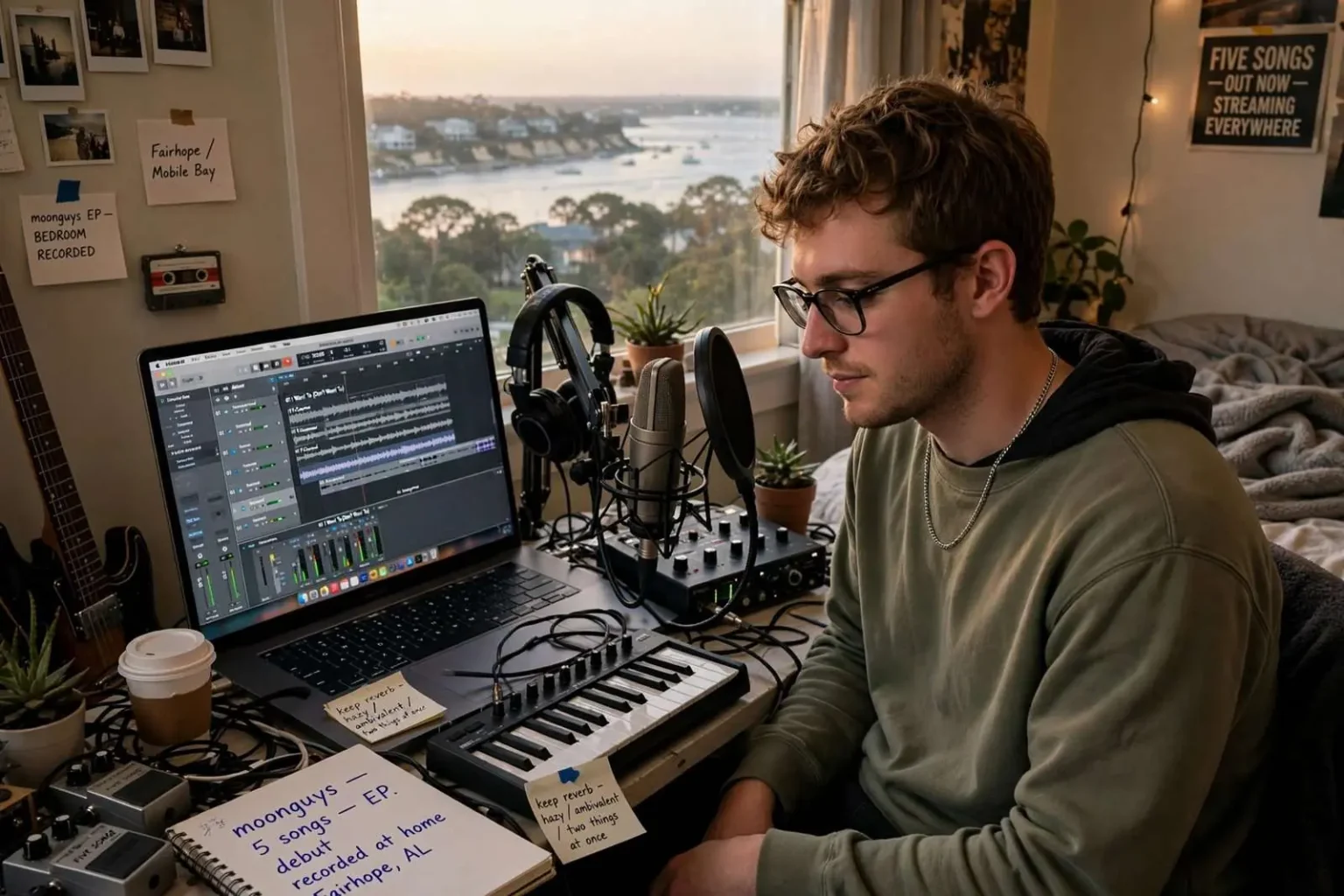
Fairhope songwriter Greg Gulbranson has quietly put out one of the Mobile Bay area’s more intriguing new releases: a five-song debut EP from moonguys, a project that presents itself as a full band but is entirely the work of one 23-year-old recording alone in his bedroom. The record arrived without label fanfare, live shows or local hype cycle, surfacing the way many small releases do now — uploaded, tagged and discoverable — but its craftsmanship and cohesion have begun drawing attention from listeners far beyond Baldwin County.
A Band of One
New acts around Mobile Bay tend to take shape gradually, trading members, names and musical directions before settling into anything stable. Moonguys arrived with none of that trial and error. Gulbranson wrote every song on the EP himself, handled the recording and production, and packaged the finished tracks under a band name — a choice that puts a little distance between the music’s introspective subject matter and the songwriter behind it. The moonguys name functions as both a disguise and a frame, letting the songs stand as objects in their own right rather than as diary entries attached to a recognizable local figure.
The approach has practical advantages for a young songwriter. Recording solo means no scheduling conflicts, no creative compromises and no waiting on anyone else’s availability, which is why so many first records now emerge fully formed from bedrooms and home offices. It also means total control over the details — the reverb tails, the synth tones, the way one song bleeds into the next — that a band recording collectively would have to negotiate. For Gulbranson, who built the project’s entire sound himself, that control is audible in the EP’s unified atmosphere.
The release lands amid a broader shift in how small-scale records get made. Affordable home-recording gear has reached the point where skipping the studio no longer means skimping on quality, and a string of acclaimed bedroom-produced albums in recent years has made the single-vision approach respectable, even fashionable. Moonguys fits comfortably in that lineage. What was once a compromise — making a record alone because there was no budget for anything else — has become an aesthetic in its own right, complete with its own audience expectations: intimacy, haze, and a sense of hearing something meant for one listener at a time.
Hazy Songs About Wanting Two Things at Once
Sonically, the EP drifts through ambient-punk territory: vocals drenched in reverb, cottony synthesizer layers, and melodies that swing between dreamy and propulsive. The production favors depth over clarity in the way that defines the genre, smudging individual instruments into a wash while keeping the emotional core of each song close to the surface. It is a sound engineered for headphones and late-night listening rather than a stage, which makes the record’s analog-of-a-band presentation all the more deliberate.
Underneath the atmosphere runs a consistent theme of divided identity — characters pulled toward opposite desires, splitting themselves into different versions depending on where they are. The songwriting keeps returning to ambivalence as a condition rather than a problem to be solved, a sensibility that fits both the songwriter’s age and the project’s name, which suggests watching over things from a distance in the dark.
The upbeat-leaning opener “I Want To (Don’t Want To)” lays out that push-and-pull from the start, its title doubling as a thesis for the record, while the centerpiece “I’ll Come Around” blends country-tinged melancholy with restless indie-rock energy. “Anonymous” rides twangy, western-style guitar lines, and “I Didn’t Mean A Word” closes the set with driving, hook-forward urgency before dissolving into a haze. The sequencing gives the five tracks an arc — open, wander, resolve, dissolve — that rewards listening straight through in the way that albums, more than singles, traditionally have.
Gulbranson has said he approached the EP as a single cohesive work rather than a loose collection of singles, and the record bears that out: shared sonic textures carry across all five songs, and none of them plays entirely like a bid for a playlist slot. In an era when many releases are engineered to be chopped up and distributed track by track, the commitment to a unified whole is itself a statement of what kind of music this intends to be.
Fairhope’s Place in the Bay Area Music Scene
Fairhope has long cultivated an artistic identity disproportionate to its size. The Eastern Shore town, perched on a bluff above Mobile Bay, built a reputation more than a century ago as a haven for writers and free thinkers, and that legacy persists in its bookstores, galleries, and the steady stream of working artists who make their homes on the Eastern Shore while staying connected to Mobile’s larger music circuit. Songwriters there tend to grow up with Mobile’s venues across the bay as their proving ground, even when their material is written in the quiet of Fairhope’s residential streets.
That geography shapes records like this one. The Mobile Bay scene is small enough that a debut release is heard by actual neighbors, but distributed platforms mean a bedroom project in Fairhope competes for the same ears as bedroom projects anywhere. Moonguys sits in both worlds at once — a local release with local roots, packaged for the borderless audience that streaming provides. For a 23-year-old working alone, that combination of intimacy and reach is precisely the trade the bedroom era offers.
What Comes Next for the Project
The questions around any promising one-person debut are the same: whether it becomes a live act, whether collaborators join, and whether the songwriter can repeat the process. Gulbranson has given no indication that moonguys will abandon its single-vision format, and the record’s self-contained quality suggests a writer comfortable working without outside input. The project’s band framing, meanwhile, leaves the door open — if moonguys ever does take a stage, the name already implies members who do not exist yet.
For listeners along Mobile Bay and beyond, the EP is available on the usual streaming platforms, and it stands as one of the more fully realized debuts to come out of Baldwin County’s quieter corners in recent memory. Five songs, one bedroom, and a band that is not a band: moonguys is a small record in scale and a confident one in every other respect, and it announces a songwriter worth following wherever the next batch of songs leads.
The Bedroom Production Toolkit
The machinery behind a record like this one is modest in cost but elaborate in use. A typical bedroom setup pairs a laptop with a digital audio workstation, a basic audio interface, one or two microphones and a small midi keyboard, with software synthesizers and sampled drums standing in for the instruments a solo producer cannot play or record at home volume. What separates a competent bedroom record from a memorable one is not the gear but the time spent on it — the countless passes over a single synth line, the reverb decisions made and remade, the arrangement choices that a committee would settle in an afternoon and a solo producer obsesses over for weeks.
That obsessive quality is audible in the moonguys record, particularly in the way its synthesizer layers stack and blur. Cottony, washed-out textures are easy to produce and hard to produce well; the temptation in bedroom production is to bury every flaw in effects, while the craft lies in keeping enough structure alive underneath the wash that songs remain songs. The EP navigates that line, letting its atmospheres thicken without ever quite swallowing the melodies that hold each track together.
The broader bedroom-pop movement that Gulbranson’s project joins has roots in the indie scenes of the past two decades, when cheap multitrack software first let teenagers make records without labels or studios. A wave of lo-fi releases proved that listeners would embrace the intimacy and imperfection of home recordings, and streaming platforms ultimately removed the distribution barrier entirely. What began as a budget constraint hardened into a recognizable sound and then into a career path, with major artists now emerging from bedrooms rather than scenes, and small scenes like Mobile Bay’s contributing their own entries to that pipeline.
Why Local Debuts Still Matter
For all the borderless reach of streaming, local releases remain the lifeblood of a regional music community. A debut like this one gives Mobile Bay listeners a reason to pay attention to what is happening in their own zip code, and it gives venues, radio shows and fellow songwriters a new name to book, play or collaborate with. Scenes grow through exactly this kind of artifact: a record that circulates among friends, gets played at house shows and bar patios, and eventually pressures the next songwriter in line to finish something of their own.
Fairhope and the Eastern Shore have produced their share of musicians who went on to wider audiences, and most of them started the same way this record did — songs written at home, recorded without help and released into the local current first. Whether moonguys stays a small regional curiosity or grows into something larger, the debut has already done the work a first record is supposed to do. It introduces a voice, establishes a standard and makes the map of local music slightly more interesting than it was the week before it arrived.