
Family and Friends Hold Candlelight Vigil for Mobile Man Killed in His Own Driveway
Family and friends gathered for a candlelight vigil honoring Samuel Wilson III, a Mobile man shot and killed in his own driveway one week ago.
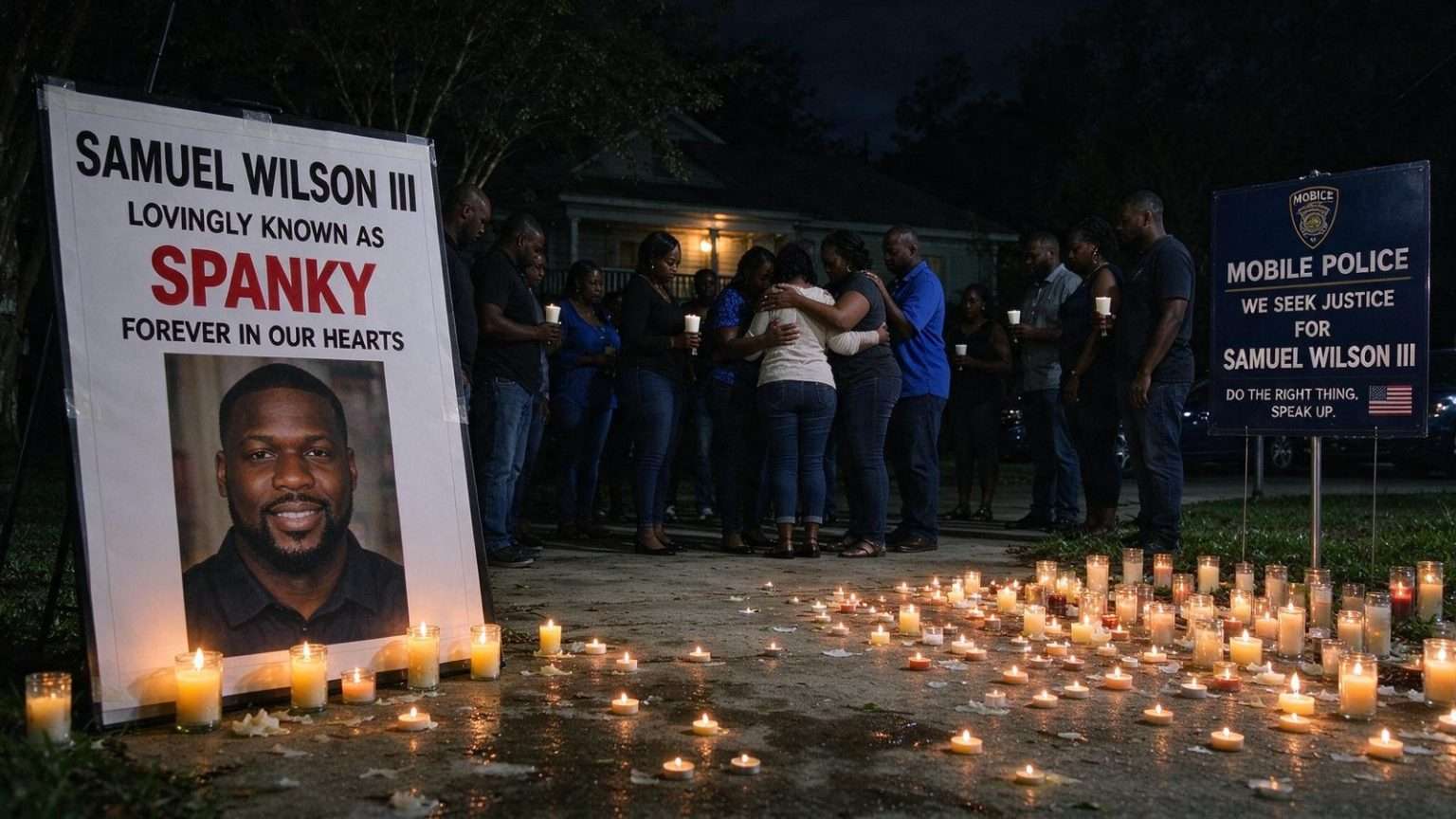
Family and friends gathered for a candlelight vigil honoring the memory of Samuel Wilson III, one week after Mobile Police say he was shot and killed in his own driveway. The gathering brought together the people who knew him best — the friends who called him Spanky, the family he supported, the neighbors who had watched the investigation unfold on their street — for an evening of remembrance and, pointedly, a public appeal for help.
Police said Wilson was on his way to work when he was shot. Officers believe Wilson may have tried to stop someone from breaking into his wife’s car when he was shot — a detail that has defined the public understanding of the case: a man interrupted a crime against his own household on an ordinary morning and did not survive it.
The driveway where Wilson died is the same pavement his family crosses every day, and the vigil held there a week later made that intimacy part of the message. Homicides in Mobile most often end in courtrooms or case files; this one began where a young family’s day begins, and the people who gathered in candlelight were asking the city to see it that way.
Friends knew Wilson as “Spanky.” One of his best friends said, “Spanky was a genuine, down to earth person. I used to talk to him every day, week after week. I’ve never known anyone to dislike Spanky.”
The nickname said as much as the tribute. Men acquire names like Spanky in childhood and carry them into adulthood only when the people around them never stop being that kid — the genuine, down-to-earth one the friend described, the man whose daily phone calls anchored a circle of people who now have one fewer call to make.
Wilson’s brother said, “I lost a little brother and I will never get him back.”
What Police Are Asking
The message at the vigil echoed what the Mobile Police Chief said earlier this week: they will not stop until whoever did this is behind bars. That pledge, delivered by the city’s top officer, transformed the vigil from memorial into partnership — the department stating publicly that the case would not age into a file drawer, and the family stating publicly that the community’s help was the missing piece.
Police still need help identifying the people in a surveillance video taken around the time Wilson was shot. The video, which investigators distributed through the department’s channels, holds the identities of at least some of the people who were present on the street that morning, and someone in the city knows who they are. Detectives’ appeal is aimed at those people: identify what the camera recorded, because the camera cannot.
Surveillance cases of this kind move when the images meet the one person who can name the faces. A week after the shooting, that had not happened, and the vigil’s speakers made the gap the center of their appeal.
Wilson’s mother made a plea to whoever pulled the trigger. “Do the right thing and speak up. Tell someone,” she said.
The appeal was aimed at more than the shooter. In cases built on surveillance video, the path to an arrest usually runs through witnesses — people who saw the video, recognized a face or a walk, and have so far stayed quiet. A mother’s words at a candlelight vigil are directed at that silence: the friend-of-a-friend who knows what the camera caught, the acquaintance who can name the person in the frame. “Do the right thing and speak up. Tell someone” is the shortest possible version of what detectives spend months trying to communicate.
Wilson’s mother-in-law spoke of the young widow he left behind. “He was the love of her life and he was my son-in-law. That’s my son. He knew my daughter since middle school. They’ve been together since middle school and someone took my son, so if anyone knows anything, please, please, justice for my Sam,” she said.
The detail of middle school carried the weight of the whole appeal. A couple who had been together since middle school are not merely married — they are a shared history, the person who knew every version of you. The vigil’s speakers described a marriage in its early chapters and a family joined across two households, and a single act in a driveway that ended it.
The Crime in Context
The circumstances police describe — a man confronting someone breaking into his wife’s car, on his way to work — place the case among the categories that trouble Mobile residents most: the crime that arrives in daylight, at home, over property. Vehicle break-ins and thefts from driveways are among the most common offenses in the city, and the overwhelming majority end with an insurance claim. This one ended with a homicide because a homeowner acted.
Officers and victim advocates have long debated the advice to give residents in such encounters — property can be replaced; a life cannot — and the case became, for the week after the shooting, the local illustration of that dilemma. Nothing in that discussion diminishes what Wilson did, which the vigil framed plainly: he protected his household.
The investigation now rests on the two assets available in most modern homicides: camera footage and community memory. Mobile Police canvassed the neighborhood for video in the hours after the shooting, and the surveillance clip at the center of the public appeal represents what that canvass recovered. Detectives can enhance frames, trace angles and build timelines — but identification still requires a resident who recognizes someone.
How Mobile Cases Like This Get Solved
Mobile’s homicide clearance typically turns on witness cooperation, and the department has spent years building the channels that make it easier: the investigations tip line, CrimeStoppers of Metro Alabama’s anonymous rewards program, and the direct appeals that detectives deliver at vigils and press conferences. Anonymous tips through CrimeStoppers can qualify for cash rewards, and the anonymity is real — tipsters never testify, and the program exists precisely for witnesses who fear exposure but cannot stay silent.
Family members at the vigil made the same appeal through different doors. The mother spoke to the shooter; the mother-in-law spoke to anyone who knows anything; the friend and the brother described the man the city lost. Together they formed the kind of public record that juries eventually see and that suspects feel — a community that is watching, waiting and refusing to let the case go quiet.
A week after the shooting, the driveway on the street where the Wilson family lives had been transformed twice: once by the crime that took Samuel Wilson III, and once by the candles that marked what his city thought of it. The investigation continues. Mobile Police ask anyone with information about the identity of the people in the surveillance video, or the shooting itself, to come forward — through investigators, or anonymously through CrimeStoppers, where a tip can be the difference between a case that closes and one that never does.
Who Samuel Wilson III Was
The man behind the nickname emerges through the people who spoke at the vigil. A regular at daily conversations with his best friend, a husband whose relationship stretched back to middle school, a son and son-in-law bound into a single family, a man on his way to work when his life ended — the portrait that assembled in candlelight was of someone ordinary in the best sense: employed, devoted, present, known.
“I’ve never known anyone to dislike Spanky,” his friend said, and that sentence became the vigil’s refrain. Cities measure their losses in statistics; neighborhoods measure them in the specific absence a death leaves — the daily call that no longer comes, the wedding anniversaries that will be kept alone. The people who spoke did not describe a case. They described a person, and asked the city to solve his case because of who he was, not just how he died.
The widow at the center of the family’s appeal was described in her mother’s words: a young woman whose life’s love was taken at the place where their mornings began. Vigils exist for many reasons, but their sharpest purpose in a case like this one is to make the abstraction of “a homicide victim” impossible — to stand the city in front of the actual people bereaved and let the name Samuel Wilson III mean a face, a laugh and a marriage, not a file number.
The Appeal to the City
Every speaker at the vigil converged on the same request from a different direction: help. The police chief’s pledge that officers will not stop until the shooter is behind bars commits the department’s resources; the family’s pleas commit its credibility; the surveillance video commits the evidence. What remains is the community’s part — the identification that only a neighbor, friend or acquaintance can provide.
Mobile residents who recognize anyone in the video are urged to act on that recognition rather than assume someone else will. Investigators emphasize that even partial information helps: a name, a nickname, a place someone frequents. Tips can be delivered directly to Mobile Police investigators or anonymously through CrimeStoppers, where information that advances a case can qualify for a reward without the tipper’s identity ever being revealed.
The family’s presence at the vigil a week after the shooting signaled what they intend for the long term: to keep the case public, keep the appeals coming and keep the name in circulation until an arrest changes the story. For a mother asking her son’s killer to “do the right thing and speak up,” and for a mother-in-law demanding justice for her Sam, the vigil was not a farewell. It was the opening argument of a campaign to see the case solved — one that the city, holding the missing piece in its memory, can end at any time by telling someone.


