Family Escapes Early-Morning House Fire on Lancewood Drive in West Mobile
A woman and young children escaped safely from a west Mobile house fire on Lancewood Drive; a neighbor grabbed a hose before crews arrived.
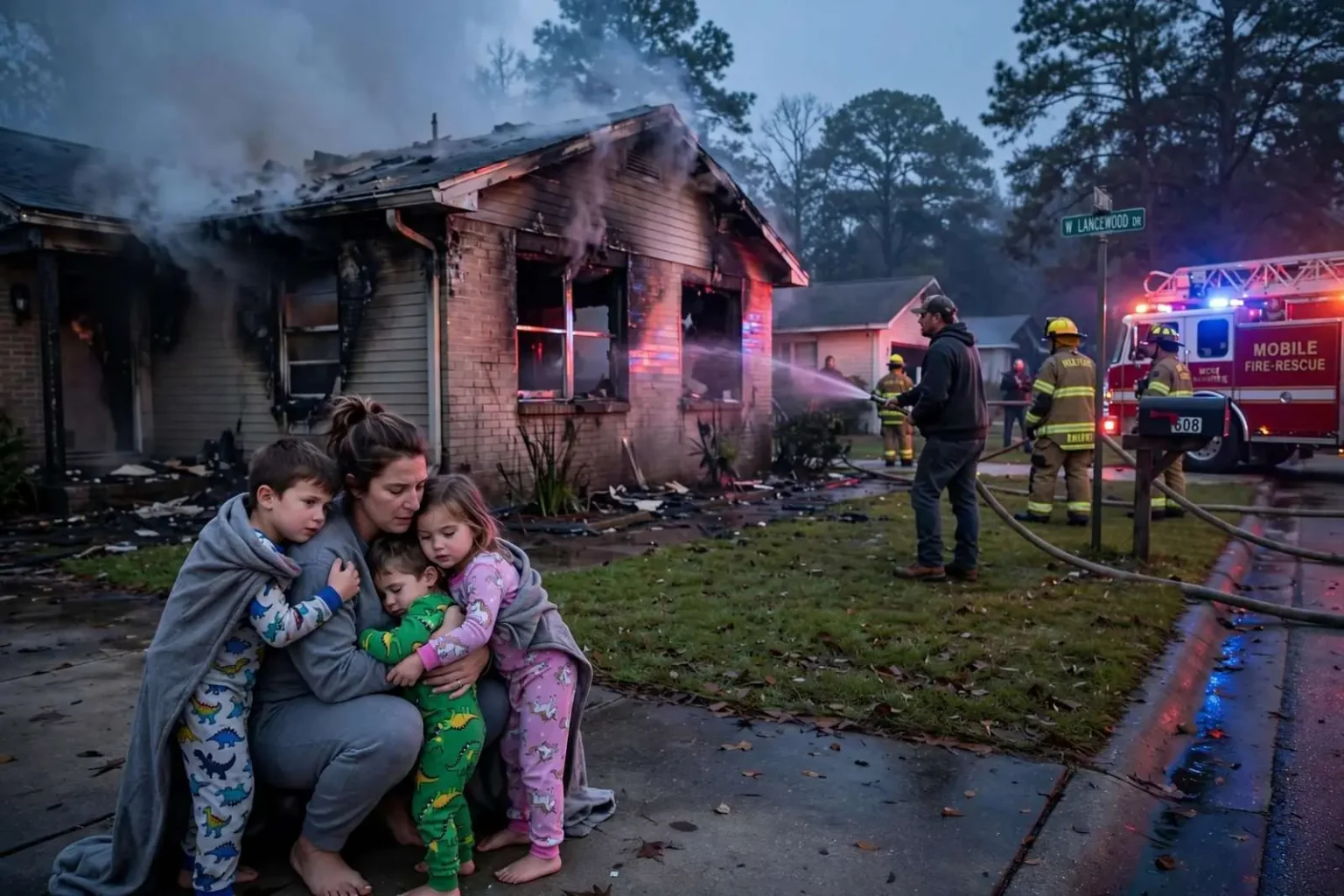
A woman and several young children made it out of a west Mobile home safely Monday morning after fire broke out inside the house just after 5 a.m. Mobile Fire-Rescue crews were called to the 600 block of West Lancewood Drive shortly after the first report came in, arriving to find the home burning while its occupants — including the young children — had already gotten clear of the danger.
Help arrived from next door almost as quickly as the fire trucks did. A man who lives a few houses down ran straight for the burning home and grabbed a water hose, doing what he could against the flames before firefighters took over, according to a relative who lives nearby with her fiancé. The cause of the fire remains under investigation, and no injuries were reported among the family or the crews that responded.
An early-morning escape
A fire in the first minutes after 5 a.m. strikes at the hour when nearly everyone in a home is in their deepest sleep, which makes the family’s escape the central fact of this incident. Getting a household of young children out of a burning house requires an adult to wake, recognize what is happening, gather the children and move them out a door, all in the span of a few minutes. That the woman and the children made it out before the first engine arrived means the family’s early-morning instincts and whatever alarm sounded in the house worked exactly as they were supposed to.
Fire officials repeat after nearly every incident like this that the first minutes belong to the occupants, not the fire department. Even with the fastest response times in the city, crews cannot arrive before a fire has been burning for several minutes, and the difference between a safe outcome and a tragedy is almost always decided by whether the people inside get out in that window. West Lancewood Drive sits in a quiet residential part of west Mobile, a neighborhood of family homes where the residents know one another, and that closeness showed in the response that followed.
The neighbor who ran toward the fire
While most people’s instinct in a fire is to move away, the neighbor a few houses down did the opposite, running toward the burning home and grabbing a water hose to fight the flames before professionals arrived. It is the kind of action that looks impulsive but reflects something real about how Gulf Coast communities respond to their own. A garden hose against a house fire is not going to extinguish it, and fire officials generally caution residents against entering or approaching burning structures, but a neighbor working the exterior can slow a fire’s spread to adjacent parts of the home and buy time until engine companies lay their lines.
The account of the neighbor’s efforts came from a relative who lives nearby with her fiancé, one of the ways that fires in close-knit neighborhoods are documented in the hours before official reports are complete. In the aftermath, the family’s needs are immediate and practical: shelter for the night, clothing for the children, and the long process of dealing with insurance and repairs. Neighbors typically supply the first of those, and Mobile’s church and community networks usually organize the rest in the days that follow a residential fire.
Mobile Fire-Rescue on the scene
For the crews dispatched to the 600 block of West Lancewood Drive, a residential structure fire with occupants already out is the best version of a bad call. The first-arriving company confirms that everyone is clear, sizes up the fire’s location in the structure, and commits the first line to the room or area that is burning, while later crews handle water supply, ventilation and a search of the home to confirm no one is inside. Arriving to find the family safe changes the tone of the response entirely, since the priority shifts from rescue to firefighting and property conservation.
A house fire also mobilizes support functions that drivers passing the scene never see. Utility crews or fire personnel cut power and gas to the structure, a safety officer tracks every firefighter going in and out, and rehab areas are set up for crews cycling through the work in heavy gear. Overhaul after the fire is knocked down can take as long as the attack itself, as firefighters open walls and ceilings to find hidden fire and make sure the home cannot reignite after everyone leaves.
What investigators will look for
With the family safe, the central open question in the incident is the cause, which remains under investigation. Mobile Fire-Rescue investigators approach a fire scene methodically, beginning with the area of most severe damage, tracing burn patterns back toward the point of origin, and examining whatever appliances, wiring or heating equipment are found there. Early-morning fires in occupied homes most often trace to a handful of familiar sources, including cooking equipment left on from the night before, electrical faults, heating devices and smoking materials, though investigators do not assign a cause until the physical evidence supports it.
The investigation matters for more than curiosity. The findings determine what the insurance claim looks like, whether the home can be repaired or must be rebuilt, and what the family and the neighborhood can learn from the incident. In fires with young children in the home, investigators also confirm that working smoke alarms were present, because that single factor shapes both the outcome of this fire and the message the department takes from it when it talks to the public.
Smoke alarms and escape planning for families
Every safe escape from a house fire is built on preparation, and fire officials use incidents like this one to remind families of the basics. Working smoke alarms on every level of the home and outside sleeping areas are the foundation, because they are the device most likely to wake an adult in time to get children out. Escape plans matter just as much: a family that has practiced getting out, agreed on a meeting spot and taught children the sound of the alarm will move faster and more surely than one deciding what to do in the moment.
Homes with young children deserve particular attention, since children sleep through noise more soundly than adults and cannot be counted on to self-evacuate. Parents are encouraged to keep bedroom doors closed at night to slow smoke, to know two ways out of every room, and to teach children never to hide from a fire, a common instinct that costs rescuers precious time. Fire departments across Alabama, including Mobile Fire-Rescue, offer alarm programs and safety education for exactly these households, and many will install alarms for families that cannot afford them.
The neighborhood’s role in recovery
The days after a house fire test a neighborhood as much as the fire itself tests a family. The Lancewood Drive household faces the immediate work of finding a place to stay, replacing clothing and school supplies for the children, and navigating the insurance process while the investigation continues. In Mobile, that support typically begins with the people on the same street, and it often extends through churches, schools and local organizations that collect furniture, clothing and gift cards for burned-out families.
The neighbor with the hose has already set the tone for that response. Communities remember the people who ran toward trouble, and acts like his tend to ripple outward, prompting others to offer what they have. For the family, the visible evidence that their neighbors cared enough to stand in their yard with a hose while their home burned matters in ways that are hard to measure, and it is the part of the story the neighborhood will tell longest after the damaged house is repaired.
No injuries were reported among the family or the crews that responded, and with the cause still under investigation, the incident stands for now as what it was: a fire that could have ended tragically, a family that escaped with their lives, and a west Mobile neighborhood that showed how quickly it moves when one of its own needs help.
Fire risk in Gulf Coast housing
West Mobile’s housing stock, like much of the Gulf Coast’s, includes thousands of homes built in the 1960s through the 1980s, and the age of that housing carries fire-specific considerations. Older wiring, panels and outlets wear over decades, and homes that have been added onto over the years sometimes carry mixed electrical systems that were never fully updated. Fire officials in growing Southern metros have repeatedly connected residential fires to aging electrical components and to modern power demands that older circuits were never designed to carry, from multiple televisions to charging devices in every room.
Humidity and heat shape the region’s fire profile in other ways. Air conditioning units run nearly year-round along the Gulf, and the compressors, wiring and outdoor components that come with them are a recurring source of residential fires in Southern states. Storm season adds its own hazards, from water-damaged electrical systems after floods to the generators that households run after hurricanes, which must never be operated in or near a garage or living space. None of these can be tied to the Lancewood Drive fire before investigators release their findings, but they are the background risks that fire marshals across the region spend the year educating residents about.
The response system behind the trucks
The speed of the response on West Lancewood Drive is the product of a system residents rarely see. Mobile’s fire stations are positioned against a map of call volume and travel time, and dispatchers route the closest appropriate units the moment an address is confirmed. A residential street in west Mobile sits within reach of multiple stations, and the first engine’s crew arrives trained to make the decisions that shape the rest of the incident: where the fire is, whether anyone remains inside, and where the first hose line goes to do the most good.
Behind that engine come the layers that make a fireground work. A ladder company opens the roof and searches the interior, additional engines secure water from hydrants, and a command officer coordinates the whole scene as it grows. When the incident ends without injuries, as this one did, it means every one of those pieces performed as designed, on a morning when a family needed them, in a neighborhood where a man with a garden hose had already set the standard for showing up.