Family of fallen Biloxi police officer Robert McKeithen speaks
The family of Robert McKeithen, a Biloxi police officer killed in the line of duty, shared memories of him in a video statement released this week.
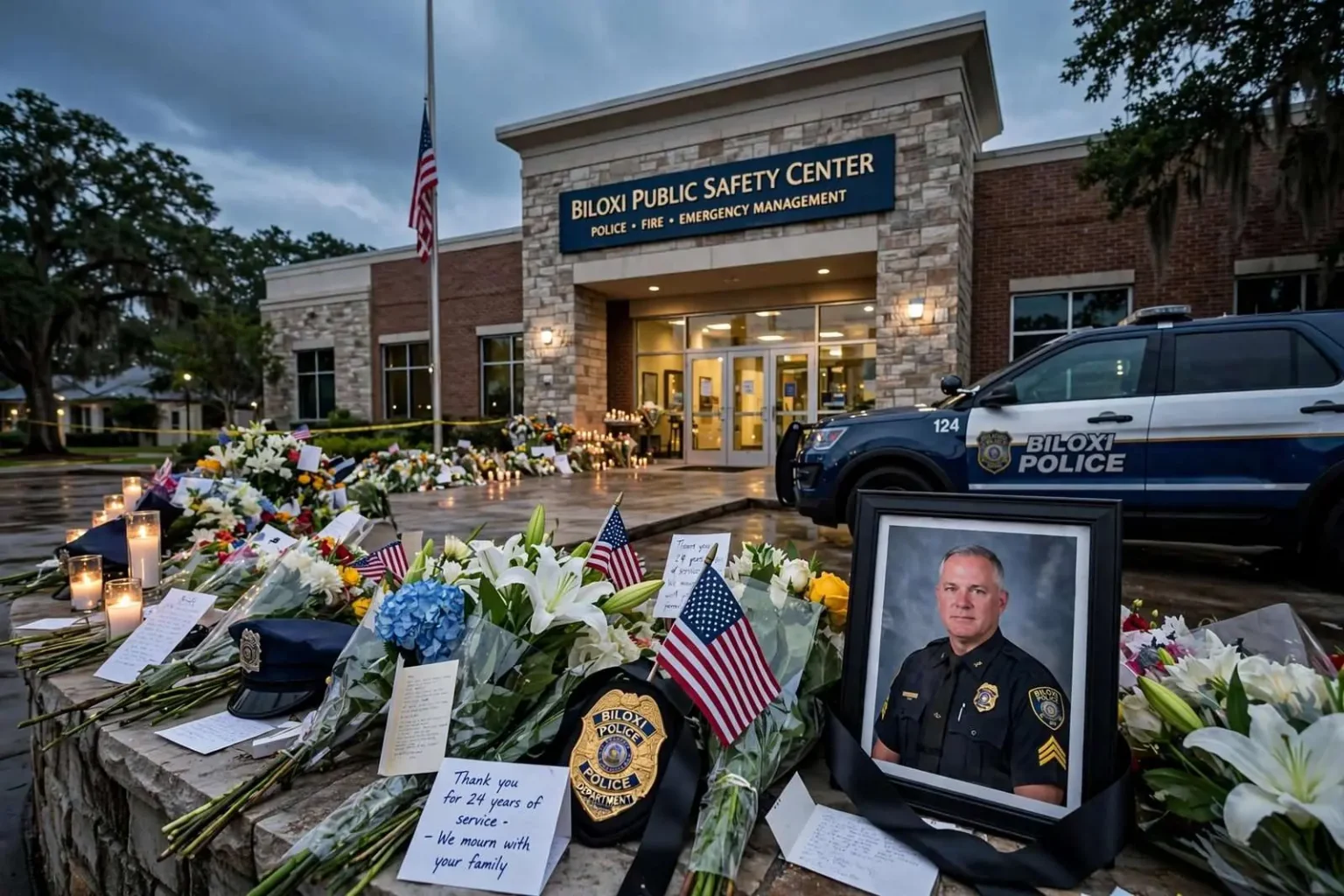
BILOXI, Miss. — The family of a Biloxi police officer killed in the line of duty has shared its grief in a video statement released this week, giving the city its closest look yet at the man behind the badge. Robert McKeithen, a 24-year veteran of the Biloxi Police Department, was shot and killed Sunday night in front of the city’s public safety center, near his squad car. He was due to retire at the end of the year.
The video, roughly six minutes long, was released by the city after requests from news organizations. City officials said the family chose to communicate through a recorded conversation with the Biloxi police chief ahead of a prayer vigil rather than speaking to reporters individually, a format that let them talk about McKeithen in their own words while avoiding the crush of cameras and microphones that follows an officer’s funeral.
His wife, Pamela McKeithen, said the job meant everything to him. “Besides his family, that was his life. He loved it,” she said. The remark captured what colleagues and friends of long-serving officers along the Gulf Coast often describe: the career becomes a family identity, shaping schedules, holidays and the rhythm of a household for more than two decades.
McKeithen’s stepson, Logan Grundel, remembered him as both a friend and a father. “He was always a very good friend of mine. And also a father,” Grundel said. The short tribute carried particular weight because of the timing — a family preparing to mark a retirement celebration at the end of the year instead found itself planning a farewell of a very different kind.
An ambush near the public safety center
Authorities have said McKeithen was killed in an ambush-style attack, shot Sunday night in front of the public safety center that houses police operations for the city, close to where his squad car was parked. The location — the very headquarters where officers report for duty and coordinate emergency response — made the loss especially jarring for the department and for residents who pass the building daily.
Ambush-style attacks on officers are among the rarest but most disturbing categories of line-of-duty deaths, and they reverberate through a department in ways that traffic fatalities and other on-duty accidents do not. Officers across the region responded to news of the shooting with an outpouring of support, and departments along the Mississippi Gulf Coast are a close-knit community, with officers who train together, back each other up on calls and often have worked side by side for decades.
For Biloxi, a city of roughly 50,000 residents anchored by the casino industry along the Back Bay and the beachfront, the killing of a veteran officer in front of the city’s own public safety center struck at the heart of the department. McKeithen’s 24 years of service meant he had worked through some of the most demanding chapters in the city’s recent history, including the recovery years after Hurricane Katrina reshaped the Coast in 2005.
A family’s grief, in its own words
The family said it has been overwhelmed by the support and love from the community. In Biloxi and across south Mississippi, that support has taken familiar forms in the days since the shooting: businesses posting tributes, residents leaving flowers and flags, and fellow officers standing watch as the department works through the loss of one of its own.
Why the video mattered
The decision to release the recorded conversation came after media requests for comment from the family, a common pressure point in high-profile line-of-duty deaths. Reporters seek reaction, and families are left to decide between silence, which invites speculation, and public statements that come at the worst moment of their lives. By recording a conversation with the police chief before the prayer vigil, the McKeithen family found a middle path: it could honor the public’s interest without surrendering its privacy entirely.
Six minutes is a short recording by the standards of television, but for a grieving family it offered enough room to describe the man — not just the officer. Pamela McKeithen’s description of a career that “was his life” echoed what long-time residents of Biloxi have come to expect from veteran officers who spend a full career in one department: a familiarity with the city’s streets, its seasons and its people that cannot be replaced with a new hire.
Grundel’s tribute, framing his stepfather as both a friend and a father, reflected the blended nature of many law enforcement families, where officers become father figures to children they meet young and raise as their own. The image he described — a man equally at ease as a patrol partner and a parent — is the one the family wanted the public to carry with them.
Line-of-duty deaths on the Gulf Coast
The loss of an officer in the line of duty is, statistically, a rare event in south Mississippi, which is part of why each one lands so heavily. Departments in the region are small enough that every officer knows every colleague, and the death of a veteran patrols officer reverberates through shift schedules, call rotations and the emotional life of the department for months afterward.
When it happens, the response usually follows a familiar pattern. Flags fly at half-staff. Area departments send honor guards. A procession of patrol vehicles from across the region accompanies the officer to services. And in the days before the funeral, the community gathers — often at a vigil like the one planned in McKeithen’s honor — to offer prayers and to give the family a moment of collective support before the more formal ceremonies begin.
Federally, line-of-duty deaths are recognized through programs that provide death benefits to surviving families, and state laws address pension and survivor benefits for officers who die while serving. Those benefits matter most to families like the McKeithens, who spent two decades building a life around a career that ended not with a retirement party but with a funeral.
What comes next
Authorities have not detailed the circumstances that led to the ambush-style attack or announced charges in connection with the shooting, and the investigation remains active. What the department has confirmed is the essential outline: a veteran officer, shot and killed while on duty, steps from the end of a long career, in front of the building where his fellow officers work every day.
For now, Biloxi is doing what Gulf Coast communities have done after every line-of-duty loss: mourning publicly, supporting the family, and waiting for answers. The video statement the family released this week gave the city a way to grieve alongside them — in the words of a wife who described a career that was her husband’s life, and a stepson who remembered a man who was both friend and father.
The prayer vigil held ahead of the video’s release gave the community its first organized moment to respond, and gatherings of that kind serve a purpose beyond ceremony. They give officers a place to stand together out of uniform, give residents a way to show up for a family they have never met, and give a department under strain a visible reminder that the city it protects is paying attention.
For the Biloxi Police Department, the practical aftermath of a line-of-duty death is substantial. Detectives from the department and its partner agencies must build the case surrounding the shooting, patrol commanders must cover the shifts their fallen colleague would have worked, and chaplains and peer-support teams typically move through the ranks in the weeks that follow. Officers who worked alongside a 24-year veteran for most of their careers are, in a very real sense, processing the loss while still doing the job he died doing.
McKeithen’s plan to retire at the end of the year added a painful detail to the timeline. Officers who spend a full career in one department usually mark the milestone with a ceremony, a last radio call, and a handshake line of colleagues. Instead, the department and the family are navigating the transition from a career about to end to one ended by violence, a shift that friends and co-workers say never feels settled.
How the community has responded
Support from the community has come in the forms Gulf Coast residents know well. Flags appeared along the routes officers travel each day. Messages of condolence arrived from departments in neighboring cities and counties. Businesses posted signs thanking law enforcement, and residents who never met McKeithen described feeling the loss as if he were a neighbor, because in a city Biloxi’s size, a quarter-century patrol officer often is.
The family said it has been overwhelmed by that response. In the recorded conversation released by the city, the grief was plain, but so was gratitude — a recognition that the same community that knew the officer as a public servant also knows the family that shared him with the job for 24 years.
The chief’s role in the recording was deliberate. Departments increasingly use their chief as the bridge between a grieving family and a curious public, because the chief can speak to the officer’s service record and the department’s loss while letting the family speak to the man. The format also spares the family repeated interviews and gives the city a single, authoritative account they can point to as the case moves forward.
Awaiting answers
Investigators have not said what prompted the ambush-style attack or whether any suspect has been identified publicly, and officials have cautioned that the inquiry remains open. In cases of this kind, charges, when they come, are typically announced only after detectives have retraced the officer’s final hours, canvassed the area around the public safety center and reviewed available camera footage.
What is already known is enough for the city to mourn: a 24-year veteran of the Biloxi Police Department, due to retire at the end of the year, was shot and killed in front of the public safety center on a Sunday night, near his squad car. His wife described a career that was his life. His stepson remembered a friend and a father. And the community he served has spent the week since answering that loss with the support the family says has overwhelmed them.