FDA Approves ‘Aletta,’ a Robot That Draws Blood Amid Phlebotomist Shortage
The FDA has approved Aletta, a standalone robotic device that locates a vein and draws blood under staff supervision, offering a fix for phlebotomist shortages.
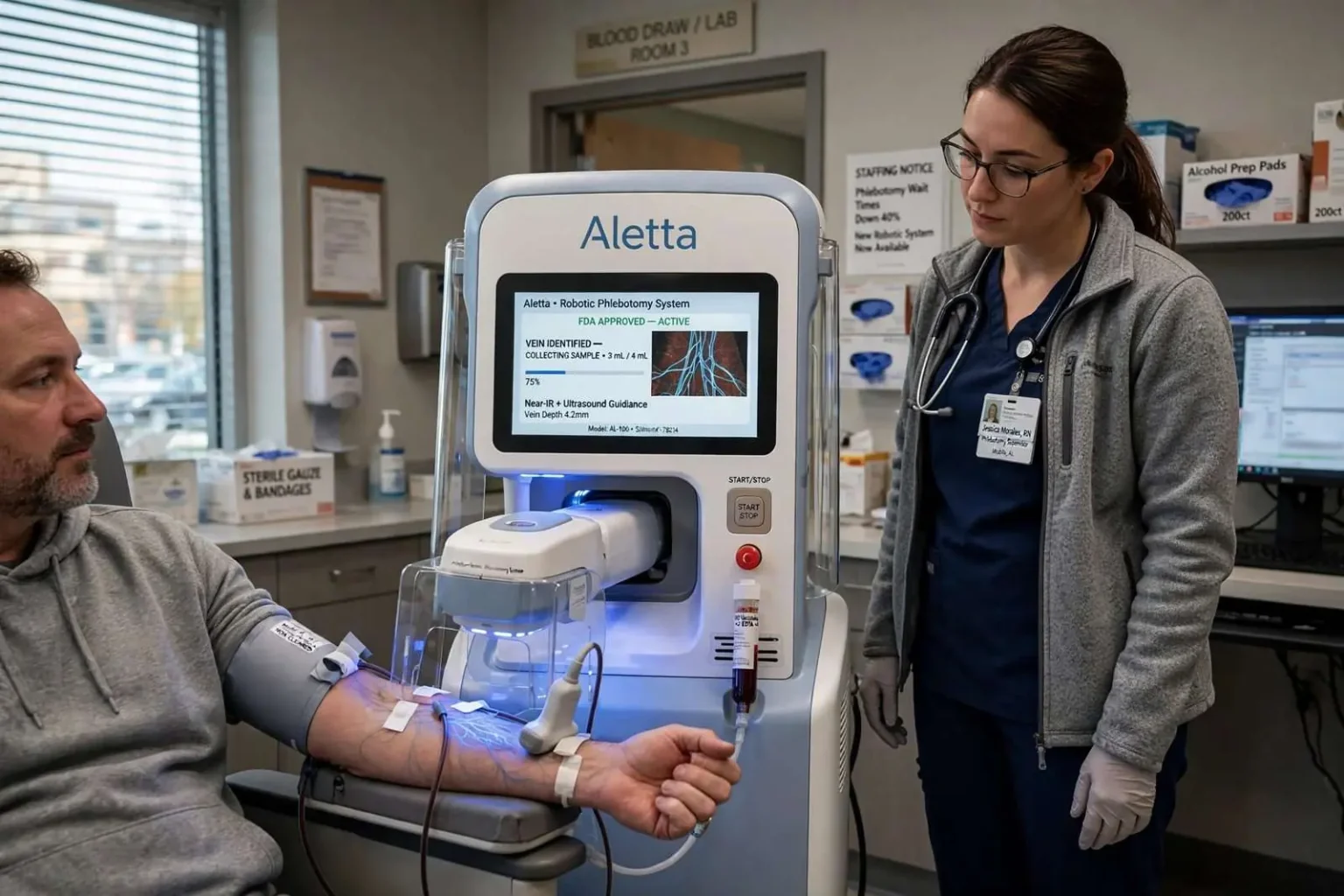
MOBILE, Ala. — Getting blood drawn is rarely enjoyable, but it is often a medical necessity. Physicians routinely order blood work to screen for a variety of conditions, including diabetes and high cholesterol. Now, the U.S. Food and Drug Administration has approved a potential solution to one of the procedure’s persistent bottlenecks: a standalone robotic device called Aletta, which arrives amid a growing shortage of trained phlebotomists that has led to longer wait times for patients.
Blood draws are among the most common medical procedures in the United States, performed countless times a day in hospitals, clinics, laboratories and physician offices. Every admission, every pre-surgical workup, every routine physical and every chronic-disease management visit can involve collecting blood for analysis. That volume places enormous demands on the professionals who perform the work — and when the supply of those professionals falls short of demand, the delay shows up directly in patients’ waiting rooms.
The shortage of phlebotomists has been building for years as demand for laboratory testing grows faster than the workforce trained to perform it. The result is familiar to anyone who has waited hours for a routine blood draw: facilities that cannot staff enough trained hands to keep up. Aletta’s approval offers those facilities a new option — a machine that can perform the mechanical steps of a venipuncture while a single trained professional supervises several stations at once.
How the Aletta Device Works
To use the device, a patient positions their arm and presses a button while under the supervision of a healthcare professional. From there, the robot takes over the sequence that a phlebotomist would otherwise perform. The device uses near-infrared light and ultrasound to locate a suitable vein — two imaging technologies that complement each other, with near-infrared imaging highlighting the blood vessels near the surface and ultrasound providing a deeper view of vein position and depth beneath the skin.
Once a suitable vein is identified, Aletta applies a tourniquet, inserts the needle, and applies a bandage once the collection is complete. The sequence covers the full arc of a standard blood draw, leaving the collected sample ready for the laboratory. According to the manufacturer, a single supervisor can oversee up to three of the robotic stations simultaneously — a staffing ratio that could substantially change the economics of high-volume blood collection.
The human role does not disappear in the model. A supervising professional remains present, both to oversee the procedure and to handle the situations that machines are not suited for: patients with difficult vein access, anxious or uncooperative patients, and any complications during or after the draw. The device takes over the routine cases; the professional handles the judgment calls and the exceptions.
Why Blood Draws Are So Hard to Staff
Phlebotomy occupies an unusual place in the healthcare workforce. The skill is essential to nearly every branch of medicine, yet phlebotomists are among the lower-paid members of clinical staffs, and the work — repetitive, physically demanding, dependent on a steady stream of human contact — has long struggled with retention. Training programs can produce new phlebotomists relatively quickly, but keeping them in the field is harder, with many using the role as an entry point before moving into other careers.
Demand, meanwhile, keeps rising. An aging population means more chronic conditions — diabetes, heart disease, kidney disease — that require regular monitoring through blood work. Laboratory medicine has expanded as well, with more conditions screened at earlier stages and more treatment decisions guided by lab values. Every one of those advances depends on someone, or something, collecting the sample.
Automation is the industry’s response to that gap, and Aletta’s FDA approval puts venipuncture on the list of tasks machines can perform. Medical robotics has already transformed surgery, pharmacy dispensing and laboratory analysis; the blood draw, long considered too variable and too patient-dependent to automate, was one of the remaining hands-on procedures. A device that can find a vein with light and ultrasound, and complete the collection reliably, changes the boundary of what automation can handle in routine care.
What FDA Approval Means
Approval by the U.S. Food and Drug Administration is the gate every medical device must pass before it can be marketed for clinical use in the United States. The agency reviews evidence that a device is safe and effective for its intended purpose, examining everything from the accuracy of the vein-finding technology to the sterility of the needle-insertion process. For Aletta, the approval signifies that the manufacturer demonstrated the device can perform a complete blood draw to the standard required of the procedure — no small claim for a machine replacing one of the most frequently performed hands-on tasks in medicine.
The approval also matters for how facilities can adopt the technology. Hospitals and clinics depend on FDA clearance before placing new devices in patient care, and insurers and accreditation bodies build their requirements around the agency’s determinations. With approval in hand, the device can move from development into the kind of real-world testing that will determine where it fits: busy hospital outpatient labs, physician offices, health fairs and the collection centers that process walk-in patients by the hundreds each day.
What It Means for Patients
For patients, the most visible effect of a staffing shortage is time — minutes or hours spent waiting for a draw that takes a trained professional less than five minutes to perform. Devices that expand the capacity of a collection facility attack that bottleneck directly. If one supervisor can oversee three stations at once, a facility that once processed patients at the pace of its phlebotomy staff can multiply its throughput without adding trained hands to the payroll.
The patient experience with the device differs from a traditional draw in ways that some will welcome and others will watch warily. The machine’s positioning is methodical: the patient places the arm, presses the button, and the device does the rest. The use of near-infrared and ultrasound imaging to find the vein can actually reduce one of the most common problems in phlebotomy — the failed first attempt, in which a needle misses the vein and must be reinserted. Patients with difficult veins, including elderly patients and those with small or deep vessels, often bear the brunt of repeat sticks; imaging-guided placement aims at that problem directly.
Human supervision remains part of the design. A healthcare professional oversees the procedure throughout, able to stop the process and take over when a patient’s situation calls for human hands. The device is a tool for extending the reach of trained staff, not a replacement for their presence in the room.
Blood Work and Modern Medicine
The scale of the demand that Aletta addresses becomes clear when considering how much modern medicine runs on blood tests. Screening for diabetes relies on glucose and hemoglobin measurements; cholesterol panels guide the management of heart-disease risk; complete blood counts flag infection, anemia and a range of blood disorders. Physicians order blood work to establish baselines, monitor chronic conditions, adjust medication doses and diagnose illness — often at every step of a patient’s care.
Each of those orders begins the same way, with a needle in a vein. That common first step makes the phlebotomy workforce a kind of infrastructure for the entire healthcare system: when it is short-staffed, the delays cascade backward into every department that depends on lab results. A device that relieves pressure at the collection stage has effects that reach far into the care process — faster lab turnaround, shorter visits, more capacity for the walk-in patient and the scheduled one alike.
In Mobile and along the Gulf Coast, where healthcare providers serve both dense urban populations and far-flung rural communities, the staffing mathematics are particularly strained. Rural clinics struggle to keep trained phlebotomists on staff, and patients in outlying counties sometimes travel long distances for routine lab work. Technologies that stretch limited staff further could land hardest in exactly those settings — which is part of why the approval of a blood-drawing robot draws attention beyond the laboratory profession.
The Phlebotomist Shortage in Context
The shortage that motivated Aletta’s development is a workforce story as much as a technology story. Phlebotomy sits at an awkward point in the clinical hierarchy: the work requires skill and carries real responsibility — patient identification, specimen handling, infection control — but it offers some of the field’s lower pay and limited career advancement. Turnover follows, and facilities in competitive labor markets find themselves training new phlebotomists only to lose them to better-paying roles within a year or two.
The shortage deepens at the moments the healthcare system needs collection capacity most. During flu season, during public health emergencies, and in fast-growing regions where patient volumes climb faster than staffing, the gap between demand and trained hands widens. Laboratories respond with overtime, with hiring bonuses and with cross-training, but the fundamental arithmetic — more tests, roughly the same number of trained collectors — has been moving in one direction for years.
Devices like Aletta are aimed squarely at that arithmetic. By allowing one professional to supervise three collection stations at once, the technology triples the number of simultaneous draws a facility can run per supervisor, converting a one-to-one staffing model into something closer to one-to-three. For a hospital laboratory processing hundreds of outpatients daily, that ratio difference compounds across every shift.
How Patients Will Encounter the Technology
The arrival of a blood-drawing robot in a clinic or hospital will change the routine of the visit, though perhaps less dramatically than patients might imagine. The patient still checks in, still has the arm positioned, still ends the appointment with a bandage. What changes is who — or what — performs the middle of the procedure, and how quickly the line moves.
For many patients the machine may feel less intimidating than they expect: the device follows the same familiar sequence as any experienced phlebotomist, and the button-press gives the patient a moment of participation in the process. Others will prefer a human hand regardless of the machine’s precision, and facilities adopting the technology will likely keep traditional collection available — both for patient preference and for the many situations, from pediatric patients to those with challenging veins, that call for experienced human judgment.
Training will shape adoption as well. The supervising professionals who oversee the stations need to learn the device’s operation, its safety stops and its limits — a much shorter pathway than training a new phlebotomist from scratch, which is part of the device’s appeal to understaffed facilities.
A Look Ahead
Aletta’s FDA approval marks a beginning rather than an endpoint. The device now enters the period in which real-world performance — across the full range of patients, arms, veins and clinical settings — will determine how widely it spreads. Manufacturers of the next generation of collection technology will be watching, because the blood draw is one of medicine’s largest remaining routine tasks, and a proven machine that handles it opens a significant market.
For the profession it touches, the change arrives gradually. Phlebotomists are not disappearing; the device depends on their supervision, and the difficult cases — the patients whose veins no machine finds easily — remain human work. What the technology offers is a way for the profession’s limited numbers to cover more ground, in an era when every additional trained hand matters.
For patients tired of waiting, the promise is simpler: shorter lines, faster draws and lab results that arrive before the appointment’s momentum is lost. Getting blood drawn may never be enjoyable, but a robot that finds the vein on the first try and leaves time for everything else might make it a little less of an ordeal — which, amid a shortage that has stretched waits for years, counts as genuine progress.