
FDOT demands lost Garcon Point Bridge toll revenue from Skanska after Hurricane Sally barge strike
FDOT is demanding lost Garcon Point Bridge toll revenue from Skanska USA after Hurricane Sally barges struck the Pensacola Bay Bridge.
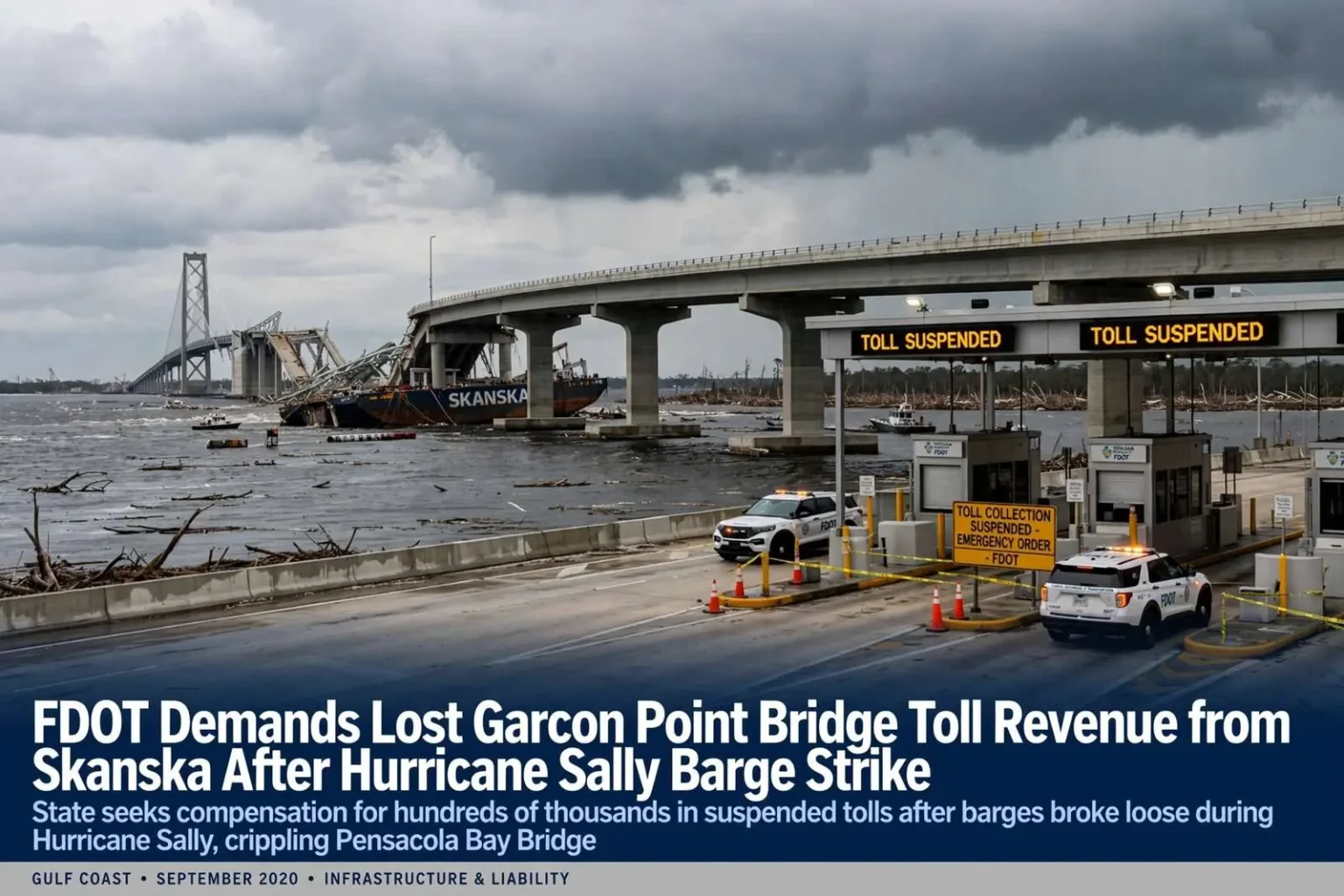
The Florida Department of Transportation is moving to recover money it says it lost when tolls were suspended on the Garcon Point Bridge after construction barges tore loose during Hurricane Sally and crippled the nearby Pensacola Bay Bridge. In a letter sent Friday to contractor Skanska USA, FDOT gave formal notice of its intent to seek damages tied to the toll revenue it was forced to halt under an emergency order.
The notice does not attach a dollar figure, but the stakes are substantial. The Garcon Point Bridge typically collects a $5 toll that generates hundreds of thousands of dollars each month, revenue that stopped flowing when state officials shut down toll collection in the chaotic days after the storm. Every week the suspension remained in place added to the bill the department intends to present.
The dispute is one of the most consequential financial fights to emerge from Hurricane Sally, which came ashore in September 2020 and battered the Panhandle with winds, storm surge and days of disruption. More than 20 Skanska barges broke free as Sally swept through the area. Three of them slammed into the Pensacola Bay Bridge, rendering it impassable and pushing heavy traffic onto the Garcon Point span.
State officials accuse Skanska of negligence in how the equipment was secured ahead of the storm. The company was working on the Pensacola Bay Bridge project when the storm hit, and the state’s position is that a contractor of its size and experience should have anticipated the threat a major hurricane posed to moored barges.
A Bridge Network Under Strain
To understand the claim, it helps to understand how the two crossings work together. The Pensacola Bay Bridge carries U.S. 98 between Pensacola and Gulf Breeze and handles the region’s heaviest east-west traffic load. The Garcon Point Bridge, farther east, connects the Gulf Breeze peninsula to the Milton area across East Bay and serves as the principal alternate route when the bay bridge is out of service.
When the barges knocked the Pensacola Bay Bridge out of commission, thousands of drivers who normally crossed it every day had few good options. Many funneled onto the Garcon Point Bridge, lengthening commutes and adding miles to routine trips across Santa Rosa County and Escambia County. The emergency toll suspension was meant to ease that burden on residents of communities such as Gulf Breeze and Milton while the bay bridge was repaired.
That relief came at a cost to the bridge’s finances. Tolls on the Garcon Point Bridge do more than cover operating expenses; they service the debt and obligations tied to the span. FDOT’s letter argues that the revenue lost during the suspension is a direct consequence of Skanska’s failure to secure its equipment, and that the contractor — not the traveling public or the state — should bear it.
Local Officials Push for Accountability
Pensacola Mayor Grover Robinson said the company needs to be held accountable. “The state needs to make Skanska be as responsible as they need to,” Robinson said, noting that more than 20 barges came loose and three struck the bay bridge.
Robinson’s frustration echoed what many Panhandle residents expressed in the months after the storm. The loss of the Pensacola Bay Bridge was not a minor inconvenience; it reshaped daily life for commuters, shut down a main evacuation route, and strained businesses on both sides of the bay that depend on customers crossing between Escambia and Santa Rosa counties.
What the Claims Process Looks Like
FDOT’s notice signals the start of what could become a formal claims process against the contractor. Under the state’s contracting framework, a notice of intent is typically a prerequisite step that preserves the department’s rights while negotiations continue. If the two sides cannot agree on compensation, the dispute can move toward litigation, where questions of contract language, force majeure provisions and storm-preparation standards would take center stage.
Skanska has faced other claims related to the barge strike, and the company’s defense is likely to rest on the extraordinary nature of Hurricane Sally, a storm that intensified quickly and shifted toward the Panhandle in its final approach. Contractors in coastal projects generally argue that no preparation scheme can be proof against every storm; the state’s counter is that Sally was a forecast, tracked event that gave the contractor time to act.
The dispute centers on who bears the cost of the suspended tolls while the regional bridge network was disrupted. For FDOT, the logic is straightforward: the toll suspension was a direct, foreseeable consequence of the bay bridge closure, and the closure was a direct consequence of barges the contractor failed to secure. The department’s letter frames the toll revenue claim as damages flowing from the same negligent act that destroyed the bridge itself.
Legal observers note that cases like this one often turn on documentation. FDOT will need to establish how much revenue the bridge would reasonably have collected during the suspension period, accounting for the fact that traffic volumes were elevated by displaced bay bridge commuters. The $5 toll applied to a surge of users could mean the monthly losses ran well beyond the bridge’s normal baseline, complicating the damage calculation in ways both sides are likely to argue over.
Why It Matters to Drivers
For residents of Gulf Breeze, Milton, Pace and Navarre, the outcome is more than an accounting exercise. If FDOT recovers the lost revenue, it strengthens the financial position of the bridge and the authorities responsible for it, which can influence future decisions about tolls and maintenance. If the recovery falls short, the gap may be absorbed by the state or reflected in how the crossing is funded going forward.
The case also serves as a test of accountability standards for marine contractors working along the Gulf Coast, where hurricane season is an annual certainty rather than a remote risk. Barrage after barrage of storms in recent decades — from Ivan to Dennis to Sally — has made equipment securing plans a standard part of coastal construction. The state’s claim asserts that standard was not met here.
Repairs to the Pensacola Bay Bridge proceeded in the months after the strike, and the crossing eventually returned to service, restoring the region’s primary link across the bay. But the financial ripples from the closure have continued long after traffic resumed, and FDOT’s letter makes clear the department intends to pursue them. The coming negotiations, and any litigation that follows, will determine how much of that cost the contractor ultimately carries.
Until the claim is resolved, the episode stands as a reminder of how interconnected the Gulf Coast’s infrastructure truly is: one loosened mooring line in a hurricane can idle a bridge, reroute a region’s commuters and, eventually, generate a legal fight over hundreds of thousands of dollars a month in tolls that never were collected.
The Bigger Picture on Storm Liability
The Garcon Point claim is part of a broader pattern in which states and local governments have sought to recover storm-related costs from private parties whose equipment or property caused collateral damage. Along the Gulf Coast, barge strikes, washed-out vessels and wind-borne debris have repeatedly produced disputes over who pays when loose property becomes a projectile. Each resolution, whether by settlement or verdict, helps define how seriously contractors must treat pre-storm preparation.
For FDOT, pursuing the toll revenue is also a matter of principle for its toll facilities statewide. Emergency suspensions are a tool the department uses to speed evacuations and recovery, and officials argue that if the costs of those suspensions simply disappear, the state absorbs a penalty for acting generously during a crisis. Making the responsible party whole keeps the incentive structure where the department believes it belongs.
Skanska, for its part, remains one of the largest contractors in the country, and the company continued work on the bay bridge repairs in the aftermath of the strike. Any settlement would likely address the toll claim alongside the broader repair costs already in dispute between the parties.
What happens next is in the hands of negotiators and, potentially, the courts. The letter sent Friday starts a clock on a claims process that could take months or longer, and neither side has indicated a rush to settle. In the meantime, drivers crossing the Garcon Point Bridge each day are crossing a span whose recent history — a $5 toll, a suspended revenue stream and a hurricane that rearranged a region’s roads — is now the subject of a very expensive argument.
Area officials have also pointed out that the closure rippled well beyond commuter routes. School transportation, emergency response times and freight deliveries between Pensacola and the beaches communities all had to be reworked while the bay bridge was down, and each workaround added cost and delay to daily operations across two counties.
The toll revenue claim, small by the standards of bridge repair costs, carries symbolic weight in that larger accounting. It represents the region’s attempt to be made whole not only for shattered concrete but for the ordinary money that stopped moving while the bridges were closed.


