
FDOT Eyes Even More Widening for Nine Mile Road After Current Project Finishes
FDOT is studying a plan to widen Nine Mile Road from four to six lanes between Mobile Highway and Pine Forest Road as Pensacola-area growth continues.
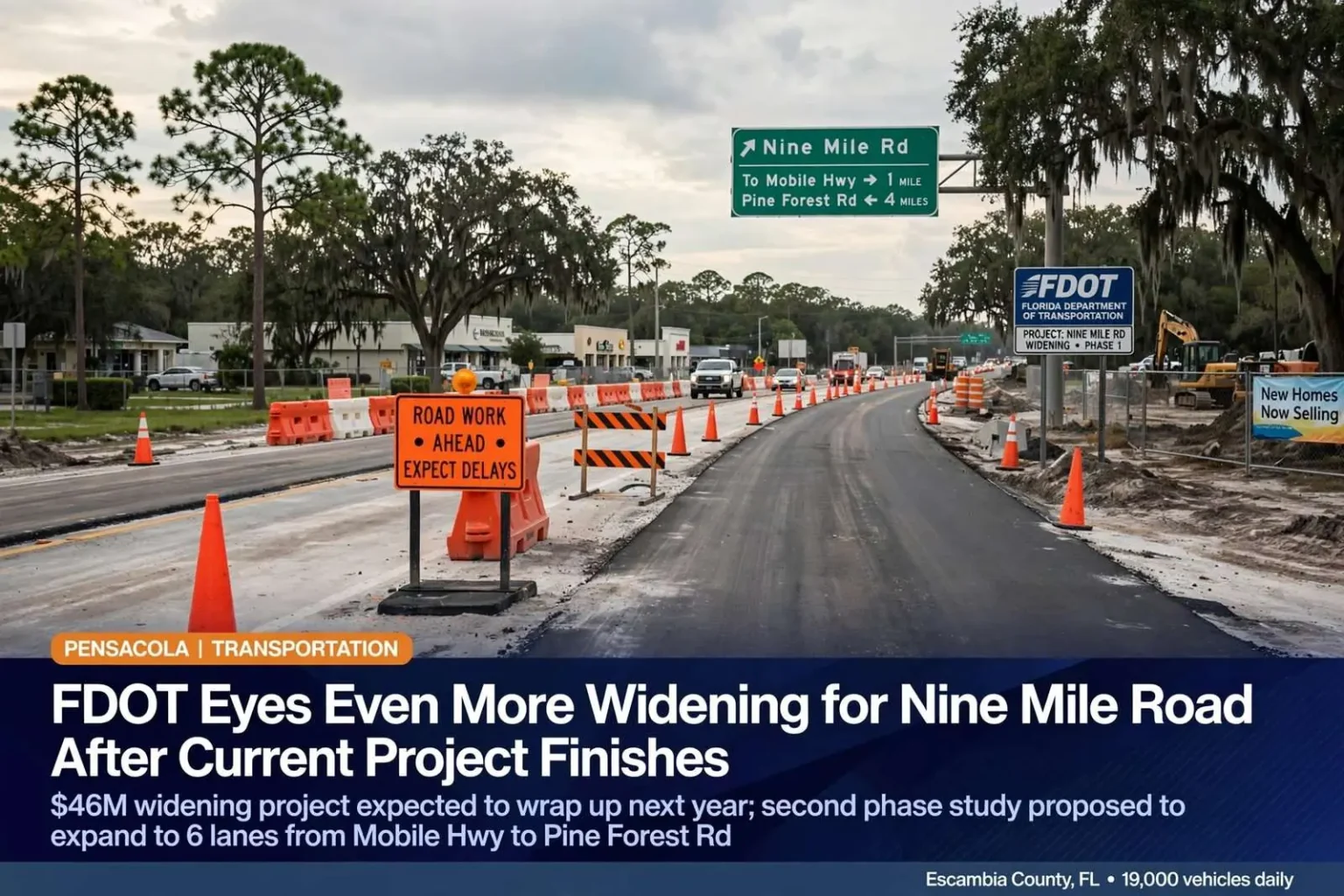
The $46 million widening of Nine Mile Road expected to wrap up next year may be only the first act in years of construction on one of the Pensacola area’s busiest corridors. The current Florida Department of Transportation project — widening the road from two to four lanes — has run behind schedule, testing the patience of the roughly 19,000 drivers who use the road daily. But FDOT is already studying a second phase that would widen the road further, from Mobile Highway to Pine Forest Road, meaning commuters who have endured years of cones and lane shifts could see the pattern continue well into the next decade.
Nine Mile Road serves as one of the primary east-west arteries in Escambia County, threading through some of the fastest-growing territory on Florida’s Panhandle. The corridor links residential neighborhoods across the county to Pensacola’s employment centers, and as growth has pushed west and north from the city, the road has absorbed traffic volumes its original two-lane design was never built to handle. The current widening project addressed a section of that strain; the proposed second phase would extend the four-to-six-lane treatment across a stretch of roughly six miles between Mobile Highway and Pine Forest Road.
The pace of the current work has been a sore spot for commuters. A project that falls behind schedule on a corridor carrying 19,000 vehicles a day does not just inconvenience individual drivers — it extends the period during which businesses along the route contend with restricted access and residents plan their days around construction zones. FDOT’s acknowledgment that the work has run late has done little to soften the frustration of drivers who bought homes along the corridor expecting improvement and instead watched the cones multiply.
Growth Driving the Push
According to the department, the additional widening is needed to keep pace with several development projects along the corridor and the continued expansion of Navy Federal Credit Union’s massive campus in the area. The credit union’s Pensacola-area campus has grown into one of the largest employment sites in the region, drawing thousands of workers to the western part of Escambia County and generating a chain reaction of residential and commercial development around it. Every new subdivision and retail center along Nine Mile Road adds vehicles to a road that is already carrying heavy daily volume.
That growth pattern explains why FDOT is not waiting for the current project to finish before planning the next one. Transportation agencies work on timelines that run years ahead of the traffic they anticipate, and a corridor like Nine Mile Road — where major employers, schools and neighborhoods all compete for the same lanes — cannot afford to wait until congestion becomes unmanageable. The study phase now underway positions the department to move into design and, eventually, construction without a gap between the two widening efforts.
The newest proposal would stretch roughly six miles, widening the roadway from four to six lanes. That additional capacity would cover the stretch of the corridor between Mobile Highway and Pine Forest Road, connecting two of the area’s major north-south routes and giving through traffic a wider path across the middle of the county. The scope places the second phase among the more significant road projects on the Panhandle’s planning horizon.
What Comes Next
FDOT plans to spend the next few months collecting data, taking public comments and refining the design before presenting a final plan early next year. The study phase is where residents and business owners get their say — through public meetings, comment periods and direct input to project managers — and the department’s refinement of the design typically accounts for issues raised along the way: driveway access, intersection treatments, drainage, pedestrian accommodations and the effects of construction on the businesses that line the corridor.
Public input carries real weight at this stage. Corridor studies in the Pensacola area have historically shaped details as small as turn-lane placements and as large as the footprint of the widened roadway itself, and the residents who show up to comment on Nine Mile Road will be the same drivers navigating the construction when the second phase moves forward. FDOT’s process — data collection, comment period, design refinement, final plan — gives the community roughly a year of visibility into a project that will define the corridor’s shape for decades.
The timeline also means the two projects will likely overlap in the public’s experience of the road. As the $46 million widening heads toward completion, the second phase’s study will progress toward a final plan, and any gap between the two would be measured in paperwork rather than in traffic relief. For commuters, the practical effect is that Nine Mile Road’s construction era continues — first the current lanes open, then the next round of work begins on the Mobile Highway to Pine Forest Road stretch.
Why the Corridor Matters So Much
Nine Mile Road’s importance to the Pensacola area goes beyond its daily traffic count. The corridor functions as a commercial spine, with shopping centers, medical offices, schools and restaurants drawing customers from the neighborhoods that surround it. It also serves as a relief valve for other east-west routes in the county, absorbing overflow when crashes or construction squeeze capacity elsewhere. When the road narrows to two lanes, the whole network feels it — which is why the current widening drew such close attention and why the proposed second phase is already generating discussion before the first phase has wrapped up.
The growth driving the expansion shows no sign of slowing. Navy Federal Credit Union’s campus expansion continues to add employees to the western county, and the residential development that follows employers of that size tends to build faster than the roads can adapt. Development projects along the corridor add their own traffic, each one individually modest but collectively significant on a road designed for another era. FDOT’s study acknowledges that the six-lane question is not whether but when — and planning ahead costs far less than catching up later.
For the roughly 19,000 daily drivers, the department’s message is a mixed one. The current project’s completion will bring real relief: four lanes where two used to carry the same traffic, smoother flow through a stretch that has bottlenecked for years. The proposed second phase promises the same treatment for the Mobile Highway to Pine Forest Road stretch, but it also means more construction, more cones and more years of adjusting routes around work zones before the corridor reaches its final form.
The next few months will determine how that story unfolds. As FDOT collects data and public comments, the design of the second phase will take shape, and the final plan expected early next year will tell residents exactly what to expect — where the six lanes will run, what happens to intersections along the route, and how the construction will be staged. For a corridor that has spent years under construction and faces more to come, that plan will be the roadmap for the next chapter of one of the Pensacola area’s most consequential road projects.
The Cost of Widening a Growing Corridor
Widening projects of this scale carry price tags that reflect the complexity of building through developed areas. The current $46 million effort covers the cost of acquiring right-of-way, moving utilities, rebuilding the roadway and managing traffic through years of construction — a reminder that highway work in a populated corridor involves far more than laying asphalt. A six-mile expansion of the kind proposed for the second phase would represent a comparable commitment, and funding decisions at the state level will shape how quickly the study turns into shovels in the ground.
The sequencing also reflects how transportation planning works in practice. Studies like the one FDOT has launched on Nine Mile Road feed into the department’s longer-range work program, where projects compete for funding against needs across the district. A corridor with documented growth, a major employer anchoring its western end and daily traffic approaching capacity stands a strong case in that competition, but the process still takes time — which is why the department began studying the second phase before the first one opened to traffic.
For businesses along the route, the construction years cut both ways. Work zones can suppress the easy access that roadside businesses depend on, but the finished product — a wider, faster corridor with improved intersections — tends to raise the commercial value of frontage along the route. The development projects FDOT cites as reasons for the widening are themselves a sign that investors see long-term value along Nine Mile Road, even with construction ongoing.
What Drivers Should Watch
As the study moves forward, several milestones will shape the corridor’s future. The public comment window gives residents their clearest chance to influence the design, and the data FDOT collects on traffic volumes, crash history and growth patterns will determine where the six lanes go and how the intersections between Mobile Highway and Pine Forest Road are reworked. The final plan expected early next year will pull those threads together into a document that sets the project’s scope, schedule and budget.
In the meantime, the current project’s completion remains the near-term milestone that matters most to commuters. When the $46 million widening wraps up, drivers will get their first experience of the four-lane corridor — and a preview of what the full six-lane treatment could feel like on the stretch between Mobile Highway and Pine Forest Road. The behind-schedule finish has tested patience, but the operational difference between two lanes and four on a road carrying 19,000 vehicles a day will be hard to miss.
The Nine Mile Road story is, at bottom, the story of Escambia County’s growth written in asphalt. The corridor is being rebuilt because the region it serves has outgrown it, and the second-phase study acknowledges that the growth is not finished. For the drivers, businesses and neighborhoods along the route, the next few months of data collection and public comment — and the final plan that follows — will define what the road looks like for a generation.


