
Firefighters Rescue Dog From Fire at Navco Road Store in Mobile
Mobile Fire-Rescue rescued Ginger, a store dog trapped in a fire at the Navco Road Community Outreach; heavy damage hit the front of the business.
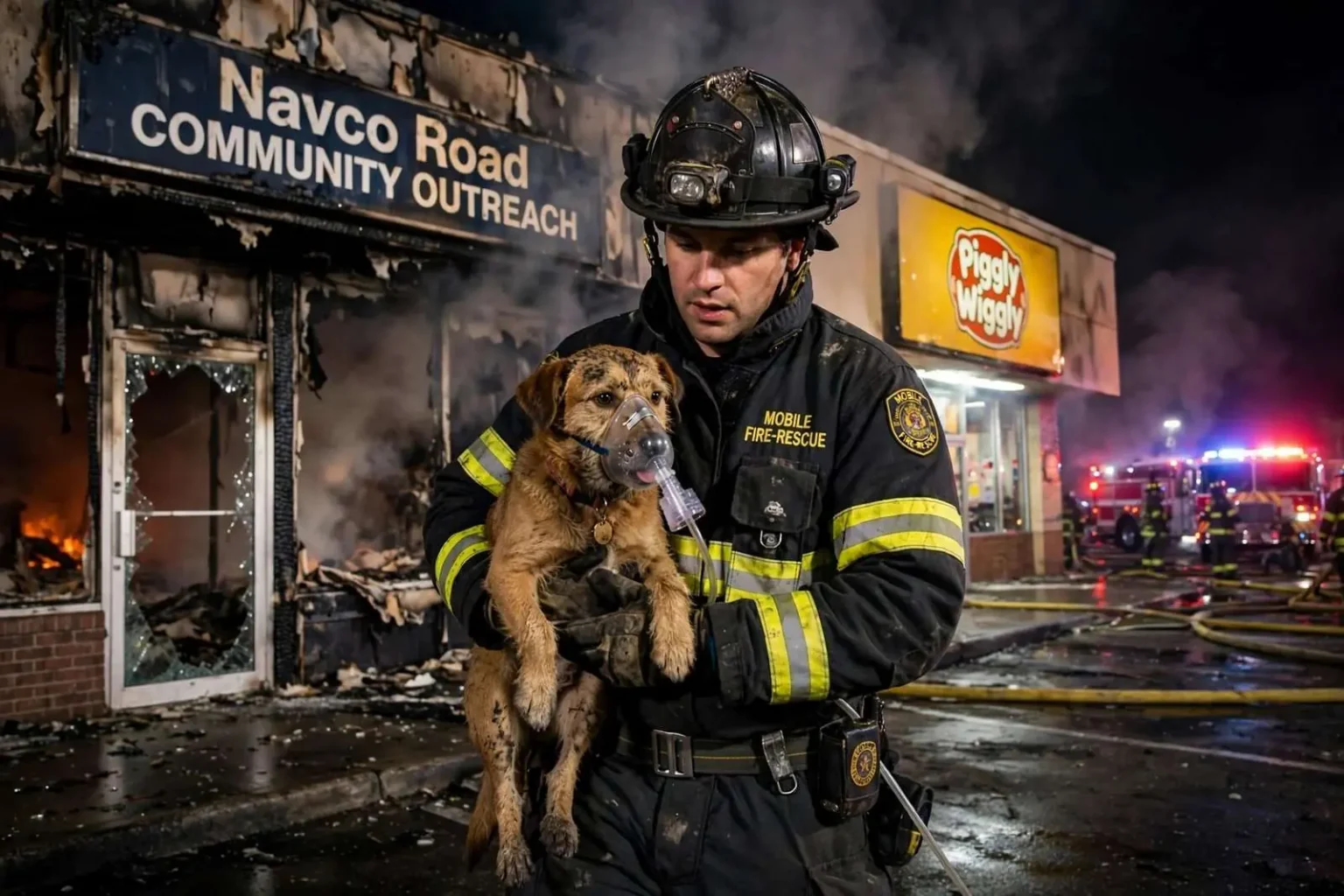
Mobile Fire-Rescue crews rescued a dog named Ginger from a fire that tore through the Navco Road Community Outreach store Wednesday evening, pulling the store owner’s pet safely from the back of a business otherwise gutted by smoke and flame. Firefighters were called to the shopping center around 6:35 p.m. and found smoke pouring from the front of the business, which sits next to a Piggly Wiggly in the Navco Road corridor of south Mobile.
Crews knocked down the flames but continued battling hot spots afterward, working through the building room by room to make sure nothing rekindled. That follow-up work is a standard part of any commercial fire response, since fire can burrow into wall voids, ceiling spaces and stacked merchandise and flare again hours later if it is not fully extinguished. The evening hour added to the challenge: darkness and a commercial strip’s tangle of shared walls and utility connections demand careful, methodical work even after the main body of fire is down.
Dog found in the back of the building
The store owner’s dog was trapped inside. With workers able to tell firefighters where she was, crews focused their efforts on the back of the building and brought Ginger out safely; she was given oxygen and is expected to be okay. The rescue turned what would otherwise have been a total-loss story into a small victory at the center of it, and bystanders who had gathered outside the shopping center as engines arrived got to see the best part of the job — a firefighter carrying a singed but living dog into the open air.
Pet resuscitation is something fire crews increasingly train and equip for. Oxygen masks sized for animals, carried by many departments including Mobile Fire-Rescue, let crews reverse the effects of smoke inhalation that would otherwise kill a trapped pet: smoke fills the lungs with soot and carbon monoxide, starving the blood of oxygen and leaving an animal weak and disoriented even after rescue. A few minutes on supplemental oxygen can make the difference, which is exactly what Ginger received on scene.
“Heavy damage, heavy smoke damage,” said Steven Millhouse with Mobile Fire-Rescue. “There was a good bit of flame damage mostly to the front and middle portions of the business.”
A close call for the whole plaza
Everyone inside made it out safely, and no other injuries were reported. That outcome — no human casualties in a fast-moving commercial fire — reflected a combination of quick reporting, working exits and crews who arrived while the fire was still concentrated in one part of the building. Commercial fires in attached strip centers are dangerous precisely because of those shared walls, and a fire that reaches the attic line or the electrical space above a row of stores can spread behind closed doors to businesses that appear untouched.
Surrounding businesses closed for the night, and it was unclear when the plaza would fully reopen. Even shops that never caught fire can be kept out by smoke migration, water in the common walls, or power and gas cuts made at the meter while crews fight the blaze. Store owners along the strip spent the evening assessing whether their inventory smelled of smoke and whether their spaces had taken on water, the unglamorous accounting that follows every fire no matter where it started.
For the owners and employees of the Community Outreach store, the road back starts with insurance adjusters, boarded doors and a long inventory of what can be salvaged — but with Ginger recovering and everyone safe, the most important losses were avoided.
The Navco Road corridor
The fire struck a part of Mobile that most drivers know as a pass-through: the Navco Road area sits in the southern reaches of the city, threading between neighborhoods, churches and the small commercial strips that serve them. Stores like the Community Outreach shop are the retail backbone of corridors like this one — close enough to home that regulars walk in, priced for the surrounding community, and staffed by people the customers know by name. When one of them burns, the loss is not just square footage; it is a daily routine for hundreds of families, and the outreach mission in the store’s very name suggests the kind of service that is hard to replace.
The adjoining Piggly Wiggly — the regional grocery brand that has long anchored neighborhood shopping across the Deep South — gave the shopping center its daily traffic, and it was that traffic that filled the parking lot with witnesses on the evening of the fire. Strip centers across south Mobile follow the same template: a grocery anchor, a row of small shops, and parking in front. Fire protection planners know the layout well, because the shared-construction style that makes these centers affordable also makes them vulnerable when fire starts in one unit.
Mobile Fire-Rescue stations cover the city from a network of fire houses spaced for response times, and a commercial fire with a working smoke condition at the front of a building typically brings multiple engines and a ladder truck, along for command, water supply and manpower rotation. The initial call at 6:35 p.m. set that apparatus in motion, and the response continued well into the night as crews relieved each other on the hot spots.
What happens after the flames are out
The days after a commercial fire follow a familiar sequence. Investigators work to determine where and how the fire started, a process that can take weeks for a commercial occupancy because the origin area must be examined before cleanup disturbs it. The building is boarded and secured, utilities stay disconnected until systems are inspected, and the owner’s insurance company sends its own adjusters to document damage. Only after all of that does rebuilding begin — and for a small business, that timeline is measured in months, not days.
Employees face the immediate uncertainty of a workplace with no paycheck attached, and community outreach stores often have thin margins that make extended closure an existential threat. Owners like Kamal Constantine, who said he is eager to reopen and resume serving a community that relies on the store, typically lean on that community in return: donation drives, temporary spaces offered by neighboring churches and businesses, and customers who make a point of returning when the doors reopen. Mobile has seen that pattern repeat along corridors from Government Street to Dauphin Island Parkway after fires, floods and storms.
Fires, smoke and the hidden damage
Millhouse’s description of the damage — heavy smoke damage throughout, with flame damage concentrated in the front and middle of the business — captures how a fire’s harm spreads unevenly. Flame consumes what it touches, but smoke travels farther, permeating fabrics, paper stock, electronics and porous shelving with soot and odor that can render inventory unsellable even when it never burned. Water and the chemical residue from suppression add their own complications. For an owner, the salvage list is often shorter than it looks from the sidewalk.
That reality is why fire officials treat smoke, not just flame, as the enemy in commercial responses, and why crews ventilate and overhaul a building so thoroughly after the fire is knocked down. Every wall opened and every ceiling pulled is a check against the fire’s least visible path of destruction.
For now, the Navco Road shopping center begins its recovery with its priorities confirmed: no injuries, a dog saved, and an owner already talking about reopening day.
How the evening unfolded
The first alarm brought crews to the shopping center shortly after 6:35 p.m., with smoke showing from the front of the Community Outreach store. Firefighters made entry and attacked the fire where it was concentrated, while others checked the adjoining units and searched the building. It was during that search that the rescue came together: store workers on the scene could point to where Ginger had last been, directing crews to the back of the building where the dog had become trapped by the fire’s path through the front and middle of the store.
Bringing a pet out of a smoke-filled building is a moment that resonates far beyond the incident report. Pets are family in the households of Mobile as anywhere, and fire departments have found that their crews’ willingness to search aggressively for animals — when it can be done safely — is one of the services the public values most. Ginger’s rescue, oxygen treatment and expected recovery made her the evening’s bright spot, and the image of a firefighter kneeling beside a dog with an oxygen cone is the kind of scene that stays with everyone who watched it happen.
The fire’s location in a shopping center added layers to the response. Crews had to account for shared attic spaces and utility connections with the neighboring Piggly Wiggly, protect the exposure while attacking the fire itself, and manage water runoff in a parking lot still busy with evening shoppers. The surrounding businesses closed for the night as a precaution, and crews remained on scene into the evening to find and extinguish the hidden fire that commercial buildings so often shelter.
Mobile Fire-Rescue at work
The response was a routine showcase of how the city’s fire department operates. Mobile Fire-Rescue protects one of the South’s major port cities with a combination of engine and ladder companies, rescue units and support personnel, responding to everything from house fires and medical calls to industrial incidents along the waterfront. Commercial fires like this one test different skills than residential runs: larger floor areas, unfamiliar layouts, heavier fire loads of stock and shelving, and the constant risk of extension into attached occupancies.
Spokesmen like Steven Millhouse serve as the department’s public voice during incidents, giving the community accurate information about conditions, injuries and damage while crews are still working. His account — heavy smoke damage, flame damage mostly to the front and middle — gave owners of the surrounding businesses and neighborhood residents a clear picture of what had happened inside, and what the days of cleanup ahead would look like.
The department’s work did not end when the flames went out. Investigators would return to the scene to determine the fire’s cause, and the building’s fate — repair or rebuild — rested on assessments that had not yet begun.
Community response and the road ahead
Owner Kamal Constantine’s determination to reopen reflects the spirit that small commercial corridors in Mobile have shown repeatedly after setbacks. Community outreach stores occupy a niche that chain retailers do not: they know their customers, they stretch budgets for families who need it, and they anchor blocks that larger development passes by. Losing one, even temporarily, is felt in ways that do not show up in any official damage estimate.
Neighbors along the plaza closed for the night and waited to learn whether smoke or water had reached them, while the store’s regulars began asking how they could help. Mobile’s history of recovering from fire — from downtown block fires to the storms that periodically batter the coast — has built a habit of mutual aid among small business owners, and there is little reason to think Navco Road would be an exception.
Ginger, given oxygen and expected to be okay, will be waiting when the doors open again — the one member of the store’s household for whom the worst night in the business’s history ended as well as it possibly could.


