
First-Ever Mobile Area Filmmakers Meetup Set for the Blind Mule
Mobile's first filmmaking networking meetup gathered crew, actors and creators at the Blind Mule downtown, following successful Pensacola events.
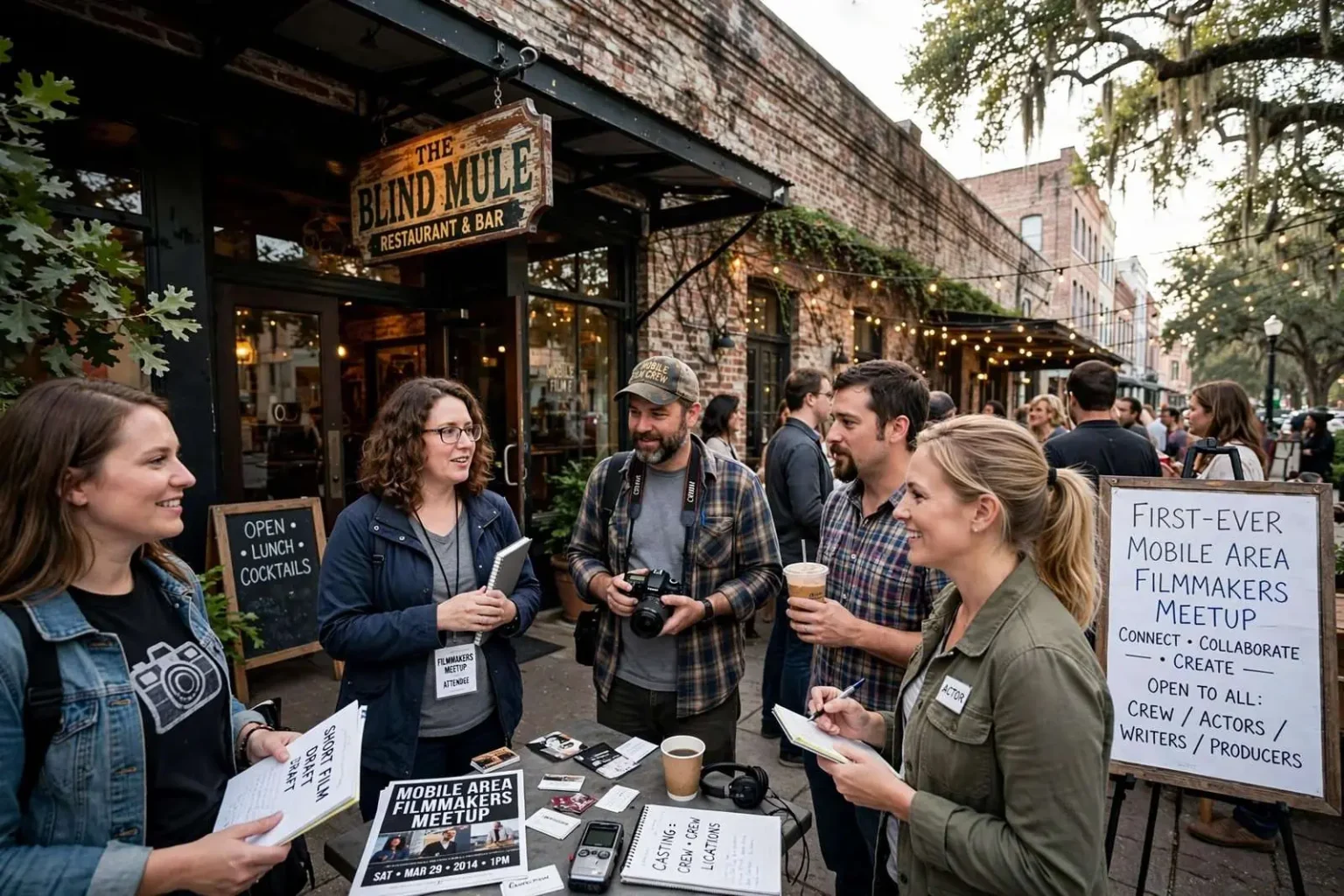
MOBILE, Ala. — Mobile’s film community got its first dedicated networking event in March 2014, when the Mobile Area Filmmakers Meetup convened at the Blind Mule Restaurant and Bar in downtown Mobile on Saturday, March 29 at 1 p.m.
The gathering was open to anyone working in film — or simply passionate about it — and aimed to connect local crew, actors, writers and producers in one room. For a city with working film talent but no regular meeting place for the people behind the cameras, the afternoon meet-up filled a gap that organizers said had limited how projects came together in the area.
The meetup followed a proven playbook. The same organizer had already run two events in the Pensacola area, both of which drew strong turnouts, and brought the format across the state line to Mobile for the first time. Those Pensacola gatherings served as the template: an afternoon slot rather than an evening one, a restaurant setting instead of a studio or theater, and an open invitation that lowered the barrier for newcomers who had never worked on a set but wanted to learn how to start.
Why a film meetup matters in Mobile
Mobile’s relationship with film production stretches back decades. The city’s historic architecture, antebellum neighborhoods, oak-lined streets and waterfront locations have drawn productions of every scale, and the region sits within driving distance of New Orleans, which by 2014 had become one of the busiest production hubs in the country thanks to Louisiana’s film tax incentives. Many Mobile-area crew members and actors commuted to New Orleans work, while others built their careers on the smaller commercial and independent projects that shoot closer to home.
What a city needs to hold that talent locally is infrastructure — not just equipment and locations, but the informal network that lets a director find a cinematographer, an actor find an agent, or a writer find a producer without driving two hours west. Networking events are where those connections happen. In larger markets they occur weekly; in mid-sized cities like Mobile, they have historically been sporadic, which is precisely the gap the Mobile Area Filmmakers Meetup set out to close.
The Blind Mule, a restaurant and bar in the heart of downtown Mobile, gave the event a relaxed setting consistent with that mission. Afternoon meetups in restaurant settings have become a standard format for film communities across the region, in part because they cost nothing to attend beyond a meal or drink, keep the tone social rather than formal, and make it easy for people to drop in between other weekend commitments.
Who the event was for
Organizers cast a deliberately wide net. The invitation extended to anyone working in film — or simply passionate about it — a formulation that covers working grip and electric crews, sound recordists, makeup artists, production assistants, actors at every experience level, screenwriters with unproduced scripts, directors developing their first short, and hobbyists testing the water. In communities the size of Mobile’s, that full spectrum typically numbers in the hundreds, but they are dispersed across agencies, day jobs and personal projects with few occasions to gather.
The value of putting those people in one room is practical rather than ceremonial. Most independent films in markets like Mobile are staffed through word of mouth, and most crews assemble only weeks before a shoot. A regular meetup compresses that search: a producer planning a summer shoot can meet available crew, actors can learn which directors are casting, and writers can find collaborators. Over time, those repeated introductions are what turn a loose collection of freelancers into a functioning local industry.
Attendees also exchange information that never appears in official channels — which equipment rental houses are reliable, which permit offices are responsive, which casting calls are legitimate. For newcomers, that shared knowledge shortens the learning curve that otherwise keeps many aspiring filmmakers on the sidelines for years.
The Pensacola connection
The organizer’s two prior events in the Pensacola area gave the Mobile launch a track record to build on. Both drew strong turnouts, demonstrating that the format — a casual afternoon gathering open to all levels of experience — resonates in Gulf Coast markets that sit far from the industry’s major hubs. Pensacola’s film community, like Mobile’s, has long been sustained by regional commercials, independent features and the occasional production drawn by the area’s beaches and historic districts.
Bringing the format west across Perdido Bay also reflects the reality of the Gulf Coast film scene, which functions less as a set of isolated city markets and more as a corridor stretching from New Orleans through the Mississippi Gulf Coast, Mobile and Pensacola toward Tallahassee. Crew and actors routinely cross state lines for work, and the relationships formed in one city pay off in the others. A Mobile meetup that drew attendees with Pensacola ties would reinforce that corridor rather than compete with it.
Organizers of similar events elsewhere have found that the first gathering sets the tone for whether a series survives. Strong turnouts at the Pensacola events suggested demand existed on the Alabama side of the line; the March 29 meetup was the test of whether Mobile’s film workers would show up for a regular local fixture of their own.
Downtown Mobile as a backdrop
The choice of downtown Mobile for the event carried its own significance. The city’s downtown core — Dauphin Street’s commercial strip, the historic districts surrounding Bienville Square, the repurposed warehouses along the waterfront — has served as both a filming location and a social hub for the creative community. Restaurants and bars in the area regularly host arts-oriented gatherings, and a Saturday afternoon slot avoided conflicts with the evening foot traffic that dominates the district on weekends.
Mobile’s pitch as a filming location rests on assets few cities its size can match: thousands of historic structures spanning architectural eras, massive live oaks draped in Spanish moss, a working port, bayous and delta wetlands within minutes of downtown, and a climate that permits year-round shooting. The city has appeared in major studio features and television productions, and regional film offices have long promoted those assets to producers scouting the Southeast.
Community events like the filmmakers meetup feed that pitch. Cities that sustain active local production communities — with trained crew, experienced actors and functioning support businesses — are better positioned to land outside productions, because producers choose markets where they can staff up locally. Every connection made at a meetup table strengthens that case for Mobile.
What attendees could expect
The 1 p.m. Saturday start put the meetup in the early afternoon, a slot that lets conversations run their course without colliding with dinner reservations or evening plans. Attendees at events of this kind typically move through a familiar rhythm: a first hour of open mingling, followed by smaller clusters forming around specific projects and interests, and introductions made between people who had only known each other’s names from credits or casting notices.
For actors, meetups are often the most direct way to meet the people who cast local work. Independent directors in the Gulf Coast market frequently skip traditional casting channels for smaller roles, drawing instead from the pool of faces they already know. Being in the room — and being remembered — has more effect on a working actor’s calendar in a market like Mobile than headshots submitted to postings ever do.
For crew, the calculus is similar but more technical. Camera operators, gaffers, sound mixers and editors trade notes on gear, availability and upcoming productions, and they identify the people they can trust to fill out a crew list on short notice. Writers and directors use the gathering to gauge interest in scripts and to find the producing partners who can move a project from page to schedule.
Building a film scene from the ground up
Every regional film community that has matured into a durable industry followed a similar arc: a handful of active freelancers, a regular gathering, then the first locally produced features that proved the market could sustain its own projects. Birmingham’s film community took that path years earlier, and New Orleans’ explosion after Louisiana’s incentive program demonstrated what happens when local talent scales up to meet sustained demand. Mid-sized markets along the Gulf Coast have been working through the same progression at a smaller scale.
The mechanics are unglamorous. A local scene grows when someone takes on the recurring organizational work — securing a venue, spreading the word, showing up month after month — and when enough working professionals decide the hour spent networking is worth the projects it produces. Most attempts fail not for lack of talent but for lack of that consistency; a single event, however well attended, produces contacts that fade unless the gathering repeats.
That is the significance of the Pensacola track record behind the Mobile launch. An organizer who had already kept two events running had demonstrated the follow-through that separates a one-time gathering from a community institution. If Mobile’s first meetup drew the turnout the Pensacola events had, the expectation was that it would become a recurring fixture rather than a single afternoon.
The bigger picture for Mobile
Mobile’s creative economy extends well beyond film — theater companies, galleries, music venues and a growing design community all draw on the same pool of creative residents — but film carries a distinct economic footprint. Productions rent equipment and locations, hire local labor, book hotel rooms and purchase services during their shoots, and every dollar of that activity depends on having qualified people in town to hire.
The March 29 gathering at the Blind Mule was a small event with a straightforward ambition: put the people who make films in Mobile in the same room and let them meet. The city’s film workers — crew, actors, writers, producers and everyone adjacent to the craft — finally had a dedicated local occasion to do exactly that, carried over from a format already proven across the bay in Pensacola.
Anyone in the Mobile area working in film, or hoping to start, had an open invitation: Saturday, March 29, 2014, at 1 p.m., at the Blind Mule Restaurant and Bar in downtown Mobile. The afternoon’s conversations — who was shooting, who was available, who needed a script reviewed or a crew filled out — would become the working relationships the local film community runs on.


