First Jobs, Part Four: The Mail Route, the DDT Truck and the Shoe Department Ambush
A substitute mail carrier's route through Tillman's Corner, a summer spent driving a city DDT truck and a teenage boy's crushing disappointment in a department store shoe department round out the recollections.
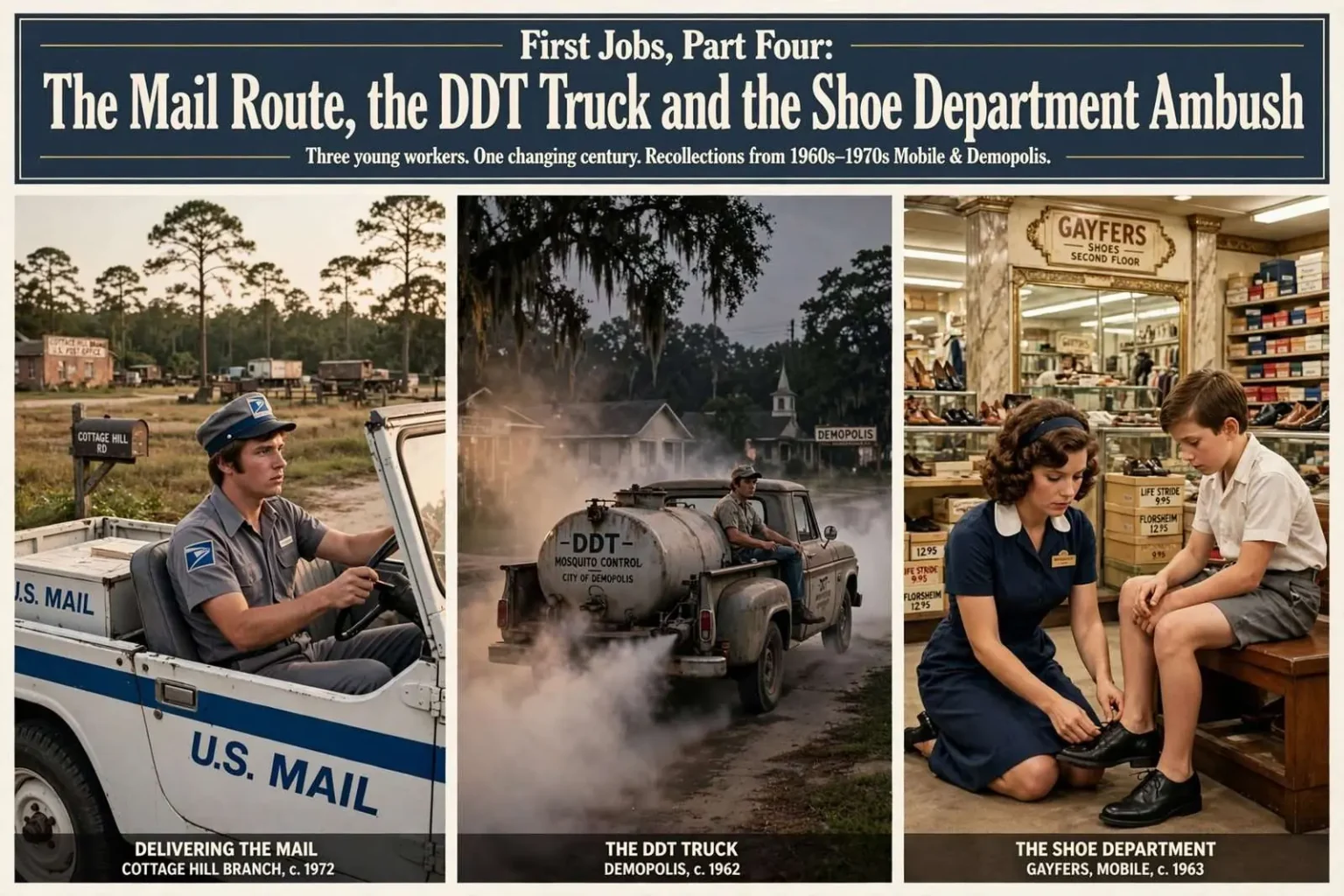
The final installment of these recollections produced the strangest jobs of the collection, and the ones that most vividly date the century that produced them.
Delivering the mail to West Mobile’s edge
Attorney Donald Stewart counted as his first job three college summers spent as a temporary substitute mail carrier for the Post Office, assigned to the Cottage Hill Branch. That branch then served an area of West Mobile that has since been absorbed into what people now casually call midtown. At the time, Stewart says, it was the certified End of the World.
The job offered what he calls high adventure and great skills development: driving mail trucks with the steering wheel on the wrong side, repelling dogs with pepper spray, and being constantly schooled by the regular carriers on the critical importance of not showing them up by running their routes faster than they did. Career mail carriers, he observes, pioneered the principle that the work of delivering a route’s mail will always expand to fill the paid time available for its completion.
The Cottage Hill Branch occupied a modest brick building on Cottage Hill Road, near the intersection with what was then the western terminus of Government Street. The route covered a patchwork of established neighborhoods — Spring Hill, Westlake, and the newer subdivisions pushing toward the city limits — interspersed with truck farms, pine plantations, and the occasional remaining dairy operation. Stewart’s right-hand-drive Jeep DJ-5, surplus from the postal service’s brief experiment with purpose-built delivery vehicles, became a familiar sight to residents who still left their mailboxes unlocked and their screen doors latched but not locked.
The Tillman’s Corner route
Among his favorite assignments was the Tillman’s Corner route, which included a widely reputed and brightly painted establishment on Highway 90 just outside the city limit. Normally the mail went in the roadside box, with care taken not to leave the neighboring church’s mail there by mistake. On one occasion, however, a COD package required him to go inside for payment and a signature.
He builds the suspense expertly and then punctures it himself: a lady in a bathrobe signed for the parcel and tipped him 18 cents, being short of the exact amount and telling him to keep the change. Something lurid and astonishing might have happened, he insists, and no one will ever convince him otherwise.
Tillman’s Corner in the early 1970s was a genuine crossroads community, anchored by the intersection of Highway 90 and Rangeline Road, where the city of Mobile’s jurisdiction gave way to unincorporated Mobile County. The “brightly painted establishment” was the Starlight Lounge, a neon-beckoning honky-tonk that had operated under various names since the 1940s. It was the kind of place where truckers, off-shift shipyard workers, and the occasional AWOL sailor from the Naval Air Station Pensacola converged. The church next door was Tillman’s Corner Baptist, its brick facade and steeple offering a stark architectural counterpoint to the lounge’s flashing sign.
The DDT truck
Retired dentist Harry Coker spent a summer driving the DDT truck for the city of Demopolis, back when the pesticide was the standard tool of municipal mosquito control. The truck carried a tank and a sprayer, dispensing a fine white cloud that drifted through the streets at dusk, and children ran behind it like it was an ice cream truck, dancing in the fog.
Coker recalls that no one thought anything of it at the time. The county agent had approved the program, the city council had funded it, and the trucks went out five nights a week from May through September. The fog smelled sharp and chemical, like cleaning fluid, and it killed the mosquitoes dead. That was the whole point. Demopolis sits on the Tombigbee River, in the heart of the Black Belt, where standing water and summer heat create mosquito populations that can make outdoor life miserable from April to October.
The DDT truck was a converted pickup, its bed fitted with a 200-gallon tank and a thermal fogging unit that heated the pesticide to create the characteristic white plume. Coker, then a college student home for the summer, drove a grid pattern through the city’s residential streets, starting at the riverfront and working north toward the hospital district. The route took about three hours. He earned $1.75 an hour, cash, paid weekly from a coffee can in the city clerk’s office.
DDT — dichlorodiphenyltrichloroethane — had been hailed as a miracle chemical during World War II, when it was used to control typhus and malaria among Allied troops. After the war, it became the backbone of public health mosquito control programs across the United States. The city of Demopolis, like hundreds of other municipalities, adopted it enthusiastically. The U.S. Public Health Service recommended it. The Alabama Department of Public Health supplied technical guidance. No one asked about long-term effects on birds, fish, or children who danced in the fog.
Rachel Carson and the changing science
Rachel Carson’s “Silent Spring” was published in 1962, the summer Coker drove the truck. He read it that fall in a biology seminar at Auburn, and the book’s meticulous case against indiscriminate pesticide use — the thinning of eggshells, the accumulation in food chains, the persistence in soil and water — made him reconsider the summer’s work. The city of Demopolis continued the DDT program until 1968, when the EPA began restricting its use. A nationwide ban followed in 1972.
By then, Coker was in dental school. He never drove the truck again. But he thinks about those summer evenings sometimes, the white cloud billowing behind the truck, the children laughing and running, the smell of chemical and cut grass and river mud. He wonders what it meant, what it did, what any of them understood at the time.
The shoe department ambush
The third story belongs to a woman who asked to be identified only as Mrs. Henderson, who spent the summer of 1963 working in the shoe department at Gayfers department store on Dauphin Street in downtown Mobile. Gayfers, the flagship of a regional chain headquartered in Mobile, occupied a six-story building with a marble facade and a clock tower that had been a downtown landmark since 1929. The shoe department was on the second floor, reached by a sweeping staircase or a cage elevator operated by a uniformed attendant who announced each floor.
Mrs. Henderson’s job was straightforward: measure feet, bring boxes, persuade customers that the more expensive last was worth the difference. She was 19, a sophomore at Spring Hill College, and the job paid $1.15 an hour plus a small commission on sales over $200 a week. The store was segregated — Black customers were served but not encouraged to linger, and the restrooms, water fountains, and employee break rooms were separated by race. Mrs. Henderson, who is white, says she didn’t question it at the time. It was simply how things were.
The ambush came on a Saturday in July, when a woman in a navy-blue dress and white gloves came in with her son, a boy of about eight. She wanted oxfords, black, size 3. Mrs. Henderson measured the boy’s foot, brought three pairs, knelt to help him try them on. The mother stood with her arms folded, watching. The boy chose the middle pair. The mother nodded. Mrs. Henderson wrote up the ticket.
Then the mother said, quietly, “He’s not my son. He’s my nephew. My sister’s boy. She died in March. Cancer. He doesn’t talk about it. I brought him for shoes because his father won’t. He says boys don’t need new shoes, they need discipline.”
Mrs. Henderson didn’t know what to say. She finished the sale. The boy walked out wearing the new oxfords, holding the box with his old shoes. The mother paid with a check from a bank in Monroeville. Mrs. Henderson watched them cross Dauphin Street toward the parking garage, the woman’s hand on the boy’s shoulder, the boy’s head up, not looking back.
She quit two weeks later. Not because of that day, exactly, but because of it. The job had seemed simple — measure feet, sell shoes. It turned out to be about everything else: grief, neglect, the quiet cruelty of fathers, the fierce protection of aunties, the way a pair of oxfords could matter more than anyone would believe. She finished her degree at Spring Hill, went to library school at Alabama, and spent 34 years as a reference librarian at the Mobile Public Library, helping people find the stories they needed.
Jobs that marked a century
These three jobs — the mail carrier on the edge of the city, the DDT truck driver in the Black Belt, the shoe clerk in a segregated department store — share a quality of revelation. Each placed a young person at the intersection of ordinary work and the deeper currents of their time and place. The mail carrier saw the city growing outward, the map redrawing itself. The DDT driver participated in a public health campaign that was both miraculous and, in retrospect, profoundly misguided. The shoe clerk witnessed a moment of private grief that cracked open the facade of a segregated society.
They are first jobs, yes. But they are also field reports from a century that is now history. The right-hand-drive mail trucks are gone, replaced by Long Life Vehicles with air conditioning and barcode scanners. The DDT trucks are gone, banned by a science that caught up to its own enthusiasm. Gayfers is gone, absorbed by Dillard’s in 1998, the Dauphin Street building now housing offices and loft apartments. The segregated restrooms are gone, the water fountains integrated, the clock tower still keeping time over a downtown that has emptied and refilled and emptied again.
Stewart became a lawyer. Coker became a dentist. Mrs. Henderson became a librarian. Each carried the job forward, not as a badge but as a lens. They learned to see what the work revealed: the expanding city, the poisoned fog, the grieving boy in new oxfords. They learned that a first job is never just a job. It is an education in the world as it is, and as it ought to be.