
Fishbone Brings Its Genre-Defying Mardi Gras Show to Alabama Music Box on Fat Tuesday
Ska-punk pioneers Fishbone headlined Mobile's Alabama Music Box on Fat Tuesday 2013 with Sista Otis and The Scorseses for $15.
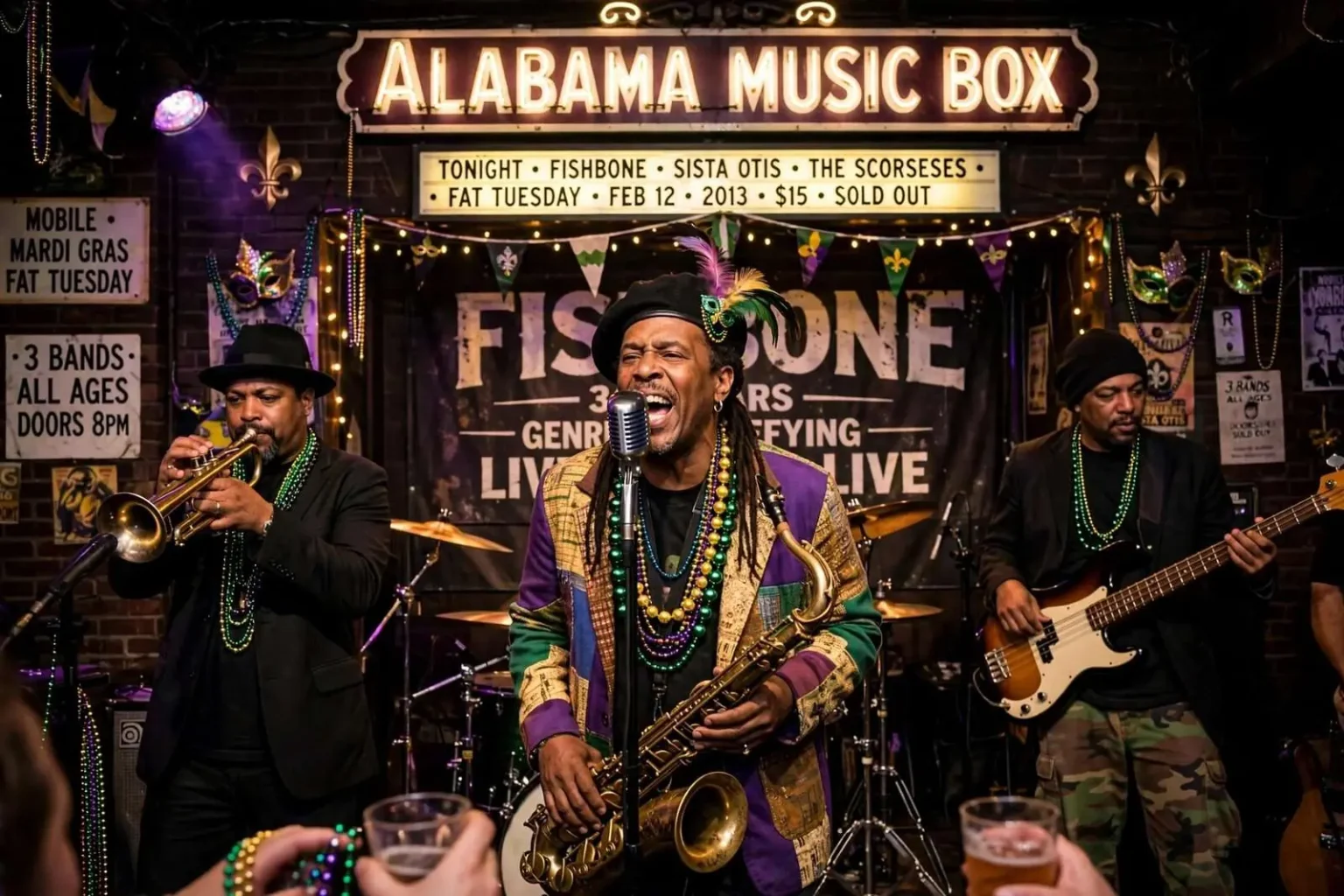
Fishbone, the Los Angeles band that helped lay the groundwork for 1990s ska-punk, returned to Mobile for a Fat Tuesday 2013 performance at the Alabama Music Box, with support from Sista Otis and The Scorseses. Admission for the three-band bill was $15 — a ticket price that put one of the most influential and restless bands of the American underground on a Mardi Gras night stage in downtown Mobile. With Mardi Gras society parades rolling elsewhere in the city, the Music Box show was billed as the biggest musical event of the evening downtown.
The date gave the show a double resonance. Fat Tuesday is the climax of Mobile’s carnival season, the oldest Mardi Gras celebration in the country, and on a day when the streets fill with masked riders, moon pies and marching bands, a band whose entire identity is built on controlled chaos found an audience already primed for a party. Fishbone’s blend of ska, punk, funk and hard rock has always been as much carnival as concert, and the band’s booking on the calendar’s most festive night was a natural match of act and occasion.
Three decades of genre-defying music
Formed in 1979, Fishbone built its reputation on a restless blend of ska, punk, rock, alternative, metal and funk — a sound that cleared the path for bands like No Doubt and Sublime. Emerging from Los Angeles in the early 1980s, the group mixed the energy of hardcore punk with the horns and rhythms of Jamaican ska and the showmanship of soul revues, refusing every category the record industry tried to impose. That refusal cost them mainstream chart success at times, but it earned them a devoted following and a lasting influence: the ska-punk and alternative-rock acts that broke through commercially in the 1990s walked a road Fishbone had opened.
Early on, the group’s first major gig was an opening slot for the Beastie Boys, and its close friendships with the Red Hot Chili Peppers and Thelonious Monster placed it at the center of the LA scene. In that era’s club circuit, Fishbone’s live shows became the stuff of legend — horn-driven, wildly physical, and unpredictable, with frontman Angelo Moore climbing speaker stacks and diving into crowds. Musicians across genres cited the band’s shows as formative experiences, and the band’s network of friendships helped carry its sound into the mainstream by way of the bands it inspired.
The band’s 1988 album Truth and Soul brought wide critical acclaim, though mainstream success stayed elusive; Sony dropped the band in 1995. Truth and Soul arrived at a moment when alternative music was crossing over, and its mix of pointed social commentary, ska workouts and heavy rock guitar won critics over even as radio formats struggled to place the band. The split from Sony after the mid-1990s marked a turning point — the end of Fishbone’s major-label chapter and the beginning of a decades-long run as an independent act sustained by touring and a loyal audience.
Fishbone rebounded with a 2000 Hollywood Records release featuring guests including Gwen Stefani, George Clinton, Rick James and H.R. of Bad Brains. The guest list read like a map of the band’s influence and connections: Stefani, whose No Doubt had ridden Fishbone’s innovations to stadium scale; Clinton, the Parliament-Funkadelic architect whose funk lineage runs through Fishbone’s DNA; Rick James, the punk-funk pioneer of the previous generation; and H.R., frontman of the Bad Brains, the band that fused punk and reggae before anyone. The album showed that even after the major-label years, Fishbone remained a band that its peers wanted to stand beside.
The band then formed its own label, issuing the Crazy Glue EP in 2011. Independence became the operating model — owning the music, booking the tours and releasing records on the band’s own terms. The Crazy Glue EP arrived as evidence that the creative engine was still running into the band’s fourth decade, with new material standing alongside the classics that longtime audiences demanded at every show.
Moore still fronting after 25 years
Frontman Angelo Moore — one of three original members remaining after numerous lineup changes — had crossed paths with Mobile audiences before, including an interview during DeLuna Fest coverage in 2012. The Pensacola Beach festival, held each fall on the Gulf Coast, had put Moore in front of regional media months before the Mobile show, and his willingness to talk — about music, politics and the strange economics of a band that outlived its labels — had made him a familiar voice to Gulf Coast listeners even before the Fat Tuesday date.
Known for thought-provoking lyrics that tackle social issues, Moore led the band into what was billed as the biggest show of the Mardi Gras evening in downtown Mobile. Moore’s writing has always reached beyond the party: racism, gentrification, media distortion and the pressures of the music business all surface in the Fishbone catalog, delivered with a urgency that kept the band aligned with the protest tradition even while playing music built for dancing. That mix — social conscience and carnival energy in the same set — is precisely what made the band a fit for a Mardi Gras night, when Mobile’s celebration carries two centuries of its own complicated history.
The Alabama Music Box, a staple of downtown Mobile’s independent music scene, has long served as the city’s stage for touring acts that fall between the touring amphitheaters and the bar bands — a venue where national underground acts meet local audiences up close. On Fat Tuesday 2013, with a $15 cover and a three-band bill topped by Fishbone, the club offered an alternative to the parade routes: a full night of live music headlined by a band whose reputation rested on live performance above everything else.
1|
Why the Fat Tuesday bill mattered locally
The supporting lineup added its own texture to the night. Sista Otis, a singer-songwriter with a rootsy, soul-driven style and a history of Gulf Coast bookings, brought a groove-heavy opening set, while The Scorseses — a scrappy rock act in the regional club circuit — filled out the middle of the bill. Three-band nights at the $15 price point were part of the economics of independent touring, where national headliners share stages with regional openers and keep ticket prices within reach of a crowd already spending on Mardi Gras week.
For Mobile audiences, the show landed in a city whose own music identity is layered. The Port City’s music scene has always run parallel to its carnival tradition: brass bands, Mardi Gras Indians-style traditions of costume and procession, blues and R&B clubs, and a college-radio lineage that made local listeners receptive to Fishbone’s genre-crossing style long before alternative rock had a marketing category. A Fat Tuesday headlining slot gave the band a stage on the one night of the year when the city’s appetite for spectacle and music peaks.
Fishbone’s longevity was itself part of the draw. By 2013, the band had been performing for 34 years — longer than many of the acts it had influenced had been recording — and its story had become one of perseverance through lineup turnover, label troubles and the collapse of the industry structures of its early years. Audiences at shows in that era came as much for the history as for the music: a chance to see the band that No Doubt, Sublime and a generation of ska-punk and alternative acts had studied, still led by the same frontman.
Moore’s performance style remained the band’s calling card — equal parts James Brown showman, punk frontman and free-jazz preacher. His between-song commentary on social questions, delivered with a showman’s timing, had long been woven into sets that could move from a ska singalong to a punk at… [truncated]
2|
For the bands sharing the bill, a Fat Tuesday slot alongside Fishbone carried its own value. Opening for an act with three decades of history put regional players in front of the largest club crowd of the carnival season, and the $15 admission kept the room full. It was the kind of bill the Alabama Music Box built its reputation on — national underground history on the headline line, Gulf Coast talent underneath it, and a holiday crowd ready to stay until the last encore.
The Fat Tuesday 2013 date also captured Fishbone at a particular moment in its long arc. The band that once fought major labels over marketing categories had, by then, settled into a mode its audience understood: relentless touring, self-owned releases, and shows that mixed the Truth and Soul-era material audiences knew word for word with newer songs from the independent years. For a downtown Mobile crowd, that meant a set drawn from across three decades rather than a nostalgia revue — the same refusal to stand still that defined the band in 1979, carried onto a carnival-night stage on Dauphin Street.
It also served as a reminder of the Gulf Coast circuit’s role in keeping bands like Fishbone alive through the industry’s upheavals. Clubs in Mobile, Pensacola, New Orleans and the Florida Panhandle formed a touring chain where independent acts could work steadily outside the label system, and the band’s 2012 appearance at DeLuna Fest and its 2013 Mobile date showed how tightly the region was woven into that network. A $15 ticket on the biggest night of Mobile’s calendar was a fitting price for a band that had spent 34 years proving that the music business’s attention was optional — the audience was what mattered, and on Fat Tuesday, the Alabama Music Box had it.


