Flomaton police captain resigns after social media comments about treason
A Flomaton police captain has resigned after Facebook comments about executing people who commit treason prompted an internal investigation.
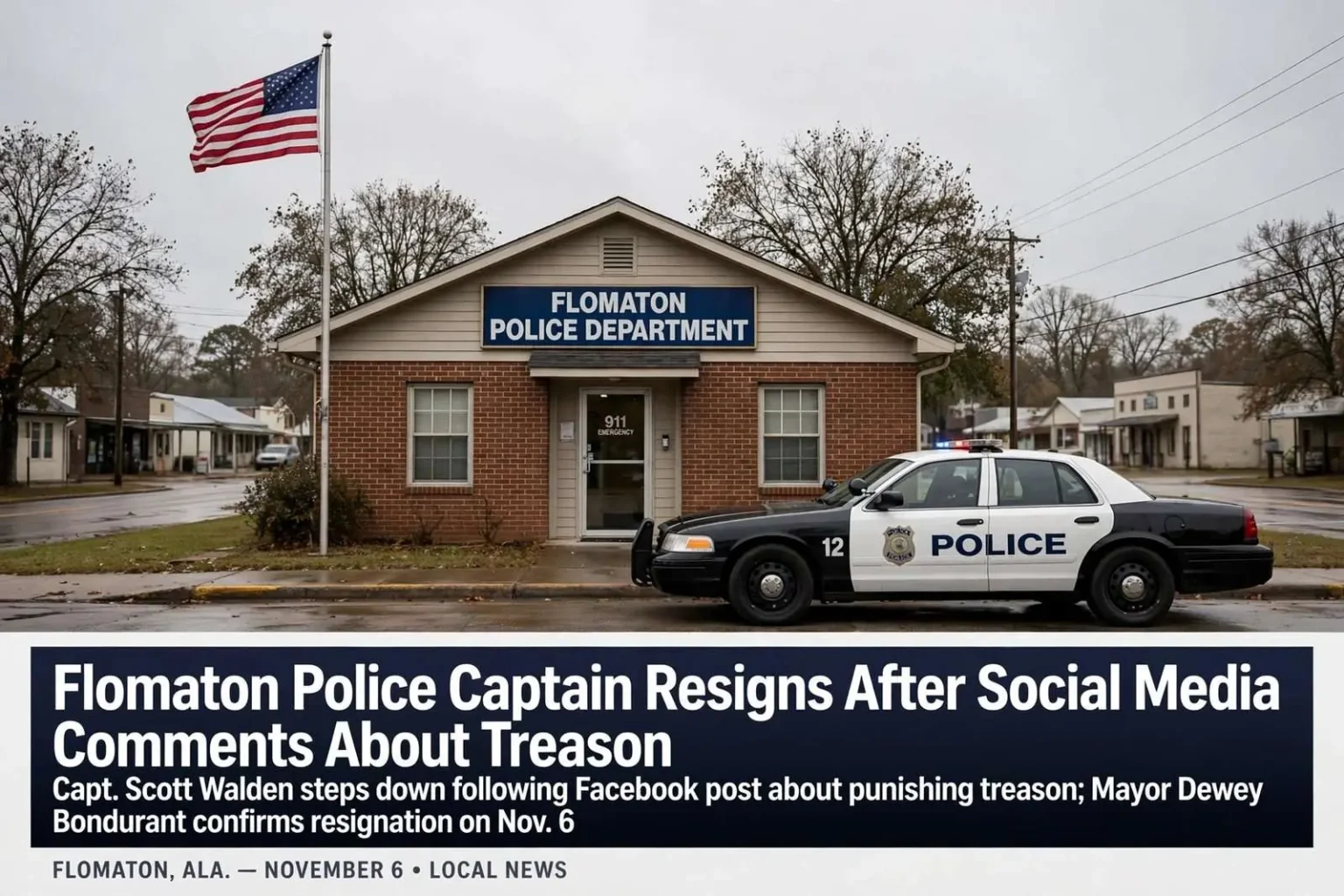
A Flomaton police captain has resigned after social media posts in which he appeared to call for the execution of people who commit treason drew criticism. Capt. Scott Walden wrote in a Facebook comment that those charged with treason should be lined up and shot.
In a follow-up post on his personal page, Walden said he was not calling for violence against any political group but was referring to punishment for traitors. The original comment came in response to a post suggesting that people who voted a certain way were “idiots” who wanted to “throw the country away.”
Flomaton Police Chief Charles Thompson said the statements were under investigation, and Walden was placed on administrative leave while an internal investigation “could and may be pending termination.” On Nov. 6, Flomaton Mayor Dewey Bondurant confirmed that Walden had resigned.
How the situation unfolded
The sequence moved quickly from an online exchange to a personnel matter with the officer’s career at stake. The initial Facebook comment — made in response to a political post that disparaged voters on one side of the divide — drew attention for its language about shooting people charged with treason. Walden’s follow-up sought to narrow the meaning of what he had written, framing it as a reference to lawful punishment for treason rather than a call for violence aimed at any political group.
By then, however, the posts had already drawn the kind of public criticism that police departments in small towns cannot ignore. A captain in a small-town department is one of the most visible figures in local government, and residents who see an officer — much less a ranking one — appearing to endorse extrajudicial violence are likely to raise the issue with city hall directly. That is effectively what happened: the department acknowledged the statements were under investigation, and Walden was placed on administrative leave while an internal review considered whether his conduct warranted termination.
The end came on Nov. 6, when Mayor Dewey Bondurant confirmed that Walden had resigned, closing out an episode that had put the small Escambia County town into an uncomfortable spotlight. The resignation resolved the personnel question without the city having to complete a termination process, but it left behind the larger questions the episode raised about what police officers may say on personal social media accounts.
The standards police officers are held to
The case illustrates the difference between the speech rights of private citizens and the standards applied to law enforcement officers. Americans can and do post intemperate political comments every day without professional consequence. Police officers occupy a different position: they carry state authority, wear the public’s badge, and are trained in the legal limits on the use of force — including the principle that due process, not individual judgment, determines punishment. A statement from an officer that appears to endorse shooting people, even as hyperbole, undermines the trust that community policing depends on.
Departments across Alabama and the country have confronted versions of this problem for years, as the social media era has made every officer’s personal page an extension of the department’s public face. Agencies typically maintain policies governing officer conduct online, and officers who post inflammatory content on their own time routinely find themselves subject to internal investigations when the posts surface. Administrative leave is the standard intermediate step — it removes the officer from duty without prejudging the outcome while the investigation proceeds, protecting both the department and the officer until the facts are settled.
Treason itself carries a specific constitutional meaning. The U.S. Constitution defines it narrowly — levying war against the United States or adhering to its enemies — and gives Congress power to declare its punishment. No amount of political disagreement, however heated, meets that definition, which is part of why the original comment struck so many readers as alarming rather than merely colorful: it invoked the gravest crime in American law in a way that suggested the writer’s personal frustration, not any actual case.
Small-town policing and public trust
Flomaton is a small town in Escambia County on the Alabama-Florida line, a community of roughly two thousand people where the police department is compact and personal. In towns that size, the relationship between officers and residents is close by necessity — the same faces appear at ballgames, churches and the grocery store. That closeness cuts both ways: it builds the familiarity that makes small-town policing effective, and it means an officer’s controversial public statement is felt personally by neighbors rather than abstractly by strangers.
Chief Charles Thompson’s handling of the matter — confirming the investigation, placing Walden on leave, and letting the internal process run — followed the conventional playbook for such situations. Mayor Dewey Bondurant’s Nov. 6 confirmation of the resignation gave the town a definitive answer and ended the matter without a public termination fight. For a small municipality, avoiding a prolonged disciplinary battle has real value, both financially and in terms of moving past a story that drew outside attention to the community.
The episode is also a case study in how quickly online speech becomes a professional crisis for public employees. A comment made on a personal Facebook page, in response to a political post, traveled from a private exchange to a city hall matter within days. Public employees at every level have learned versions of this lesson in recent years, but the stakes are highest for police, whose authority depends on the community’s willingness to call them in a crisis and cooperate afterward.
With the resignation confirmed, the town’s focus can return to the department’s daily work. Walden’s departure closes the personnel file, but the episode’s lesson — that officers’ personal accounts are public business, and that comments about violence will be treated as conduct issues rather than jokes — is one that departments of every size continue to absorb. In Flomaton, it ended with a captain’s resignation, confirmed by the mayor, after posts that a small town could not and did not overlook.
The internal investigation process itself deserves explanation, because it is the mechanism through which police accountability actually operates in cases like this. When an officer’s conduct comes under question, an internal affairs review gathers the evidence — in social media cases, the posts themselves, the context of the exchange, and any department policies implicated — and weighs it against the agency’s standards of conduct. The officer is ordinarily given an opportunity to respond. The possible outcomes range from a letter of reprimand to suspension to termination, and the administrative leave that accompanies the investigation is explicitly not a finding of guilt; it is a neutral holding position.
What the investigation found in Walden’s case will not be fully known outside city hall, because the process ended with a resignation before a termination decision was announced. Resignation in these circumstances is common — it allows the officer to leave without a formal termination on the record, and it allows the department to resolve the matter without an appeal, an arbitration hearing or a civil challenge. The mayor’s confirmation of the resignation was the public’s only official answer.
The broader debate over officers’ online speech
Across the country, police agencies continue to wrestle with how far to regulate officers’ personal social media activity. The legal landscape gives departments real but bounded authority: officers do not surrender their First Amendment rights when they take the badge, but courts have consistently allowed agencies to restrict speech that undermines the department’s mission, disrupts its operations, or damages public trust — and violent rhetoric from a sworn officer falls squarely into the categories most departments treat as actionable.
Professional policing organizations have generally advised officers to assume that anything they post publicly reflects on their department, regardless of disclaimers or privacy settings. Screenshots travel; contexts disappear; and the audience that eventually sees a post is never only the audience it was written for. The escalation from a Facebook comment to a national-style controversy is a pattern that has repeated in departments large and small, and small departments like Flomaton’s — without dedicated public information staff — feel the attention most acutely, since the entire town becomes the story’s setting.
There is also a practical dimension specific to law enforcement: an officer’s public statements can become evidence in criminal cases they touch. Defense attorneys routinely search officers’ social media histories for material that suggests bias, and a post endorsing violence — even one the officer explains as rhetoric — can be raised to challenge an officer’s credibility on the stand. That professional exposure is separate from the disciplinary one, and it is a reason agencies police their officers’ public statements so carefully.
For Flomaton, the episode ends where it does: with a captain’s resignation confirmed by Mayor Dewey Bondurant on Nov. 6, a department moving past the controversy, and a community that watched a familiar institution handle an uncomfortable moment through its established processes. The chief investigated, the officer was placed on leave, the process played out, and the captain is gone. It is a small-town story with a very modern engine — a few sentences typed into a Facebook comment box — and a lesson about public trust that extends well beyond the Alabama-Florida line.