Foley Library Launches Bites and Insights With a Session on the Invasive Plants Taking Over Gulf Coast Yards
The Foley Community Library begins its Bites and Insights series Sept. 15 with Graham Creek Nature Preserve experts discussing how to identify and manage invasive plant species across South Alabama.
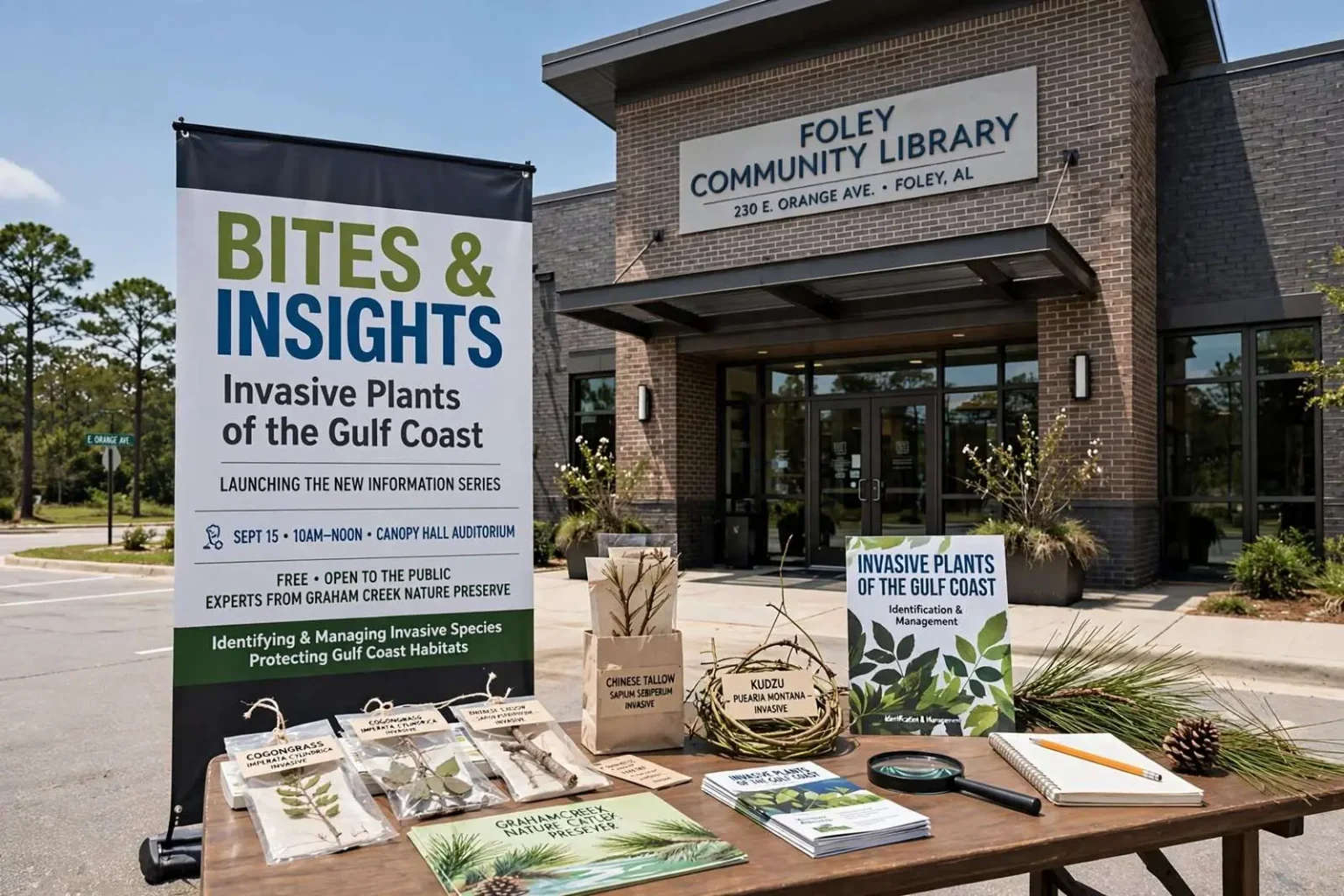
FOLEY, Ala. — The Foley Community Library launches its Bites and Insights information series on Sept. 15 with a discussion of the invasive plant species reshaping habitats across the Gulf Coast.
The free event runs from 10 a.m. to noon in the Canopy Hall auditorium at the library, 230 E. Orange Ave. in Foley.
Experts from Foley’s Graham Creek Nature Preserve will discuss invasive plant species commonly found in Foley and throughout South Alabama, examining how those plants affect native habitats, wildlife, forests, wetlands and residential landscapes.
Participants will also learn how to identify common invasive plants and use practical management techniques to help protect local natural areas.
The event is open to the public. Registration is available through the Foley Community Library event calendar.
Why Invasive Plants Matter on the Gulf Coast
The subject can sound like a specialist concern until the mechanics are laid out.
An invasive plant is a non-native species that spreads aggressively and displaces native vegetation. What makes it invasive rather than merely introduced is the absence of the constraints that limited it in its native range — the insects that fed on it, the diseases that infected it, the competitors that held it in check.
Freed from those pressures, an introduced plant can grow faster and reproduce more prolifically than the native species around it. The result is displacement: a diverse plant community replaced by a monoculture of one aggressive species.
The consequences run through the whole system. Native insects, which have evolved to feed on specific native plants, cannot use most invasive species. Fewer insects means less food for birds, particularly during nesting, when most songbirds feed insects to their young regardless of what adults eat. The effect propagates upward.
The Gulf Coast is especially susceptible. The climate is mild enough that plants from a wide range of subtropical regions survive here. Port traffic and the horticultural trade provide continuous introduction pathways. And hurricanes disturb established vegetation on a large scale, opening ground that fast-colonizing invasive species exploit better than natives.
What Homeowners Are Dealing With
The residential landscape angle in the presentation is the part with the most immediate application for attendees.
A substantial share of invasive plants in the Southeast arrived through the nursery trade, sold as ornamentals for exactly the traits that make them problematic: rapid growth, dense cover, tolerance of poor soil, resistance to pests. Some remain commercially available.
The practical implications for a homeowner include plants that escape a bed and colonize a yard, vines that overwhelm trees and shrubs, and species whose root systems make removal a multi-year project rather than a weekend one.
Management technique matters considerably here, which is why the session covers it. Cutting many invasive species without treating the stump produces vigorous regrowth from the roots. Pulling some species leaves root fragments that resprout. Timing of treatment relative to the plant’s growth cycle affects whether an application works. Doing the wrong thing at the wrong time can leave a homeowner worse off than doing nothing.
Graham Creek Nature Preserve
The experts leading the discussion come from Graham Creek Nature Preserve, a City of Foley property that has become one of Baldwin County’s significant conservation and outdoor recreation assets.
The preserve encompasses hundreds of acres of pine savanna, wetlands and creek frontage, with trails, paddling access, disc golf and an interpretive center. It also functions as a working conservation site, with habitat management including prescribed burning and invasive species control.
Pine savanna habitat is among the most reduced ecosystems in the Southeast, and it is fire-dependent — without periodic burning, it succeeds to a different plant community entirely. Staff managing a site like Graham Creek deal with invasive species as an operational problem rather than an abstract one, which is what makes them useful presenters on the subject.
The Bites and Insights Format
The series launching Sept. 15 reflects a role public libraries have taken on well beyond lending books.
Libraries have become among the most accessible venues for adult education in American communities. They are free, centrally located, welcoming to people who would not enroll in a class, and unaffiliated with any commercial or political interest. A resident who would not attend a university extension course will attend a two-hour session at the library.
For subject matter like invasive species management, that accessibility matters. The knowledge is genuinely useful to anyone with a yard, and it is not knowledge most people encounter otherwise.
Event Details
What: Bites and Insights — invasive plant species of the Gulf Coast
When: Monday, Sept. 15, 10 a.m. to noon
Where: Canopy Hall auditorium, Foley Community Library, 230 E. Orange Ave., Foley
Cost: Free
Registration: Through the Foley Community Library event calendar
The library sits within the downtown district recently improved through the East Jessamine Street project, which strengthened pedestrian connections between the library, Foley City Hall and Heritage Park.