Foley Freezes Data Center Applications for Six Months — Before Anyone Has Asked
The Foley City Council approved the final reading of a six-month moratorium on data centers, crypto mining and server farms on Sept. 8. No facilities have been proposed, and Mayor Ralph Hellmich says the pause is about writing rules before an applicant arrives.
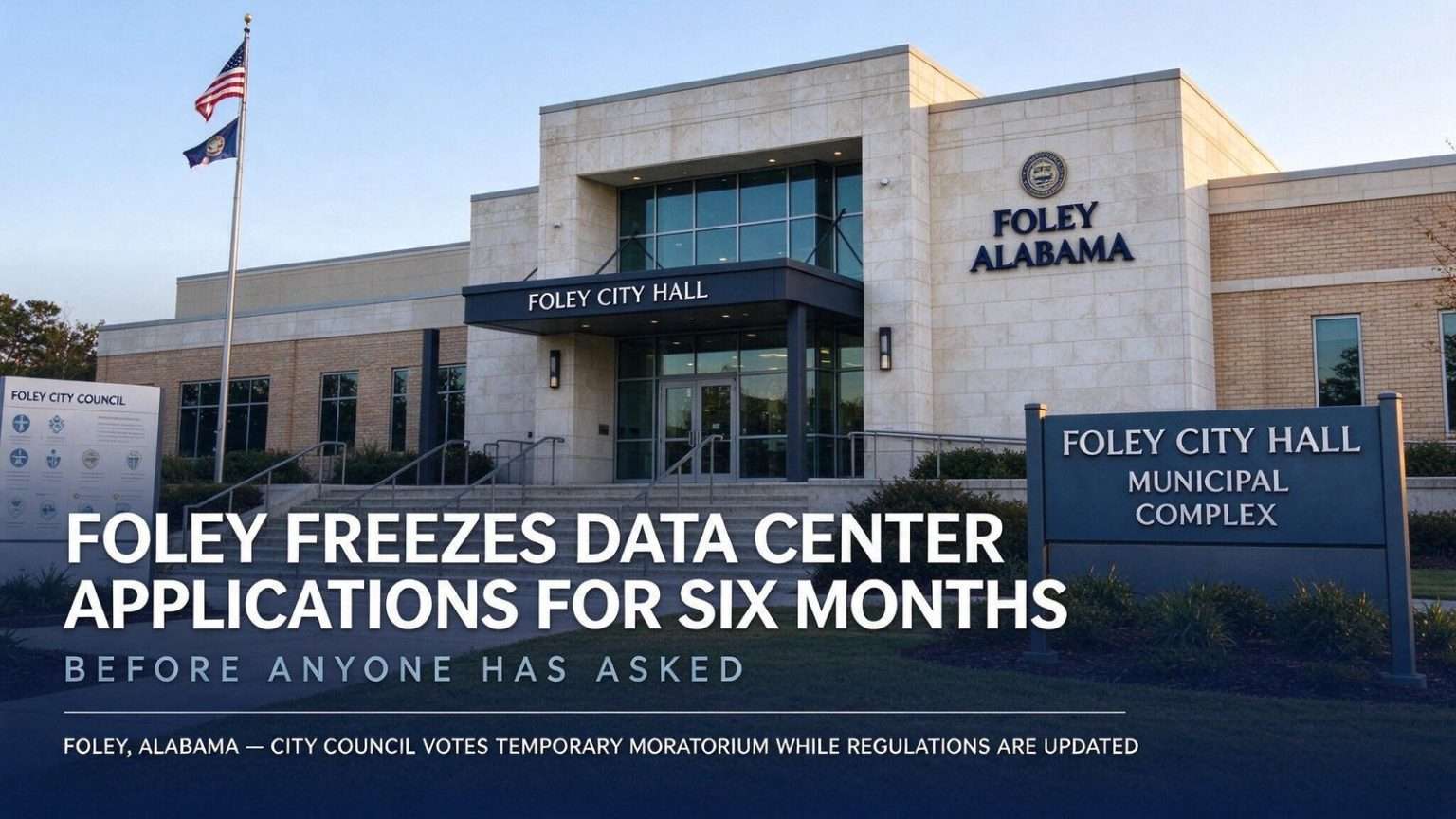
Foley now has a six-month freeze on data centers, and the city does not have a single one proposed.
That is the point. The Foley City Council voted Tuesday, Sept. 8, to approve the final reading of an ordinance imposing a temporary moratorium on data centers while city staff update local regulations. The ordinance is active, and it will remain in place for six months.
Mayor Ralph Hellmich was direct about the reasoning: the city would rather have its rules written before anyone walks through the door than after.
“We want to make sure that our city has all the questions answered before anybody shows up,” he said.
What the Moratorium Covers
The ordinance restricts the acceptance, processing, approval and consideration of applications for data centers, Bitcoin and cryptocurrency mining facilities, server farms, and similar technically oriented uses, facilities and operations.
The breadth is deliberate. Writing the restriction around a category of operation rather than a single business label makes the ordinance considerably harder to sidestep by relabeling a project.
A moratorium is a pause, not a ban. It suspends the city’s ability to accept and process applications for a defined period. It does not permanently prohibit the use, and it does not decide in advance that any future application will be denied.
Nothing Is Proposed — and Officials Don’t Expect Much
No data centers have been proposed for the Foley area, according to Hellmich. He went further, saying he does not believe South Baldwin County is a likely target for a data center site.
So the city is preparing for a possibility it considers unlikely. That is an unusual posture for a municipal government, and the mayor explained it in terms of readiness rather than alarm.
“This way we can review all of our regulations, environmental, zoning, and make sure everything coordinates so that if, in the future, any of one of these types of industries come to us, we’re prepared,” Hellmich said. “We want to have the answers if they show up, so that all the right questions are asked.”
Communities across the country have found themselves negotiating multi-hundred-megawatt facilities under rules written for warehouses. Foley is trying to avoid being in that position.
The Riviera Utilities Factor
Foley has a structural advantage that most cities considering this question do not: it owns its electrical provider.
“We’re in a unique position,” Hellmich said. “Foley owns Riviera Utilities, which already has protections built in. The big three things are water use, noise, and electrical use that punishes current customers. Riviera had already put into place a policy that will not allow a data center to put the burden onto existing customers. If a data center comes, they have to bring the power with them.”
That last sentence is the entire debate elsewhere, resolved in advance. The most common complaint about large data center projects is cost-shifting — a facility with enormous electrical demand arrives, the grid needs upgrading, and existing ratepayers finance the upgrade through their bills.
Riviera’s policy places that burden on the applicant. Municipal ownership is what makes it enforceable: the city does not have to negotiate with an outside utility to protect its own residents.
What Staff Will Study
During the six-month window, city staff will examine how Alabama cities and other communities across the country have managed data centers, looking at both benefits and drawbacks.
Staff will also work with Riviera Utilities specifically on:
- Water usage
- Power consumption
- Anticipated megawatt thresholds
Megawatt thresholds are the technical heart of the exercise. A facility drawing a few megawatts is an ordinary commercial customer; one drawing hundreds is an infrastructure project. Setting thresholds in advance lets the city decide which review process applies before an application arrives rather than improvising once it does.
Rewriting the Rulebook
The six months also give staff time to update the city’s zoning ordinances and technical design manuals.
Those updates would address potential impacts from data center operations including water resource use, air pollution and noise pollution. Noise is a frequent and underestimated complaint: large-scale cooling systems run continuously, and the resulting low-frequency hum has generated resident opposition in communities that permitted facilities without sound standards.
A Stated Limit on the City’s Own Authority
City officials said they do not want to restrict the legal use of private property. They said they believe updated regulations should be in place before considering any proposals, in order to protect both the community and the environment.
That framing acknowledges a genuine tension. A moratorium does temporarily restrict what a property owner may apply to do. The city’s argument is that a six-month pause with a defined end date and a specific work plan is a narrower intrusion than either approving a project under inadequate rules or denying one without a defensible standard.
Why Foley, Specifically
Foley is one of the fastest-growing communities in the United States. City leaders have said they want to balance the needs of a growing population against preserving the qualities that made the city attractive to new and longtime residents in the first place.
Rapid growth is exactly the condition under which zoning codes fall behind. A city adding residents quickly is processing a continuous stream of applications under rules that were written for a smaller place, and the gap between the code and the reality widens until something forces a rewrite.
Foley chose to force the rewrite before a specific project made it urgent — which is, in practice, the only time a city gets to write rules without a particular applicant in the room.
What Happens in Six Months
The moratorium expires on its own terms. By then, city staff are expected to have completed their review of other communities’ experiences, worked through the utility analysis with Riviera, and drafted updates to the zoning ordinance and technical design manuals.
Whether Foley ever sees a data center application remains an open question the mayor himself doubts. If one arrives, the city intends to have its answers ready.