Foley’s D.J. Fluker re-signs with Seahawks on two-year, $9 million deal
Foley native and offensive lineman D.J. Fluker has re-signed with the Seattle Seahawks on a two-year, $9 million contract, the team announced Friday.
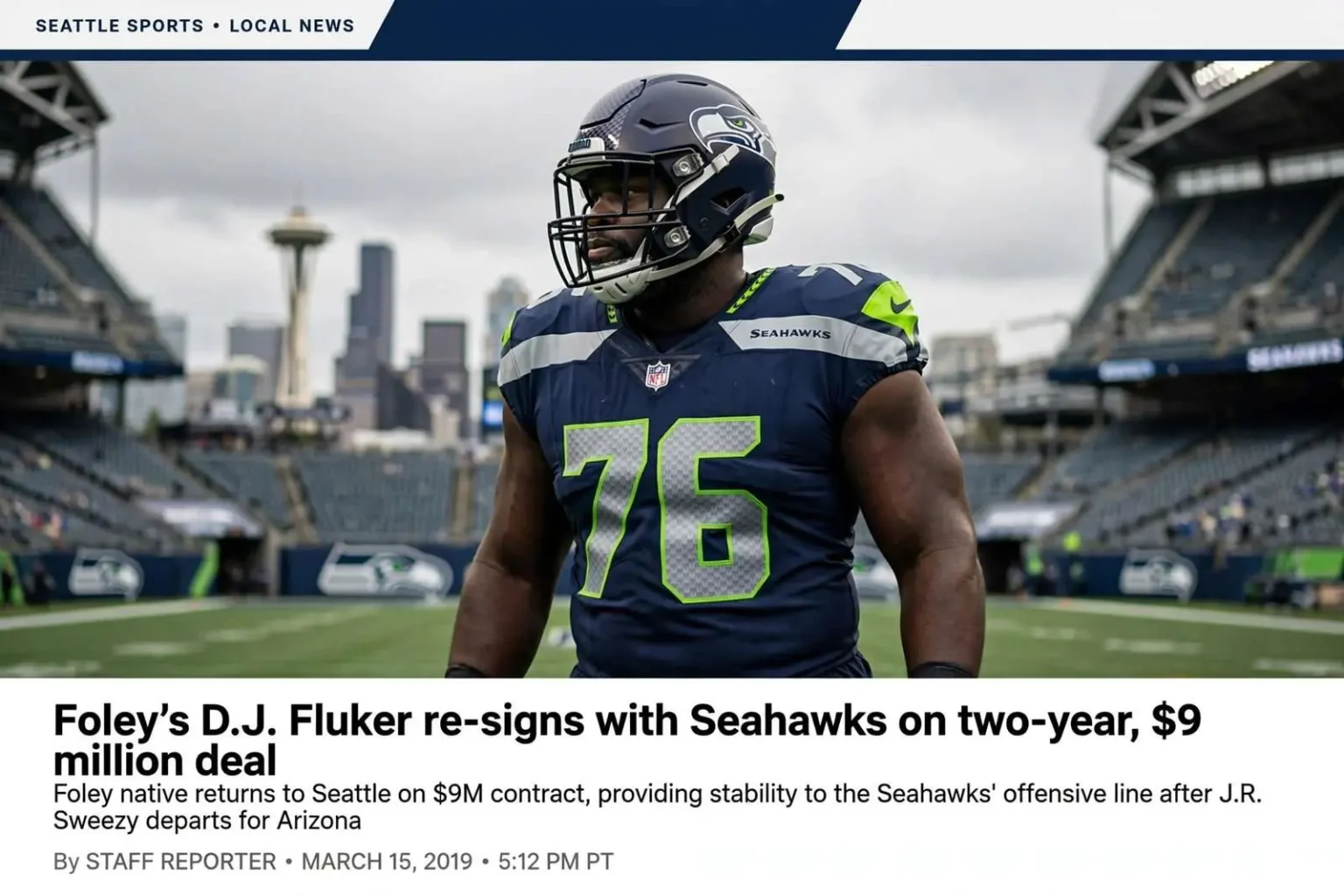
Foley native D.J. Fluker is staying in Seattle. The offensive lineman signed a two-year, $9 million contract with the Seattle Seahawks on Friday, keeping the former Foley High School standout with the team he joined as a free agent two years earlier. The deal ends another round of offseason uncertainty for the big lineman, whose career has taken him from the Baldwin County high school ranks to the top of the NFL draft and across three professional teams.
The Seahawks re-signed Fluker after their other starting guard, J.R. Sweezy, agreed to a deal with Arizona, according to Spotrac.com figures cited in the report. The sequence made sense on both ends: Seattle needed to keep experience on the interior of its offensive line after losing one starter to the Cardinals, and Fluker had already proven himself in the Seahawks’ system over two seasons. Guard is one of the least glamorous positions in football and one of the most important — the interior protectors decide whether a quarterback has time in the pocket and whether a power-running game has anywhere to go.
Fluker was one of several players with local high school or college ties appearing on the NFL’s free-agent market. The list included linebacker C.J. Mosley of Theodore, who signed a five-year, $85 million contract with the New York Jets — reported as the largest ever for an inside linebacker. Baltimore placed a restricted-free-agent tender on Daphne’s Michael Pierce, a defensive tackle, while defensive back Jimmie Ward of Davidson and linebacker Mark Barron of St. Pauls were among others tracking toward new deals.
A pipeline that runs through south Alabama
The concentration of Mobile-area and Baldwin County talent in a single NFL offseason is nothing new. The region stretching from Mobile County down through Baldwin County produces football players at a rate that few metro areas of its size can match, and the names on the year’s free-agent market read like a map of local high school football: Foley, Theodore, Daphne, Davidson, St. Pauls. Youth leagues, middle school programs, and ferociously competitive high school districts feed a college recruiting pipeline that then restocks the NFL every spring.
Fluker’s own path is the classic version. He played at Foley High School, where he was a dominant offensive lineman for a program that has regularly sent players to the college ranks, before a college career at the University of Alabama and a first-round selection in the 2013 NFL Draft. At Alabama, he played for Nick Saban’s teams during the height of the Crimson Tide’s dynasty years, blocking on an offensive line that helped power national championship offenses and learning in a program known for turning high school prospects into pro-ready linemen.
Going in the first round put Fluker among the highest draft selections ever produced by a Baldwin County high school, and he carried the expectations that come with it — the Chargers took him with the kind of investment that demands a starter from day one, and he delivered a multi-year run of NFL starts. His journeyman phase, moving from that first team to New York and then to Seattle, is the normal arc of a veteran lineman: teams rotate, schemes change, and players who can protect in multiple systems keep finding work.
Seattle was a fit for what Fluker does. The Seahawks’ offense under Pete Carroll built its identity on a physical running game, and guard play is where that identity lives. Fluker’s size and power style matched what the scheme asked of its interior linemen, and his two years with the team gave the coaching staff enough evaluation to commit real money to keeping him.
The rest of the local market
Mosley’s deal with the Jets set the market for inside linebackers, and it came as no surprise to anyone who watched him go from Theodore High School to Alabama to a Pro Bowl career in Baltimore. Inside linebackers are the defensive quarterbacks — they call the fronts, make the tackles, and play every down — and the Jets paid accordingly. The contract was a landmark for the position and another data point in south Alabama’s producing-the-best argument.
Pierce’s situation was different but equally lucrative in its own way. As a restricted free agent, the defensive tackle from Daphne was tendered by Baltimore, meaning the Ravens retained the right to match any offer he received or collect compensation if he left. The mechanism keeps teams in control of young players who have outplayed their rookie contracts, and Pierce’s run as a run-stuffing nose tackle made him exactly the kind of player Baltimore wanted to hold.
Ward and Barron rounded out the group of local names in the market. Ward, the Davidson product, had spent his career in San Francisco’s secondary, battling through injuries while establishing himself as a versatile defensive back. Barron, from St. Pauls Episcopal and then Alabama before a first-round career that had already included a Super Bowl run in Los Angeles, was tracking toward another stop as a hybrid safety-linebacker whose skill set fits the modern NFL’s demand for defenders who can cover tight ends and play the run.
For high school coaches in the area, an offseason like this one is a recruiting pamphlet that writes itself. When a Foley lineman signs a $9 million deal and a Theodore linebacker sets the market at his position in the same week, the argument that a player can stay home, develop in a local program, and reach the highest level writes itself into every locker room conversation on the coast.
Fluker’s return to Seattle also carries the practical weight of continuity for a team with playoff expectations. Offensive line play is famously about cohesion — five men executing the same calls, footwork, and timing — and replacing a starter mid-offseason is one of the harder roster problems to solve. By re-signing Fluker, the Seahawks solved it with a known quantity who already knew the scheme, the locker room, and the standard the coaching staff expects.
What the deal means going forward
The two-year term gives both sides what they wanted. Fluker gets security and a defined role rather than gambling on a one-year prove-it deal elsewhere, and Seattle gets stability on the interior for the prime window of its roster. For the player, the contract also represents a recovery of value after the journeyman stretch that followed his first-team years — proof that a first-round lineman who keeps himself in shape and in scheme can re-establish his market even after changing teams.
The $9 million figure also reflects the market realities for quality guards. Interior linemen do not command the money that tackles do, but a proven starter at guard in a run-first offense is worth a real investment, and Seattle’s willingness to commit two years says the coaching staff views Fluker as part of its foundation rather than a stopgap.
Back in Foley, the signing registers as another chapter in a hometown story that the community has followed since Friday nights at the high school stadium. Baldwin County’s football culture tracks its own closely — from Foley to Tuscaloosa to the draft to a professional career — and every contract announcement gets shared through the same networks that once packed the stands. Fluker’s return to Seattle keeps one of the area’s most prominent football exports in a starting role, and it adds another line to a local pipeline that, year after year, keeps sending players from the Gulf Coast to the NFL.
The free-agency window itself is worth understanding for readers who follow it casually. When contracts expire in March, players without deals hit an open market that moves fast — teams clear salary cap space, agents shop their clients across the league, and the biggest names sign within days. Restricted free agency works differently: the old team extends a tender that keeps matching rights and, usually, draft-pick compensation if the player signs elsewhere. The rules explain why Mosley flew to New York while Pierce stayed tethered to Baltimore, and why Fluker’s re-signing came after Seattle had watched Sweezy leave.
Salaries tell their own story about how the league values positions. Mosley’s $85 million headline reflects what NFL teams will pay for a three-down inside linebacker who never leaves the field. Fluker’s $9 million reflects the guard market — solid money for a starter, but a fraction of what tackles and pass rushers command. Ward, Barron, and Pierce fall along that same spectrum, each paid according to what their position and role bring to a defense. For local fans, the deals are a lesson in roster building: every position has a market, and every market has a number.
The Alabama connection runs through all of it. Fluker, Mosley, and Barron all played for the Crimson Tide during its most dominant stretch under Saban, and all three arrived in Tuscaloosa from south Alabama high schools. That overlap — same hometown region, same college program, same draft classes a few years apart — is the clearest illustration of the pipeline this article keeps returning to. The Tide’s staff recruited the Gulf Coast heavily, developed the players it found there, and sent them to the league as first-round picks and pro-level starters.
Seattle’s re-signing of Fluker closes one thread of this offseason’s local storyline while the others continued to unfold around it — Mosley in green and white in New York, Pierce tendered in Baltimore, Ward and Barron weighing their markets. For a metro area this size, having five players of that profile in a single free-agent cycle is remarkable, and it is why south Alabama’s football reputation travels far beyond the Friday-night stadiums that produced them.