Former Mobile County Deputy Faces Drug, Theft and Evidence Tampering Charges
A former Mobile County Sheriff's Office deputy has been indicted on drug, theft and evidence tampering charges after an internal probe found he kept seized drugs and a firearm instead of logging them into evidence, one of several recent conduct cases involving local law enforcement officers.
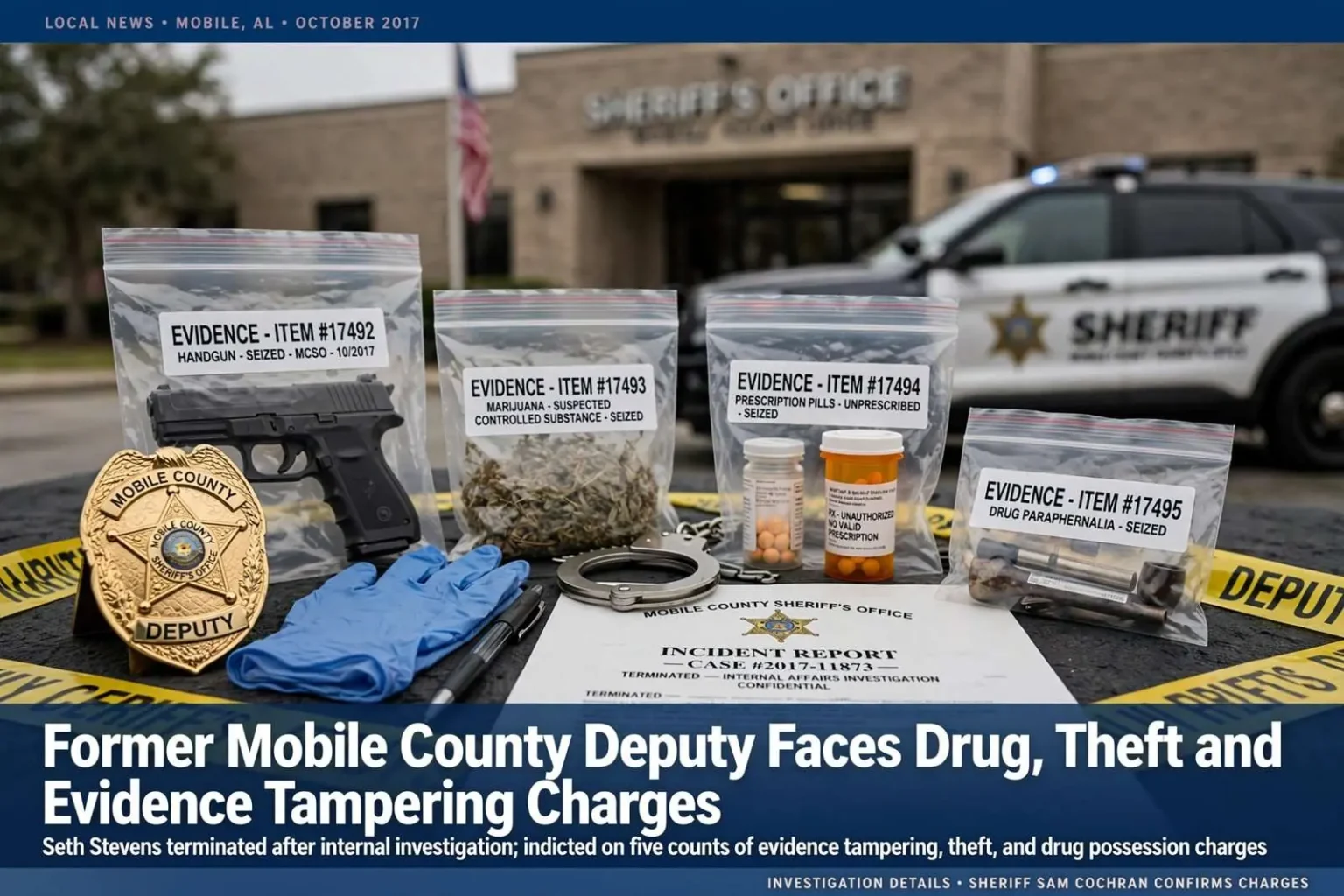
A former Mobile County Sheriff’s Office deputy has been arrested and indicted on more than a half-dozen criminal counts after an internal investigation found he had kept drugs and a firearm seized during agency operations rather than logging them into evidence, according to Mobile County Metro Jail records and Sheriff Sam Cochran. Seth Stevens, who was terminated from the agency after the internal probe, faces five counts of tampering with physical evidence, a count of second-degree theft of property and multiple drug possession charges connected to paraphernalia, marijuana, an undisclosed controlled substance and prescription pills obtained without a valid prescription.
Cochran told reporters the investigation began after supervisors determined Stevens had, on more than one occasion, failed to properly turn in evidence collected during Mobile County Sheriff’s Office operations. Investigators say Stevens instead kept an assortment of drugs and a handgun that should have been logged into the department’s evidence system, and that he could not offer a clear explanation when confronted about the missing items.
Much of the evidence in question was later recovered from Stevens’ home and from the trunk of his personal vehicle, Cochran said. After his termination, the sheriff’s office opened a criminal investigation and eventually forwarded its findings to the Mobile County District Attorney’s Office, which pursued the indictment.
What remains unclear, even to investigators, is why Stevens allegedly held onto the evidence rather than submitting it through normal procedures. Cochran said Stevens had received training on proper evidence handling and that nothing in the investigation suggested he was selling or using the drugs himself.
“There was no indication he was selling any of these drugs or any indication he was using any drugs,” Cochran said, adding that Stevens was drug tested as part of the internal investigation and the results came back clean. “We don’t have a good answer, but what we do know is he violated criminal statutes and did not follow our rules and regulations.” Cochran said most of the underlying cases tied to the missing evidence were minor misdemeanor matters that had already been resolved in court by the time the internal investigation uncovered the problem, limiting the practical impact on those prosecutions.
The case bears similarities to an earlier one this year involving former Mobile County Sheriff’s Deputy Chris Parsons, who was fired in March after the agency caught him purchasing illegal drugs and keeping controlled substances in his patrol car. Unlike Stevens, Parsons was not arrested immediately — Cochran instead sent the case to a grand jury while Parsons completed a drug treatment program.
Parsons was indicted roughly two months later on six drug-related counts and ultimately pleaded guilty to one charge, receiving two years of probation. Stevens likewise was not arrested for several months after the sheriff’s office discovered he had illegal drugs and what investigators believe was a stolen firearm in his possession.
Cochran defended the delay, saying the criminal investigation remained active after Stevens’ termination and that laboratory testing of the seized drugs took additional time to complete. “When you take a case to the grand jury, you’re actually expediting the case and bringing about a quicker solution to it,” Cochran said.
“The reason to arrest someone is to keep them from fleeing or leaving town, and we didn’t feel like there was any risk of him fleeing.”
Cochran acknowledged that criminal charges against sworn officers can be viewed as embarrassing for law enforcement generally, but argued that pursuing charges against Stevens, Parsons and others sends the opposite message. “We tell our folks they’re going to be held to a higher standard,” Cochran said.
“If they violate our standards of conduct, it will result in their termination, and if they violate any criminal offenses, they’ll be charged just as any other citizen.”
Stevens and Parsons were not the only Mobile County Sheriff’s Office deputies to leave the agency over conduct issues in 2017. Agency spokeswoman Lori Myles confirmed that two additional deputies, Justin Arata and Paul Sonny Smitherman, resigned in June while under investigation by the internal affairs unit.
Myles said the specific nature of those investigations could not be disclosed because neither deputy became the subject of a criminal case. The Mobile County Sheriff’s Office is not the only local law enforcement agency to see officers face criminal charges or leave under a cloud in the past year.
Former Mobile Police Department Cpl. Damian Colvin was charged in August with possession of a controlled substance, theft of property and tampering with physical evidence — allegations similar to those against Stevens.
Colvin resigned from the department shortly after the charges became public. The Mobile Police Department has lost two other officers to disciplinary issues since December 2016, including one terminated after firing a weapon at an unarmed man outside the department’s jurisdiction and another who resigned after being recorded driving a patrol car erratically and striking another motorist.
Elsewhere in the region, a Prichard police officer, Bryan Pearman, was arrested in November on charges including domestic violence, kidnapping and harassing communications.
In Baldwin County, Sgt. Carl Griffith resigned from the Baldwin County Sheriff’s Office while under investigation for allegedly abusing overtime pay and falsifying time records; that matter remains an active criminal investigation.
More recently, Bay Minette Police Department Cpl. Charles Tingler was arrested by Baldwin County deputies on a domestic violence charge and has since been terminated from the department.
How the charges work
Under Alabama law, tampering with physical evidence and second-degree theft of property are both Class C felonies, while possession of marijuana for personal use and possession of drug paraphernalia are generally misdemeanors. A grand jury indictment is a formal accusation that there is enough evidence for a case to proceed to trial; it is not a finding of guilt, and Stevens is presumed innocent unless convicted.