Fort Morgan Oyster Festival Returns Feb. 25 at The Beach Club in Gulf Shores
The Fort Morgan Oyster Festival hits The Beach Club in Gulf Shores Feb. 25, 10 a.m.-4 p.m. Tickets are $30 in advance, $35 at the door.
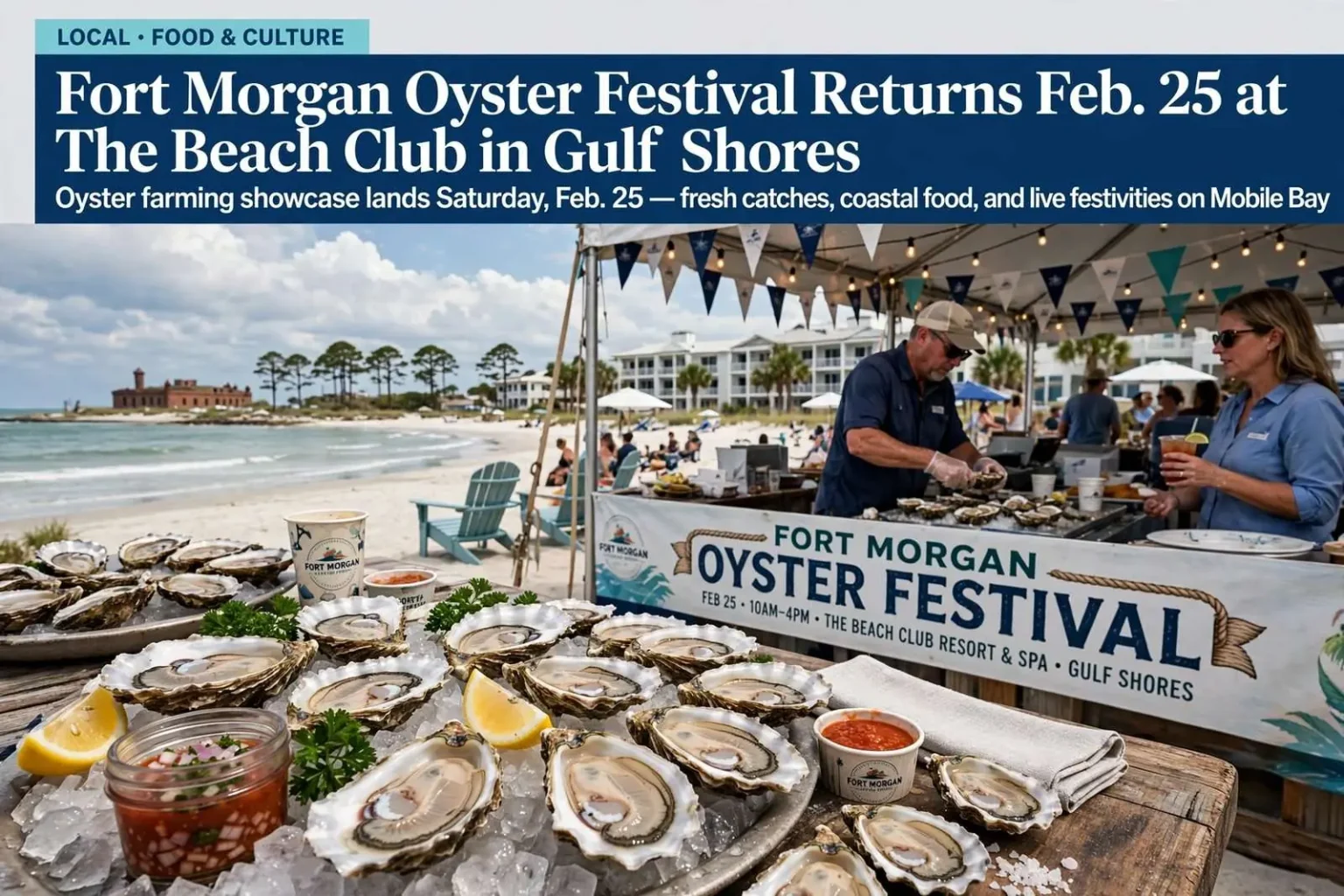
Oyster lovers, mark the calendar: the Fort Morgan Oyster Festival is set for Saturday, Feb. 25, from 10 a.m. to 4 p.m. at The Beach Club Resort and Spa in Gulf Shores, and it is shaping up as a full-day salute to one of the Alabama Gulf Coast’s signature industries. The one-day event puts the region’s fastest-growing agricultural trade on center stage, with freshly shucked oysters, coastal food, live festivities and a beachfront setting that few festivals anywhere in the country can match.
The festival celebrates the oyster farming industry that has taken root in the waters around Fort Morgan and Mobile Bay, where area growers have built a reputation for some of the country’s most prized boutique oysters. What began as a handful of experimental farms has grown into a genuine economic presence on the peninsula, and the festival gives the public a rare chance to meet the growers, taste the product at its freshest and learn how oysters make the journey from bay bottom to half shell.
The rise of Mobile Bay oyster farming
The waters around Fort Morgan sit at the mouth of Mobile Bay, where fresh water from the Mobile-Tensaw Delta mixes with Gulf saltwater to create the brackish conditions oysters favor. That mix of nutrients and salinity is what gives locally farmed oysters their distinctive flavor, and it is the reason growers settled on the area in the first place. The bay’s western side, sheltered by the Fort Morgan peninsula, offers the calm water and steady currents that oyster cages need to thrive.
Unlike traditional wild-harvest oystering, which pulls oysters from public reefs with tongs and dredges, modern oyster farming uses off-bottom techniques. Young oysters — called spat — are raised in cages or baskets suspended above the bay floor, where they are protected from predators and silt, tumbled regularly to develop deep cups and sturdy shells, and harvested individually at peak condition. The method takes more labor than wild harvesting, but it produces the plump, consistently shaped oysters that raw bars and chefs prize.
That labor-intensive approach is exactly what earned the region its boutique reputation. Because each cage is tended by hand and each oyster is graded before market, local farmers can deliver a premium product with a flavor profile shaped by the exact waters it grew in — a concept oyster lovers borrow from wine and call merroir. Restaurants across Baldwin County and along the coast now advertise locally farmed oysters by name, and the farms around Fort Morgan and nearby Navy Cove have become fixtures on Alabama raw bar menus.
Local partners behind the event
Spectrum Resorts is hosting the festival in partnership with Navy Cove Oysters and Sassy Bass, pairing the resort’s beachfront setting with the folks who actually farm and serve the oysters being celebrated. The partnership puts every link of the local chain in one place: the grower that raises the oysters in bay waters, the restaurant group that cooks and serves them, and the resort that provides the grounds and the Gulf-front backdrop.
Navy Cove Oysters has been among the best-known names in Alabama’s farmed oyster movement, raising its crop in the waters just off Fort Morgan near the cove that gives the company its name. Sassy Bass, a Baldwin County restaurant group with deep coastal roots, brings the kitchen side of the equation, turning the day’s harvest into platters, shooters and grilled preparations alongside its broader coastal menu. The collaboration is the kind of farm-to-table arrangement that festival organizers across the region have been trying to encourage — shortening the distance between the water and the plate to a few hundred yards.
Hosting at The Beach Club Resort and Spa adds its own draw. The resort sits on the Fort Morgan peninsula within sight of the historic fort that anchors the area’s tourism identity, and its pools, lawns and beach access give festival-goers room to spread out for a full day. Visitors can make an afternoon of it, moving between shucking stations, food stands and the shoreline without ever leaving the property.
Tickets and details
Admission is $30 in advance or $35 at the door. Festival-goers can expect a spread of freshly shucked Gulf oysters alongside food and festivities from the partner restaurants and oyster farms, with proceeds and attention shining a spotlight on the coastal community’s working waterfront traditions. For the price of a nice dinner entree, attendees get a full afternoon of tastings and coastal atmosphere on one of the prettiest stretches of beach in Baldwin County.
Organizers recommend buying tickets ahead of time, since door pricing runs higher and the one-day event draws oyster fans from across Baldwin County and beyond. February is a popular stretch on the coast calendar — Mardi Gras season is in full swing across Mobile and the Eastern Shore, and the weather is typically cool enough for outdoor events without the heat of summer. Advance purchase also helps organizers plan shucking and food quantities, which matters for an event built around a perishable product.
Timing matters for oyster quality as much as for tickets. Oysters are at their best in the cooler months, when Gulf and bay waters are cold and the animals are firm and briny, so a late-February festival lands squarely in peak season for local product. Attendees who have only eaten shipped oysters in summer will notice the difference that fresh, locally farmed, cold-water oysters make on the half shell.
Why oysters matter to the coast
Oysters have been part of life around Mobile Bay for centuries, long before anyone strung a cage beneath the water’s surface. Wild reefs in the bay supported a commercial oystering industry for generations, and the oyster’s place in Gulf Coast cuisine — eaten raw, fried, grilled, smoked, stewed and baked into dressings — runs deep in local kitchens. The festival’s nod to working waterfront traditions is a recognition of that history as much as of the newer farming trade.
The modern farming industry has given that tradition an economic future. Oyster farming creates skilled coastal jobs that do not depend on the health of wild public reefs, and it turns a premium product into a marketable brand for the region. Every plate of Fort Morgan oysters served in a Birmingham or Atlanta restaurant is an advertisement for the Alabama coast, and events like the festival feed that reputation directly.
The oyster itself is an environmental worker, too. A single oyster filters many gallons of water a day as it feeds, meaning a bay full of healthy oysters is also a bay with clearer water and a healthier ecosystem for fish, crabs and seagrass. Farmers and restoration groups in the region talk often about that double benefit: the same animal that ends up on a plate with cocktail sauce is, while it grows, quietly cleaning the water around it.
A full day on the Fort Morgan peninsula
Festival-goers who make the drive to Fort Morgan will find a part of Baldwin County that feels a world away from the high-rises farther east. The peninsula stretches west from Gulf Shores toward the fort at its tip, lined with pine forests, dunes, historic sites and some of the least crowded beach access on the Alabama coast. The drive out is part of the experience, and many attendees pair the festival with visits to Fort Morgan State Historic Site or a quiet afternoon on the sand.
For a one-day event, the schedule runs long: gates run from mid-morning to late afternoon, which gives attendees time to arrive, sample the oyster offerings, enjoy the food and festivities from the partners, and still catch the beach in the afternoon light. Organizers have billed it as a family-friendly day, and the resort setting means there is shade, seating and restrooms on hand rather than the bare-bones setup typical of a field festival.
With the oyster farming industry around Fort Morgan and Mobile Bay still growing, the festival doubles as a showcase for where the trade is headed. Growers use events like this to introduce new customers to farmed Alabama oysters, restaurants to feature their preparations, and the community to celebrate a working waterfront that has become a point of pride. Whether attendees come for the food, the setting or the story behind the shells, organizers say the goal is the same: send everyone home understanding why the oysters raised in these waters are worth celebrating.
Planning ahead also helps attendees make the most of the day. Parking on the peninsula is more limited than at Gulf Shores’ main tourist strips, so arriving early keeps the morning simple, and sunscreen and beach gear are worth packing even in February along the Gulf. Anyone bringing a hearty appetite should pace the shucked oysters across the full four-hour window, leaving room for the cooked preparations and side dishes the partner kitchens roll out through the afternoon, and designating a driver if the day includes anything beyond the food stands.