Fort Walton Beach and Lucedale named ‘Most Courageous Cities’ by Insurify
Insurify named Fort Walton Beach, Florida, and Lucedale, Mississippi, its Most Courageous Cities, recognizing residents in public safety and high-risk.
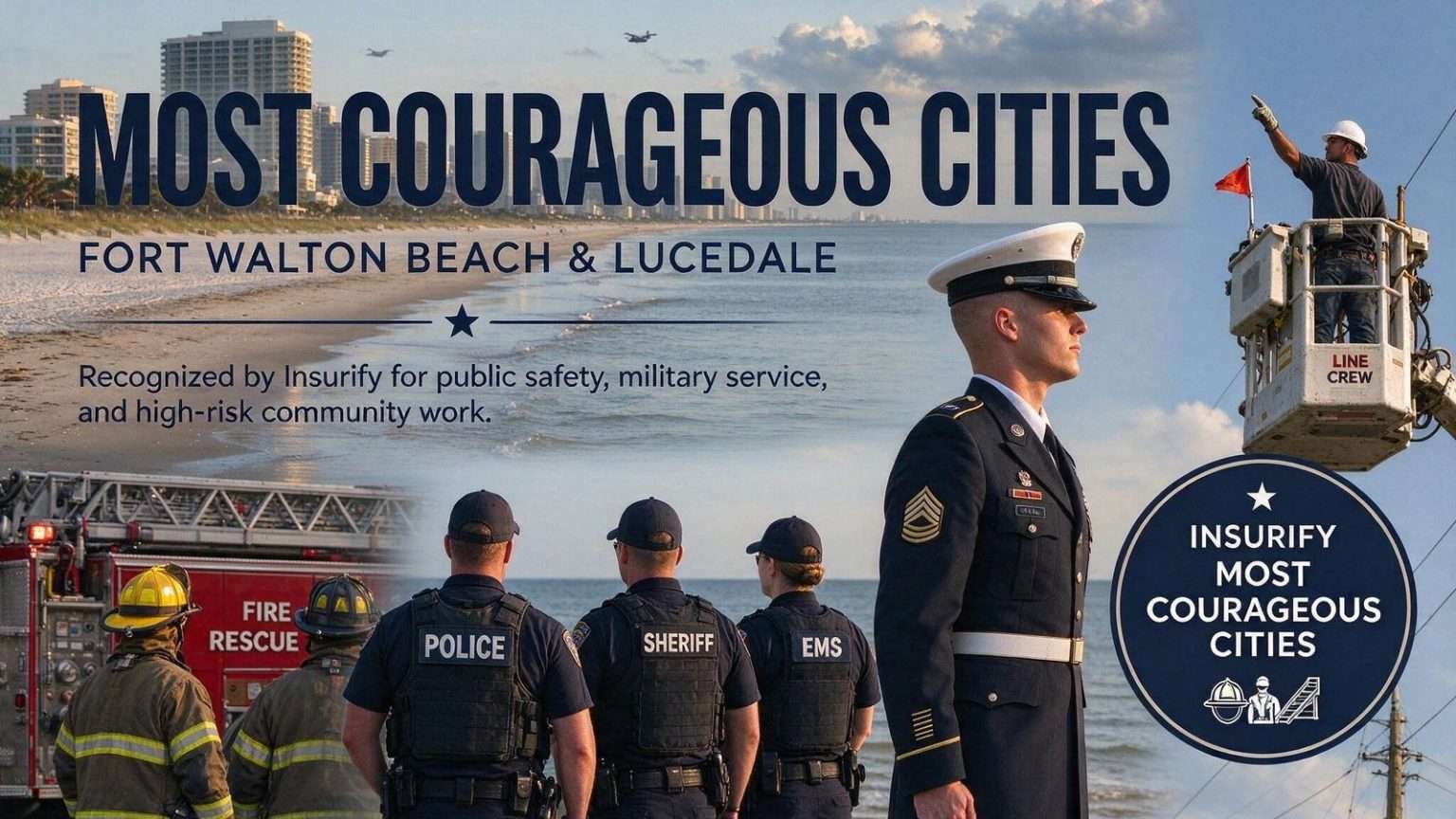
Two Gulf Coast communities have been recognized for a quality their residents rarely think of as remarkable: the sheer number of people who run toward danger for a living. The insurance comparison site Insurify has named Fort Walton Beach its Most Courageous City Award winner in Florida and Lucedale its winner in Mississippi, an honor built not on sentiment but on a per-capita count of who actually lives in these towns and what they do for work.
The rankings were based on a per-capita measure of residents working in public safety — firefighters, park rangers, law enforcement officers and emergency medical technicians — as well as high-risk jobs with a large benefit to society, such as electrical power line installers and structural metalworkers, and current or past members of the Armed Forces. A city earns the distinction when that cluster of occupations makes up an outsized share of its working population.
For Fort Walton Beach and Lucedale, the awards are less a surprise than a confirmation. Both communities sit in a stretch of the Gulf Coast where military bases, first-response agencies and the skilled trades that keep infrastructure running are woven into daily life, and where the person next door is as likely to be a firefighter or an airman as anything else. The honors spotlight the concentration of service-minded residents along the Florida Panhandle and the Mississippi Gulf Coast, where military and first-responder communities are a major part of local life.
How the rankings work
Insurify’s Most Courageous City Award rests on occupational data rather than anecdotes or reputation. The site aggregates employment information and calculates the share of each city’s residents who work in occupations the rankings treat as courageous — a deliberately broad category that spans three clusters of work.
The first cluster is public safety: the firefighters who staff the stations, the law enforcement officers on patrol, the EMTs and paramedics on ambulances, and the park rangers who protect public lands. The second is the high-risk civilian trades that society depends on but rarely notices — the electrical power line installers who climb towers and bucket trucks to keep electricity flowing through storms, and the structural metalworkers who build and maintain the steel skeletons of buildings and bridges at height and in all weather.
The third is military service, counted as current or past members of the Armed Forces. Including veterans alongside active-duty personnel is what tilts rankings like this toward Gulf Coast communities, where decades of basing decisions have seeded the population with people who served and stayed. A retiree who spent twenty years in uniform counts the same as a serving airman on active duty, and towns near major installations accumulate that population over generations.
Because the measure is per capita, small cities have an inherent advantage. A town of a few thousand people with one fire station and a National Guard armory can post a higher courageous-occupation share than a large city with dozens of stations, simply because the denominator is small. That arithmetic favors places like Lucedale — and it means the award says something real about the texture of a community, not just its size.
Fort Walton Beach: a city built around the base
Fort Walton Beach, on the Panhandle between Pensacola and Destin, is in many ways the archetypal military town. The city sits adjacent to Eglin Air Force Base, one of the largest military installations in the world by land area, and Hurlburt Field, home of Air Force Special Operations Command, lies just to its west. The defense presence is not merely adjacent to Fort Walton Beach’s economy — it is the economy, driving employment, contracting, health care and the service businesses that follow a military population. Veterans settle in the city after their service ends, drawn by the medical system, the familiar community and the Panhandle’s way of life.
The city’s fire and police departments, its emergency medical services and its veteran population all feed directly into the occupational categories Insurify measured. Public safety employment per capita in a base town runs high for structural reasons: installations bring their own fire and security forces, and the surrounding civilian agencies scale to serve the resulting population density. The result is a community where courageous occupations are not a niche but a leading employer category.
Lucedale: small town, outsized service
Lucedale, the seat of George County in southeastern Mississippi, is a town of roughly 3,000 people positioned between Mobile and Hattiesburg along U.S. Highway 98. Its economy is anchored by timber, small manufacturing and the service businesses that support a rural county — and, per Insurify’s math, by an unusually high concentration of residents in courageous occupations.
Small rural towns across the South depend on volunteer and career first responders in ways that suburban residents rarely contemplate. In a town like Lucedale, the volunteer fire roster, the county’s EMS crews, the police department and the local National Guard presence together draw on a working population that is small to begin with. One plant closure or military retirement wave can swing the percentages dramatically. The same smallness that makes the statistics possible makes the service personal: the EMT who answers a 911 call in George County is likely to be a neighbor, a relative or a classmate.
Veterans make up another deep vein. Mississippi consistently ranks among the states with the highest veteran population shares in the country, and the communities along the Gulf Coast — shaped by Keesler Air Force Base in Biloxi, the former Naval Construction Battalion Center in Gulfport and Camp Shelby near Hattiesburg — hold generations of former service members who settled inland in towns like Lucedale after leaving active duty.
What the awards mean locally
Behind the statistics are the ordinary mechanics of Gulf Coast life. Fire departments in both states run continuous recruiting cycles, ambulance services staff around the clock, and utility crews from the Panhandle and south Mississippi are routinely sent out of state when hurricanes knock out power elsewhere in the Southeast. The occupations Insurify counted are the same ones that fill mutual-aid convoys heading toward the next disaster, and communities that produce them disproportionately are, in effect, exporting courage every hurricane season.
Awards of this kind carry no prize money and change no budgets, but they matter to the towns that receive them. Civic leaders in communities like Fort Walton Beach and Lucedale spend real effort recruiting and retaining police officers, firefighters, EMTs and line workers in an era when all of those professions report chronic hiring shortfalls. External recognition that a community has become a home for people in these fields is a recruiting tool — it tells a firefighter considering a move that he or she would be moving among peers.
The timing of the recognition also gives both cities a moment of self-description. Fort Walton Beach markets itself to tourists as a beach destination, but the Insurify ranking describes the city that lives there year-round — the airmen, the retirees, the deputies and the line crews. Lucedale rarely appears in national lists of any kind, and for a county seat of 3,000 to top a state ranking is the kind of notice that civic clubs print in their newsletters and schools post on their marquees.
There is also a quieter reading. Per-capita occupational data of this kind reflects choices people made about where to live after choosing what to do. Someone who has spent a career in law enforcement or the military tends to settle where the culture fits, and rankings like Insurify’s map that self-selection across the country. The Gulf Coast’s showing — two winners in adjacent states — reflects a regional identity in which service is not an abstraction but a common resume line.
The recognition also lands in a practical context for both cities. Fort Walton Beach’s fire department and police department serve a city that swells with tourists each summer, stretching first-response capacity; Lucedale’s volunteer-dependent services cover a rural county where response times are measured in the distance between homes. In both places, the people the award honors are the same people residents call first when something goes wrong.
The Gulf Coast’s service tradition
The Panhandle and south Mississippi share a military and first-responder tradition that runs back more than a century — from the naval stations of Pensacola to the airfields built across the region during World War II to the shipyards and bases of the Mississippi Gulf Coast. Each generation of installations left behind veterans who stayed, founded families and filled the fire houses and sheriff’s offices of the towns around them.
Insurify’s awards are a statistical echo of that history. Fort Walton Beach and Lucedale did not set out to be the most courageous cities in their states; they simply ended up, through basing decisions, geography and economics, as places where the people who do dangerous work for others chose to live. The award is the numbers noticing what residents have always known about their own neighbors — and, on the Gulf Coast, that is a story worth celebrating.