Four Friends Keep 15-Year Cane Syrup Tradition Alive Ahead of Frost
Four friends ground sugar cane with a vintage mill and boiled the juice for hours on Nov. 12, continuing a syrup-making tradition they have kept for 15 years.
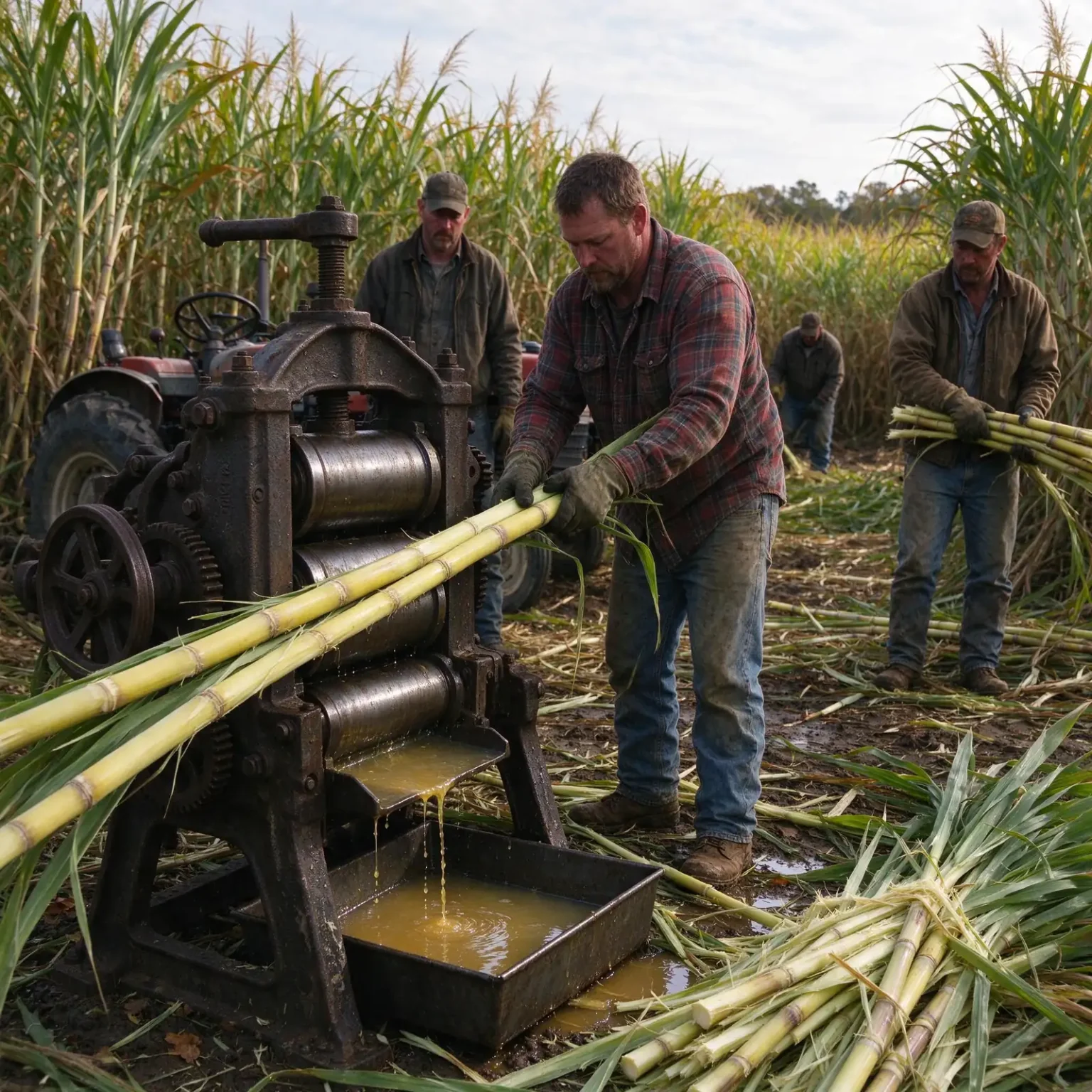
Long before the first bottle of syrup is poured over a hot biscuit, there is a field of tall cane, an old iron mill and a long day of work. For four friends, that day came on Thursday, Nov. 12, when they gathered once again to make homemade cane syrup the old-fashioned way, carrying on a tradition they have kept alive for 15 years.
The group makes its homemade cane syrup only once each year, usually close to Thanksgiving. This fall, with frost showing up in the forecast, they decided not to wait and moved their annual session up to beat the cold weather.
Why one man set out to learn homemade cane syrup making
The tradition began with curiosity. One of the men said he took up syrup making because he simply wanted to understand how it was done and to help keep an old skill from fading away. He noted that many people today have never seen syrup made and have little idea of the work that goes into it.
He also pointed to one of the biggest changes from the way earlier generations handled the job. In years past, a mule walking in a circle supplied the power to turn the mill. Today, the group uses a tractor for that task.
A craft rooted in rural Southern life
Cane syrup making was once a familiar autumn event across the rural Deep South, from south Georgia and north Florida through south Alabama and into Louisiana. Many farm families grew a small patch of ribbon cane or other syrup cane varieties, and when the stalks matured in the fall, neighbors would come together to grind the cane and cook the juice. The finished syrup was a staple sweetener on the table through the winter months and beyond.
As commercial sugar and store-bought syrups became cheap and widely available, fewer families kept up the practice. Today, syrup making survives largely through small groups, heritage festivals and families who see value in passing the knowledge along. The four men’s yearly gathering fits squarely within that tradition.
From stalk to juice
The work starts in the field, where the sugar cane is cut and gathered. The stalks are then carried to an old steel cane mill, a vintage machine built with heavy rollers that squeeze the juice from the cane as the stalks are fed between them.
Each man had a job this year. One drove the tractor in a steady circle to turn the mill. A second fed stalks of cane into the rollers, while a third cut and readied the remaining cane so the mill never sat idle. Once the rollers had pressed a stalk dry, the crushed fiber was tossed aside.
That leftover pulp is known as bagasse. On large commercial sugar operations, bagasse is often burned as fuel or used in other products, but on a small scale like this, it is typically discarded or composted once the juice has been pressed out.
A lot of juice for a little syrup
Even with a tractor doing the heavy turning, making cane syrup with an old mill takes time and patience. The biggest reason is volume. It takes roughly 80 gallons of raw cane juice to produce only about eight to 10 gallons of finished syrup, meaning most of what comes out of the mill eventually leaves the kettle as steam.
That ratio helps explain why homemade cane syrup has always been treasured. A full day of cutting, grinding and cooking may yield only a modest number of jars, each one representing hours of labor.
The long boil
After all the cane has been ground and the juice collected, the next stage is cooking. The juice is boiled over steady heat for around four hours. As the water evaporates, the juice gradually darkens and thickens until it reaches the consistency of syrup.
Traditional syrup makers in the South have long cooked their juice in large, shallow pans or kettles over a wood fire, and they commonly skim away the foam that rises to the surface during the boil to produce a cleaner, clearer syrup. Judging when the syrup is finished has historically been as much an art as a science, relying on the color, the thickness and the way the syrup drips from a paddle, although some modern cooks also use thermometers or hydrometers to check for doneness.
The result is old-fashioned homemade cane syrup. Syrup cooked this way typically has a deep amber color and a rich, slightly caramel flavor that many Southerners remember from their grandparents’ kitchens.
A team effort
Syrup making has always been a job for more than one person. Someone has to keep the mill turning, someone has to keep it fed, someone has to keep fresh cane ready, and eventually someone has to tend the fire and watch the kettle. Dividing those tasks among four people allows the work to move steadily from the field to the finished product in a single long day, much as it did when neighbors once pooled their labor at harvest time.
Why frost matters
The decision to start early this year was not just about convenience. Sugar cane is a tropical grass, and it is sensitive to freezing temperatures. A hard freeze can damage the stalks, and once cane has been frozen, the quality of its juice can decline as the plant tissue breaks down. For that reason, growers who make syrup in the Deep South generally try to harvest and grind their cane in late fall, before the coldest weather settles in.
With frost in the outlook for mid-November, getting the cane through the mill ahead of the cold gave the group the best chance at a good batch.
Cane syrup, molasses and sorghum: What is the difference?
People who did not grow up around syrup making sometimes use the terms cane syrup, molasses and sorghum interchangeably, but they are distinct products.
- Cane syrup is made by boiling down the whole juice pressed from sugar cane, with nothing removed. It is what the four friends produce each year.
- Molasses is generally a byproduct of sugar production. After sugar crystals are extracted from boiled cane juice, the dark liquid left behind is sold as molasses, which tends to be stronger and less sweet than cane syrup.
- Sorghum syrup, often simply called sorghum, comes from the juice of the sweet sorghum plant rather than sugar cane. It is made in a similar way and was historically more common in areas farther north where sugar cane does not grow as well.
Keeping the knowledge alive
For the men behind this yearly ritual, the effort is about more than a few jars of syrup. The day brings friends together, keeps an aging cane mill turning and preserves practical know-how that was once common in nearly every rural community in the region.
Many skills of that kind are learned only by doing them alongside someone who already knows how: how to feed cane into the rollers without jamming the mill, how to keep a fire at the right heat for hours, and how to tell by sight when syrup is ready. Groups like this one keep those lessons in circulation simply by showing up each fall and doing the work.
Ways to experience syrup making
Residents who are curious about the process can often find chances to see it firsthand. Across the Southeast, heritage days, farm museums and fall festivals sometimes feature cane grinding and syrup cooking demonstrations, typically scheduled in October and November when the cane is ready. Local historical societies and county extension offices may also be able to point interested residents toward demonstrations or longtime syrup makers in their area.
For anyone lucky enough to come across a jar of homemade cane syrup, those who make it often recommend enjoying it in the most traditional way of all: poured over warm biscuits or pancakes, or stirred into recipes such as pecan pie and baked sweet potatoes.
A tradition that marks the season
After 15 years, the annual syrup day has become a fixture on the calendar for the four friends, one that signals the arrival of the holidays as surely as the first cold snap. By starting two weeks ahead of Thanksgiving this year, the group got its cane through the mill before the frost arrived and kept the tradition going for another season.