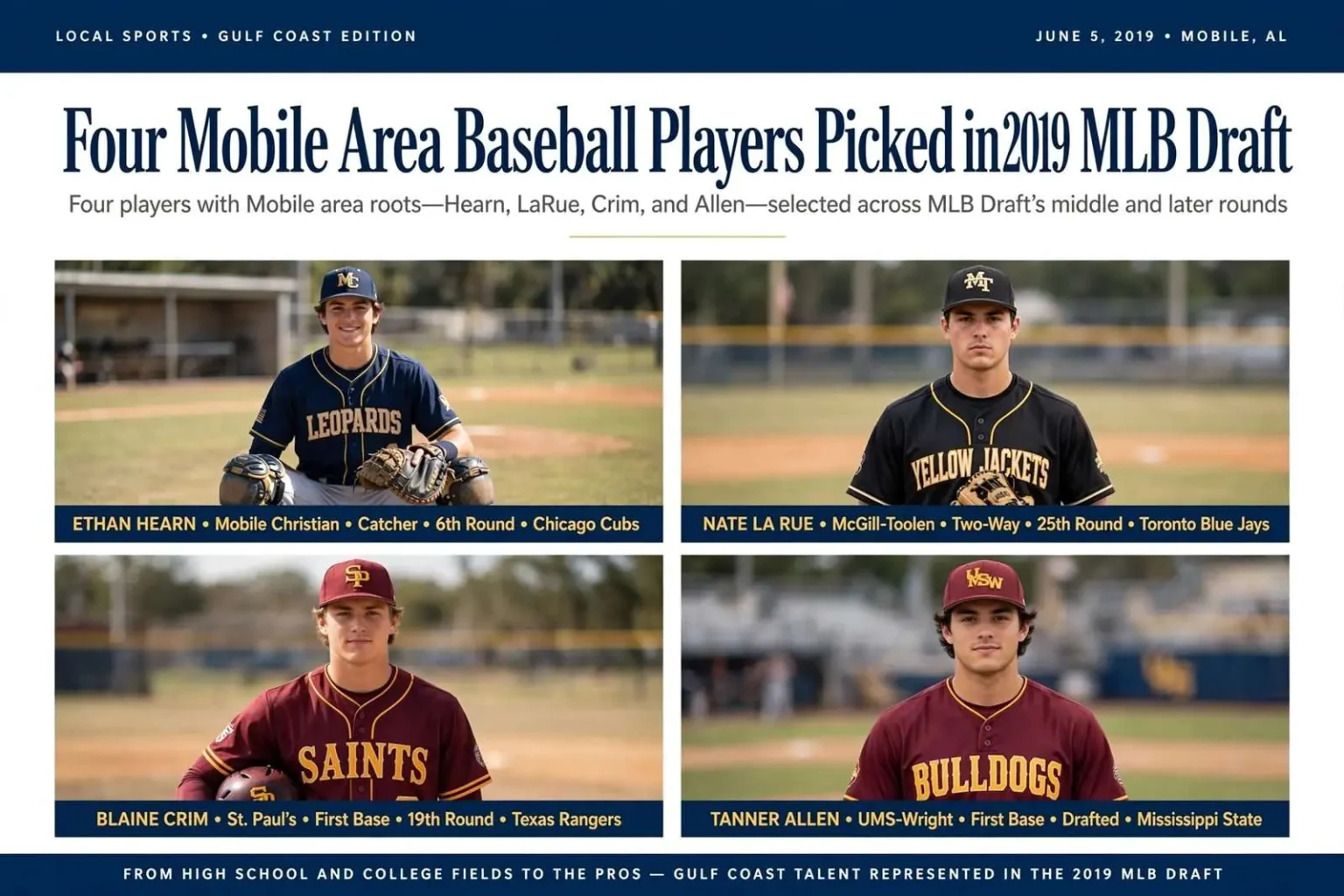
Four players with Mobile area roots heard their names called during the 2019 Major League Baseball Draft, which wrapped up Wednesday after three days of selections. The group spans current high school prospects and college standouts who came up through area programs, and it stretched across five rounds of the draft’s middle and later stages.
Prep Prospects Off the Board
Mobile Christian catcher Ethan Hearn was the highest area selection, taken in the sixth round. Hearn had committed to Mississippi State but is expected to sign with the Chicago Cubs instead, a decision that would send the young catcher straight into professional baseball rather than through the SEC program that had recruited him.
Draft-day choices like Hearn’s are the ones that shape a prospect’s future most. A sixth-round selection carries a signing bonus that makes professional ball immediately practical, and catchers — the game’s scarcest position — often draw strong offers because organizations need them at every level. Choosing between a college commitment and a pro contract is a calculation every drafted high schooler makes with family, advisers and the club’s scouts, and Hearn’s case pointed toward the Cubs’ offer winning out.
McGill-Toolen’s Nate LaRue went in the 25th round to the Toronto Blue Jays. LaRue, an Auburn commitment, is a two-way player who can both pitch and handle a position in the field, and that versatility is precisely what makes two-way high schoolers attractive picks — clubs can draft the arm they like best and keep the flexibility to develop the bat.
LaRue’s selection continued McGill-Toolen’s long record of producing professional prospects, a pipeline that has run through the Catholic school’s baseball program for decades and made the Yellow Jackets a fixture on area scouting radars each spring.
College Standouts With Area Ties
Blaine Crim, a first baseman who prepped at St. Paul’s, was selected by the Texas Rangers in the 19th round. Crim was named Gulf South Conference Player of the Year at Mississippi College, competing at the Division II level.
Crim’s path illustrates the road less traveled. Division II products have to make the most of every look they get, and a conference player-of-the-year season is exactly the kind of line that moves a player onto draft boards. First basemen are judged almost entirely on bats, and a .300-plus collegiate hitter with power potential earns a professional chance regardless of division.
Tanner Allen, a Theodore native who played high school ball at UMS-Wright, was also picked. The first baseman hit .350 as a sophomore at Mississippi State this season, anchoring a Bulldogs lineup that spent the spring among the Southeastern Conference’s most competitive programs.
Allen’s selection came from a different position in the draft calculus — a college sophomore with a proven SEC bat, drafted while still eligible to return to Starkville. Clubs that take players in that situation are buying a known quantity against a player’s remaining college leverage, and Allen’s .350 season made the case that his bat deserved a professional look now.
Pitcher Chad Bryant of Thomasville rounded out the group with area ties. Bryant just finished his second year of junior college baseball at Pensacola State and had committed to the University of Alabama before the Atlanta Braves selected him in the 25th round.
The junior college route has long been a proving ground for players whose high school recruitment fell short of expectations. Two seasons of Division I-caliber competition at Pensacola State gave Bryant the innings and the development time to re-enter the draft conversation, and the Braves’ selection put the choice back in his hands — sign with an organization whose player development system has produced major-league arms year after year, or enroll in Tuscaloosa and try to raise his stock further.
Northwest Florida Selections
Several players from the neighboring Northwest Florida area were also drafted. Pace right-hander Brandon Sproat went in the seventh round to Texas, and Tate outfielder Trey LaFleur was taken in the 21st round by the Los Angeles Dodgers. Tate alum Branden Fryman, who played collegiately at Samford, was selected in the 21st round by the New York Mets. Fryman is the son of former major leaguer Travis Fryman.
Sproat’s seventh-round slot made him the highest selection from the Pensacola area, a reflection of the velocity and frame that scouts value in high school right-handers. Pace has become one of the Panhandle’s most consistent producers of drafted talent, feeding the pipeline that runs from Pensacola’s summer leagues to professional organizations across the country.
Fryman’s selection added a family chapter to the draft. His father, Travis Fryman, spent more than a decade at shortstop and third base in the majors with Detroit and Cleveland, and the younger Fryman carved his own path through Samford’s program before the Mets called his name. Second-generation prospects carry expectations their fathers know better than anyone — and, in the best cases, the guidance that only a former big-leaguer can provide.
What the Draft Means for the Area
The 2019 draft reinforced what area baseball followers already know: the Gulf Coast’s stretch of the recruiting map — from Mobile County high schools through Baldwin County, Pensacola and the Panhandle — produces professional talent as reliably as regions many times its size. The annual showcase season, summer travel ball and a competitive high school landscape give scouts a long runway to watch local players against strong competition.
The draft’s three-day format, which condensed the modern event’s rounds into an early-June window, spread the area’s names across the middle and late rounds. Sixth round or twenty-fifth, every selection represents the same starting point: a roster spot in a rookie-level clubhouse, a jersey with a professional team’s name and the smallest possible odds of reaching the majors, odds that every draftee accepts knowingly.
Paths From the Gulf Coast to the Pros
The variety of routes in this year’s group is worth noting because it mirrors the many roads the sport offers. Hearn and LaRue came straight from Mobile County high school diamonds; Crim climbed through Division II at Mississippi College; Allen proved himself in the SEC at Mississippi State; Bryant rebuilt his stock at Pensacola State. Scouts draft production and projection from wherever it appears, and the Gulf Coast’s players reached the draft board by four different roads.
The decisions that follow draft weekend determine which paths continue. High school draftees with college commitments weigh signing bonuses against three years of development and exposure at programs like Mississippi State and Auburn; college sophomores weigh a professional paycheck against two more seasons of SEC competition; junior college players weigh the certainty of signing against a transfer that could improve their standing a year later. Each club negotiates accordingly, and the area’s four selections will spend the days after the draft making those calls with their families.
For Mobile Christian, McGill-Toolen, St. Paul’s, UMS-Wright and the other programs named over draft weekend, selections serve as both validation and recruiting material. Every player who reaches professional baseball becomes an example shown to the next roster — evidence that the path from a Gulf Coast high school field to an affiliated clubhouse is real and recently traveled.
Names to Follow
Fans who want to follow the group will find them spread across the low minors once assignments are announced. Rookie-level rosters in the Arizona and Gulf Coast leagues and short-season clubs typically carry the summer’s draftees, with statistics posted in box scores most local followers now track online. Catchers develop slowly; pitchers move by innings limits; hitters rise on performance. The timeline from sixth round to the majors usually runs years, and most careers end somewhere in between — but every one of the area’s selections begins with the same phone call heard this week.
The 2019 draft also set up storylines for next spring: a LaRue decision that determines whether the two-way McGill-Toolen star reaches Auburn or signs with Toronto, and a Mississippi State roster that either returns Tanner Allen’s bat or turns it over to the organization that drafted him. Gulf Coast baseball follows its own to every level, and this year’s draft class gave the region a fresh set of names to track from the Gulf Coast to wherever the game takes them.
The 2019 event also carried the weight of the draft’s own recent history. Major League Baseball’s shortened format — with rounds compressed into three days of coverage rather than the weeklong marathons of earlier eras — means fewer picks, faster calls and a narrower window in which names are read. For a region like the central Gulf Coast, that makes every selection announced even more meaningful, since the clubs have fewer slots to spend and spend them on the players they believe most strongly in.
What never changes is the spring that precedes the draft. The area’s players spent the year in playoff runs and all-star games, in showcases where scouts lined the backstop fences with radar guns and notebooks, and in the slow accumulation of at-bats and innings that a draft board is built from. When the selections came this week, they confirmed what the spring had suggested — that the Gulf Coast’s talent pipeline remains as productive as ever, from Mobile Christian’s backstop to Pace’s power arm.