Free Carpentry Course Opens to North Baldwin Adults in Bay Minette
A free eight-week residential carpentry course for adults 18 and up runs Sept. 25 to Nov. 20 at the North Baldwin Center for Technology in Bay Minette.
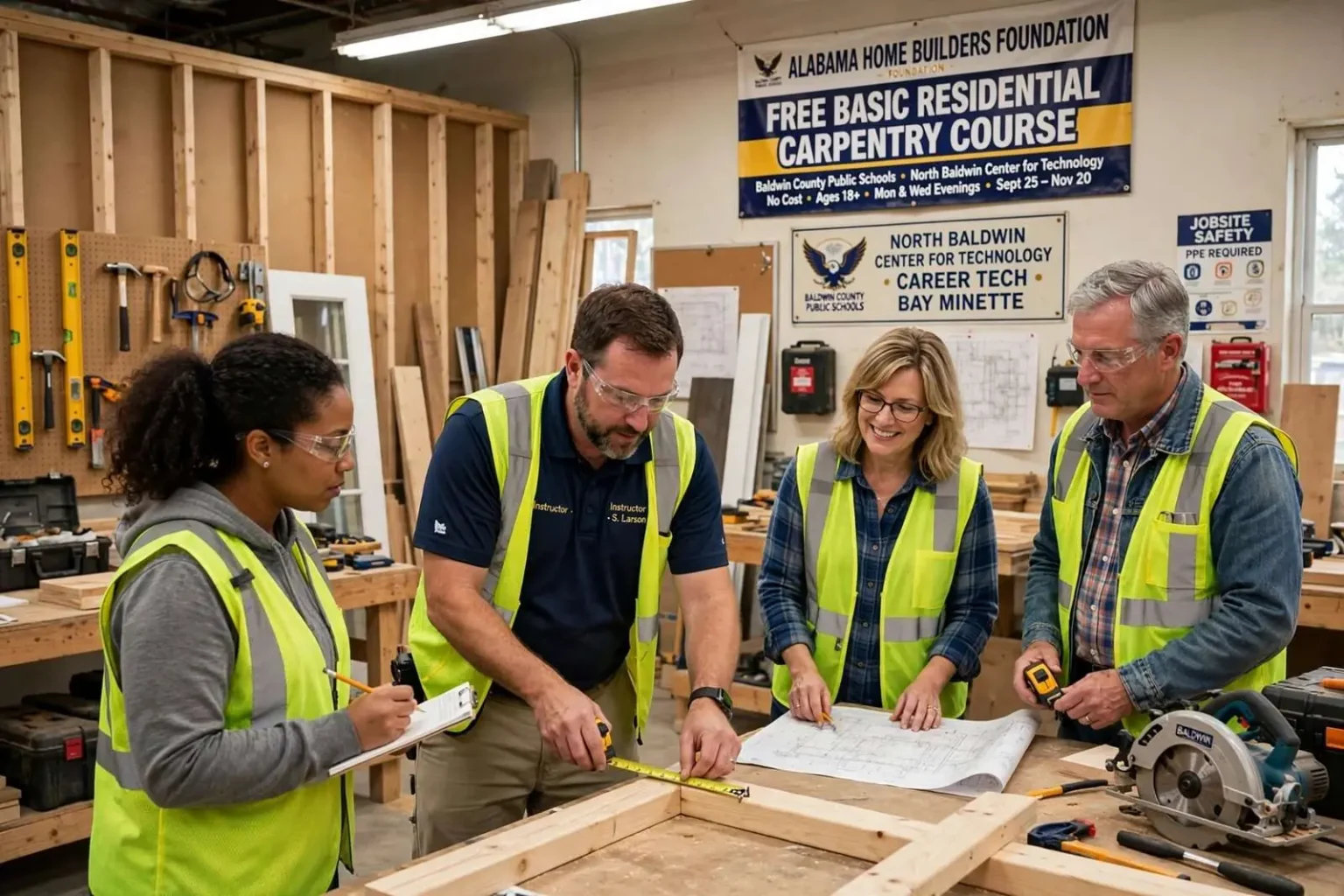
Adults in north Baldwin County who want to learn a building trade can do it this fall without paying tuition. The Alabama Home Builders Foundation has teamed up with Baldwin County Public Schools to run a free basic residential carpentry course for anyone 18 and older — a no-cost on-ramp into one of the region’s most consistently in-demand occupations.
Classes meet on Monday and Wednesday evenings from Sept. 25 through Nov. 20 at the North Baldwin Center for Technology, located at 505 Dr. Martin Luther King Jr. Blvd. in Bay Minette. Scott Larson is teaching the sessions. The eight-week format is built around evening hours so participants can keep daytime jobs while they train, and no prior construction experience is required to enroll.
The partnership pairs a school system’s career-tech campus with an industry foundation that has a stake in the outcome. Baldwin County Public Schools’ technology centers exist to connect students and adult learners to real workforce skills, and the Home Builders Foundation exists to solve a problem its member builders face every day: not enough trained hands to frame, trim and finish the houses the state’s fastest-growing county keeps buying.
What the course covers
The curriculum walks students through the fundamentals a working carpenter uses on a residential job site. According to the foundation, that includes jobsite safety instruction, construction layout, reading blueprints, wall and floor framing, window and door installation, and siding and exterior trim work.
That list amounts to the core of residential carpentry. Jobsite safety comes first for a reason — construction sites are where new workers learn habits that protect them for a career, and employers screen for candidates who take safety seriously from day one. Blueprint reading and construction layout translate paper plans into accurate work on the ground, the skill that separates a helper from a carpenter. Framing is the structural heart of house-building, and window, door and trim installation is the finish work buyers see first.
Students who finish the program receive a certificate of completion issued by the Home Builders Association of Alabama, a credential the group says helps graduates when they approach builders looking for entry-level help. In an industry where most workers are hired on demonstrated skill rather than degrees, a certificate backed by the state’s home builders association tells a contractor two things: the graduate has been taught the fundamentals, and someone in the industry vouches for the training.
Foundation President Peggy Turner said the classes serve both job seekers and an industry that has struggled to fill skilled positions. “The value of the carpentry classes that the Alabama Home Builders Foundation offers is vital to our industry and to those seeking jobs in the home building field,” Turner said. “These classes provide an extremely useful skill at no charge.”
Turner said she has watched students of widely different ages and experience levels move from the classroom into steady work. “When I have observed these classes and see students that pick up a tape measure for the first time and in eight weeks they have helped frame a small house, I am impressed,” she said. “If you have any interest in the home building field this class is a great pathway to your first job.”
Her description of the classroom — students handling a tape measure for the first time in week one and helping frame a small house by week eight — captures the speed at which hands-on trade instruction works. Eight weeks of evening classes cannot make anyone a master carpenter, but it can make a person useful on a job site, and useful is where every building career starts.
A pipeline into the building trades
The course exists against a backdrop the construction industry has complained about for a decade: a shortage of skilled trades workers across Alabama and the Gulf Coast. Builders in Baldwin County — one of the fastest-growing counties in the state, where rooftops have multiplied along the Interstate 10 corridor for years — have consistently reported difficulty finding framers, trim carpenters and dependable entry-level crews. Each retirement and each worker lured to another field deepens the gap between the houses being planned and the crews available to build them.
Programs like this one attack the shortage at the entry point. The barriers to enrollment are deliberately low — no tuition, no experience required, evening hours compatible with full-time work — and the exit point is a credential plus practical skills a builder can put on a payroll immediately. For career changers, the free format removes the financial risk that stops many adults from retraining; for young workers who never connected with a four-year college path, it offers a route to a well-paid occupation without student debt.
The choice of Bay Minette as the course site matters for access. The North Baldwin Center for Technology sits at the center of the county’s northern half, within commuting distance of Bay Minette, Stockton, Perdido, Whitehouse Forks and the communities along U.S. 31 — an area where residents otherwise face a long drive to career-training options clustered in the county’s southern population centers. Evening classes twice a week keep the commitment manageable for students who work in Bay Minette’s mills, plants and shops by day.
The center itself is built for this kind of instruction. As a career-technology campus in the Baldwin County Public Schools system, it houses the workshop space, tools and materials that a hands-on carpentry course requires — resources that would be costly for a foundation to assemble on its own. The school system gains course offerings and activity for its campus; the foundation gains a teaching facility; and students gain both.
Carpentry also sits at the front door of a wider construction career. Carpenters who master framing and finish work move naturally into supervision, estimating, contracting and home building on their own account — and the earnings ladder in the trades rises steeply for those who do. A free eight-week course does not promise any of those destinations, but it supplies the first rung, and the foundation’s message is that the rung is worth grabbing.
How to apply
Applications and program details are available through the Alabama Home Builders Foundation. Prospective students can also reach program coordinator Kory Boling by phone at 1-800-745-4222 to ask about enrollment and remaining seats.
Organizers encourage early applications. Hands-on trade courses enroll a limited number of students per session — workshop space and instructor attention set the cap — and free courses with a credential attached tend to fill before the first class meets. Adults who miss the fall session can ask about future offerings, since the foundation has run these classes as a recurring program across the state.
Applicants need nothing but eligibility: participants must be 18 or older, and no prior construction experience is required. Tools and course materials are handled by the program, so a student’s only investment is ten evenings across eight weeks and the willingness to learn a trade from the ground up.
For the foundation, the classes are an investment in the industry’s future workforce, and Turner’s comments frame the return in both directions: builders get trained recruits, and students get “an extremely useful skill at no charge.” Few workforce programs compress that exchange so efficiently — the industry pays, the student learns, and the certificate at the end carries the weight of the state’s home builders behind it.
Why carpentry, and why now
Carpentry is among the most portable skills in the construction economy. Framers, finish carpenters and trim crews are needed wherever houses are built, and Baldwin County’s growth has kept that demand local and steady. Workers who complete a fundamentals course like this one can move between builders, subcontractors and job types without restarting their training — a flexibility that classroom-bound careers rarely offer.
The timing also lines up with the school year. A Sept. 25 start lets the course run through the heart of the fall, finishing Nov. 20 before the holiday season disrupts work schedules and before the winter building season, when contractors take on crews for the next year’s construction push. Graduates finishing in November step into the hiring window when builders are lining up labor for the spring.
For north Baldwin adults weighing the decision, the practical questions are few. The course is free. It runs on evenings that leave weekdays open. It requires no experience and provides the training, tools and materials. It ends with a certificate from the Home Builders Association of Alabama and, for those who take to the work, a direct line into an industry actively looking to hire. Turner’s advice to anyone curious about the building field is unambiguous: “If you have any interest in the home building field this class is a great pathway to your first job.”
Enrollment information is available through the Alabama Home Builders Foundation, and coordinator Kory Boling can answer questions at 1-800-745-4222. The first class meets Sept. 25 at the North Baldwin Center for Technology in Bay Minette — the date, for a new crop of carpenters, when the tape measure comes out for the first time.