
Free History Walking Tours Return to Downtown Mobile Every Saturday in April
Free walking tours of downtown Mobile depart each Saturday in April at 10 a.m. No reservations needed for the Alabama Tourism series.
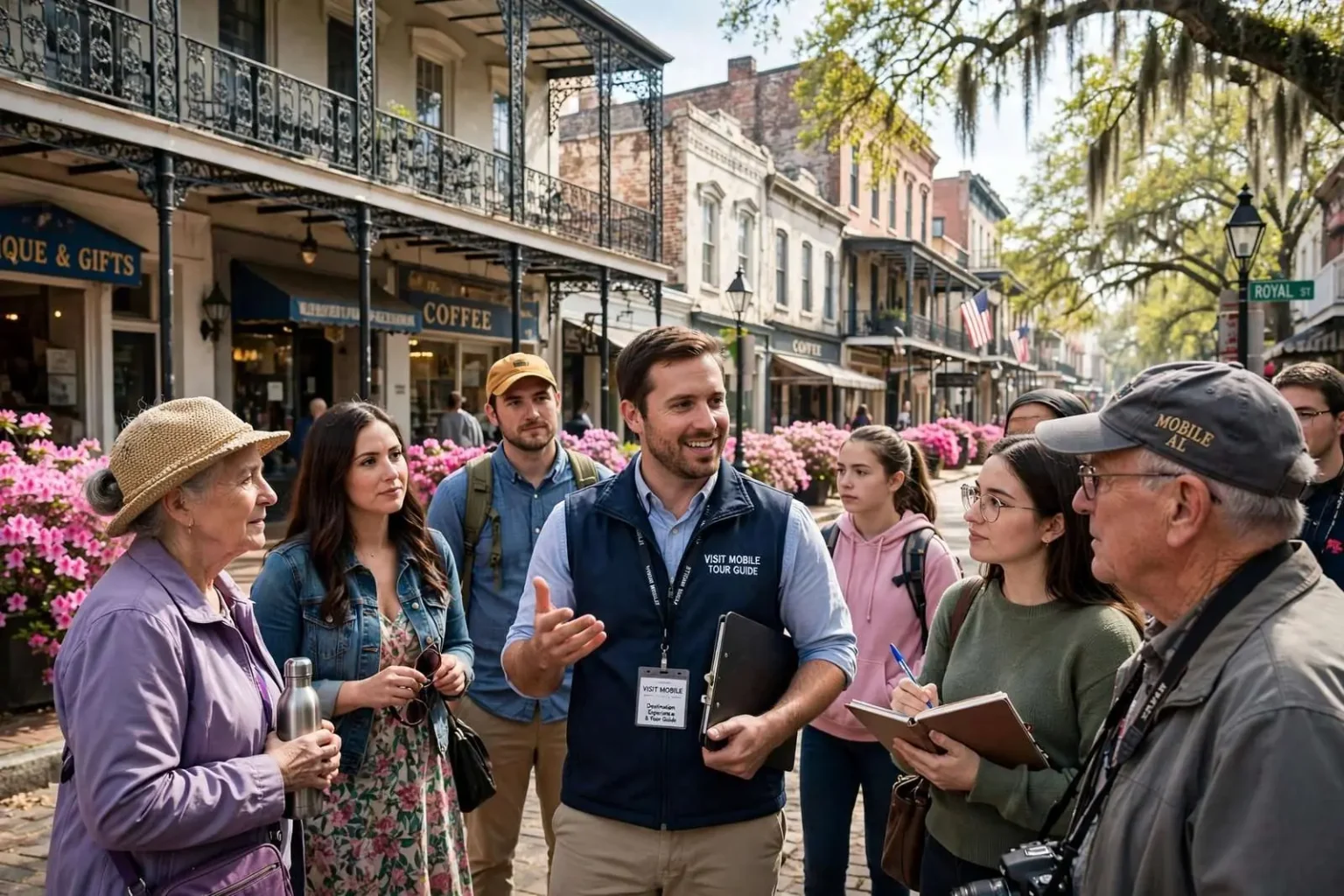
Mobile residents and visitors can explore the city’s deep history on foot this spring, with free walking tours departing every Saturday in April. Tours leave at 10 a.m. and wrap up around 11 a.m., with no reservations required — an easy hour-long commitment that organizers hope will turn casual curiosity into a deeper connection with the city’s past.
The annual series is organized by the Alabama Tourism Department to showcase the state’s diverse history during one of the most pleasant seasons to be outdoors. April in Mobile brings azaleas in bloom, mild temperatures, and some of the best walking weather the Gulf Coast offers all year, which is why the tourism department schedules the statewide program for that month.
“The April Walking Tours are a great opportunity for locals to become tourists in their own city,” said Michael Dorie, destination experience and tour manager for Visit Mobile. “They’re also great for tourists to learn some of the lesser-told stories of Mobile.” Dorie added that a Saturday morning stroll through downtown is a strong way to start the weekend. Full details on each tour are available at Mobile.org.
A Program Built for Locals First
The April Walking Tours have been a fixture of Alabama’s tourism calendar for years, with communities across the state hosting their own versions each Saturday of the month. The concept is deliberately simple: free, one-hour, guided walks that require no booking, no tickets, and no prior knowledge of local history. Participants simply show up at the designated starting point and join a guide who leads them through a handful of blocks, pointing out buildings, markers, and stories that most passersby walk straight past.
For Mobile, the format suits a downtown that packs three centuries of history into a walkable footprint. The city predates the United States itself — founded by the French in 1702 as the original capital of French Louisiana — and its streets carry layers of French, Spanish, British, and American influence. Few cities of its size can claim a heritage that deep, and the tours are designed to surface it in bite-sized form rather than as a museum marathon.
Tourism officials have long noted that the tours draw a distinctly local crowd. Visitors from out of town plan their own itineraries, but residents — including many who have lived in Mobile for decades — make up the backbone of attendance. Organizers say the appeal for locals is learning the stories behind the buildings they pass every day: why a street is named what it is named, who built a particular storefront, and what happened on a corner a century before anyone now living was born.
What a Walk Through Downtown Reveals
Downtown Mobile holds an unusual concentration of historic sites within a few blocks of each other. Fort Condé, a reconstruction of the original 18th-century French fort, anchors the historic district and offers a tangible link to the colonial era. Nearby, the Church Street East district contains some of the oldest surviving structures in Alabama, and government Street and Royal Street trace the city’s 19th-century commercial growth as a cotton port and shipping center on Mobile Bay.
The city’s role as the birthplace of America’s original Mardi Gras celebration is another recurring theme. Mobile’s Carnival traditions predate New Orleans’ by years, brought by French settlers and formalized in the 19th century through mystic societies whose halls and legacies still shape downtown. Walking tours typically weave that story into the streetscape, where the buildings that hosted early Carnival balls and parades still stand.
Then there are the lesser-told stories that Dorie referenced — the chapters of Mobile’s history that don’t always make the guidebooks. The city’s African American heritage runs through downtown in churches, schools, and commercial blocks tied to generations of Black enterprise and civil rights-era organizing. Its maritime and industrial history, from shipbuilding to the port that still drives the local economy, has left markers along the streets leading toward the river. A one-hour tour can only sample those threads, but organizers say the goal is to give walkers a map for further exploring on their own.
Why April, and Why Walking
The choice of April is no accident on either count. Weather across south Alabama turns mild and dry by mid-spring, and the azalea season that Mobile famously celebrates is at its peak, dressing historic neighborhoods in color. The Alabama Tourism Department has long structured its promotional calendar around the season, and the walking tours slot into a month that already draws visitors for spring festivals and outdoor events.
Walking, meanwhile, is the pace at which historic districts reward attention. Details invisible from a car — cast-iron detailing on a balcony, a date stone above a doorway, a marker tucked beside a sidewalk — become apparent at three miles an hour. Urban historians and preservation groups have made the same argument for decades: the scale of a 19th-century city like Mobile’s downtown was built for pedestrians, and it reads best that way.
The free admission removes the last barrier. Paid guided tours operate in Mobile year-round, and they serve visitors willing to budget for them, but the April program extends the experience to anyone — families with children, retirees, students, and visitors who stumbled into town for a weekend. No reservations means no commitment beyond showing up by 10 a.m., and the tours wrap around 11 a.m., leaving the rest of the Saturday open for lunch at an area restaurant or a stroll through Bienville Square.
Visit Mobile’s Role
Visit Mobile, the city’s tourism organization, coordinates the local tours as part of the statewide effort led by the Alabama Tourism Department. The agency promotes Mobile’s attractions — from the historic district to the USS Alabama Battleship Memorial Park across the bay — and positions events like the April tours as entry points for deeper engagement with the city. Michael Dorie’s role as destination experience and tour manager places him at the center of that work, shaping how guides present the city’s story to audiences who range from lifelong Mobilians to first-time visitors.
The statewide program that Mobile joins each April now covers communities large and small across Alabama, from county seats with a courthouse square’s worth of history to cities like Mobile with colonial-era districts. The tourism department launched the initiative to highlight what it calls the state’s diverse history, and participating towns tailor their tours to local stories — civil rights landmarks, industrial heritage, Native American sites, antebellum architecture, or, in Mobile’s case, a French colonial founding and three centuries of Gulf Coast life.
How to Join a Tour
Prospective walkers should check Mobile.org for the details of each week’s tour — starting location, route, and the theme of the guide’s route — since the lineup varies across the four Saturdays. Comfortable shoes, water, and an early arrival are the practical essentials; the tours proceed rain or shine in most cases, though severe spring weather can force adjustments. There is no charge and no sign-up form, so the only planning required is choosing which Saturday to attend.
For families, the hour-long format fits young attention spans, and guides are accustomed to mixed audiences that include children. For newer residents of the Mobile area, the tours offer a compressed orientation to the city’s identity — why the place looks the way it does and how its French, Spanish, British, and American chapters layered on top of one another. And for visitors passing through on the way to the beaches or the bay, a Saturday morning tour is a compact introduction that turns a stopover into a story worth retelling.
The spring series closes out with the final Saturday of the month, after which the free program goes dormant until the next April. Those who miss the window can still explore downtown on their own — the historic markers, Fort Condé, and the museums of the historic district remain open year-round — but organizers say nothing replaces a guide who can stand on a corner and bring three centuries of Mobile history to life in an hour.
The Stories Guides Love to Tell
Every city’s walking tour lives or dies by its stories, and Mobile’s stock is deep. Guides working the April circuit can stand in front of a single block and cover the Spanish governor who once governed from a site nearby, the Yellow Fever epidemics that shaped the city’s early public health institutions, the fires that destroyed entire districts and dictated which buildings survived, and the hurricanes that tested the city’s resolve across generations. Each layer adds to the narrative that Mobile is not simply an old city but a layered one.
The city’s colonial rotations are a favorite subject. Founded by the French, governed by the British after 1763, claimed by the Spanish, and finally American after 1813, Mobile changed hands among European powers more times than nearly any other American city. That history shows up in street names, architectural details, and even in food traditions that guides point out as walkers move through downtown.
Preservation itself is part of the story. Much of what makes downtown Mobile attractive to walkers is the result of decades of preservation work that saved 19th-century commercial blocks from demolition and restored ironwork balconies, facades, and storefronts to their original character. Guides often note which buildings are original, which are restorations, and which were lost — a candid accounting that gives walkers a realistic sense of the city they are standing in rather than a postcard version of it.
What the Tours Mean for the Local Economy
Free tours might seem like a modest economic lever, but tourism officials treat them as a proven draw. Participants who come downtown for a Saturday morning walk frequently stay to eat, shop, or visit attractions, turning a no-cost event into spending at downtown businesses. Restaurants near the tour routes do brisk late-morning business on tour Saturdays, and local retailers benefit from foot traffic that a routine Saturday would not otherwise bring.
The tours also serve the city’s broader effort to position downtown as a destination in its own right rather than a place people simply pass through on the way to the coast. Hotels in the downtown core fill with weekend visitors, and the walking tours give those guests an organized activity within walking distance of their rooms. The April program thus fits into a larger strategy of using Mobile’s history as an economic asset — one that costs little to maintain and compounds in value as more people experience it.
For the Alabama Tourism Department, the statewide April program doubles as a marketing engine for small-town Alabama, and Mobile anchors the far south end of that effort. Out-of-state travelers who discover the tours while visiting Mobile often carry the idea home and seek out tours in other Alabama towns on future trips, spreading visitation across the state.
A Tradition That Keeps Growing
The April Walking Tours have grown into one of Alabama tourism’s most reliable annual traditions, and Mobile’s participation connects the city to a program that reaches every corner of the state. Each year’s iteration brings refinements — new routes, new guides, and stories that respond to what participants ask about — and the series has proven durable enough that it now functions as a rite of spring for history-minded Alabamians.
Organizers’ advice to anyone considering the Mobile tours is consistent: don’t overthink it. The events are free, the routes are short, the guides are knowledgeable, and the worst outcome is an hour spent outdoors in one of the prettiest months Mobile gets. The best outcome, based on years of feedback from participants, is a changed view of the city — the moment when a building walked past a thousand times becomes a story worth telling, and the walker starts seeing downtown Mobile not as a backdrop but as a museum without walls.
Details on this year’s routes and starting points are available at Mobile.org, and with no reservations required, the only decision is which Saturday in April to show up. For a city whose history began more than three centuries ago, one hour a week in spring is a small ask — and a fitting way for Mobilians to meet the past where it still stands.


