Free Traveling Exhibit on Naturalist William Bartram Opens in Thomasville
A free traveling exhibit on 18th-century naturalist William Bartram, whose writings documented the Southeast's landscapes and wildlife, is on display in Thomasville through August.
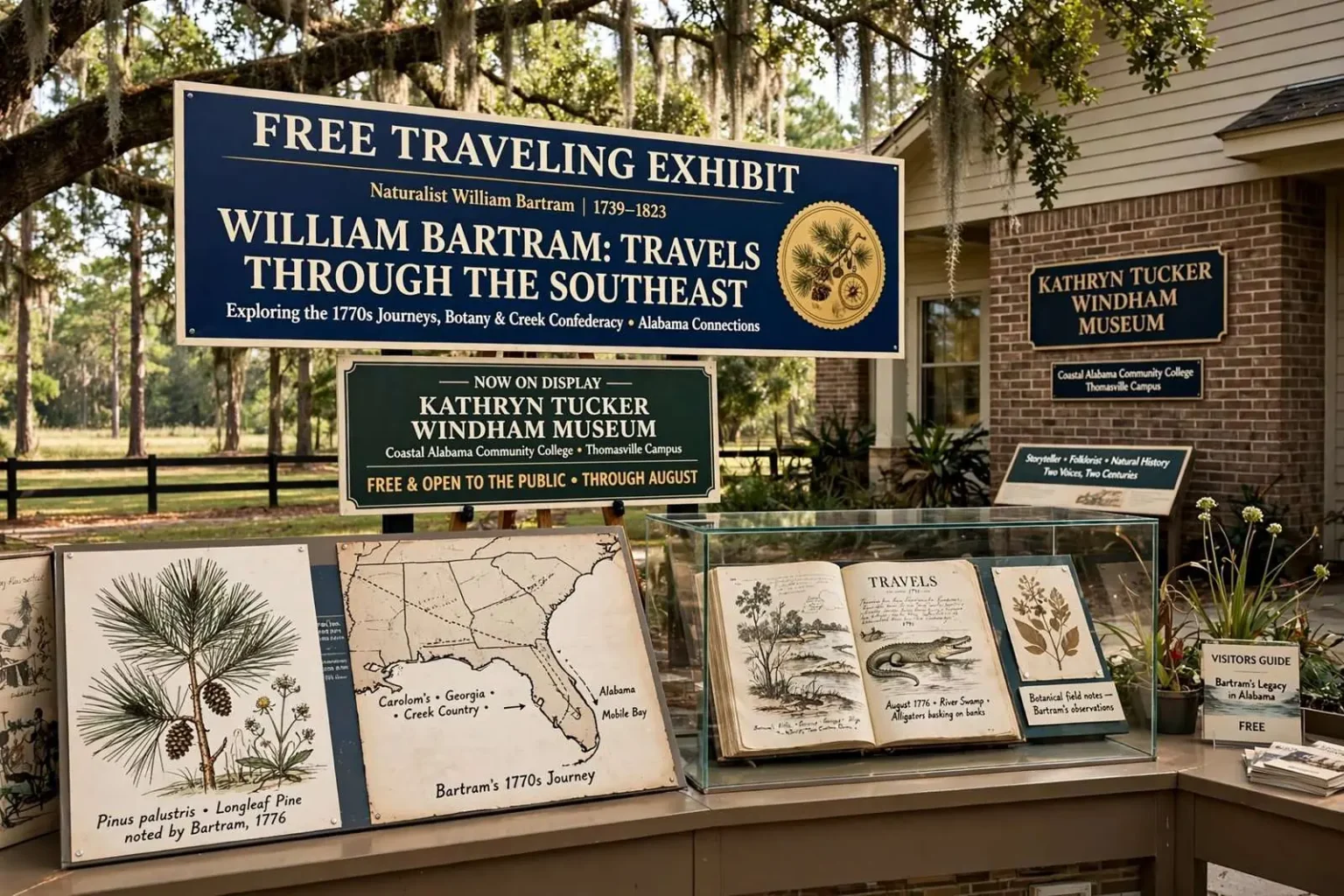
A free traveling exhibit exploring the travels and legacy of 18th-century naturalist William Bartram is now on display at the Kathryn Tucker Windham Museum on Coastal Alabama Community College’s Thomasville campus, where it will remain throughout August. The exhibit examines Bartram’s journeys through the Southeast and his connections to Alabama.
Bartram was a naturalist, botanist and explorer whose writings documented the landscapes, wildlife and Native American cultures he encountered across the region during his travels in the late 1700s. His observations, later published in his 1791 book “Travels,” are considered an important historical record of the Southeast before widespread settlement and development reshaped the land. Bartram’s detailed accounts of plant and animal life, along with his interactions with Native American communities, have made his work a lasting resource for historians, botanists and naturalists studying the pre-industrial South.
“Travels” has never gone out of print in more than two centuries of publication, a rarity for any book of its era. The work influenced writers and thinkers far beyond the sciences — the Romantic poets in England read Bartram’s descriptions of the American wilderness, and generations of naturalists since have retraced his routes through the Carolinas, Georgia, Florida and the lands that became Alabama and Mississippi. His habit of recording observation alongside reflection gave the book a literary quality that set it apart from the dry expedition reports common in his day.
Who William Bartram Was
Bartram came to his life’s work naturally. He was the son of John Bartram, a Pennsylvania botanist often called the father of American botany, and grew up around plants, seeds and scientific correspondence from an early age. After early ventures in Philadelphia as a merchant and in Florida as a plantation hopeful, he joined his father on a botanical journey through the southern colonies and later struck out on his own, spending roughly four years in the 1770s traveling through Creek and Cherokee country under the patronage of an English correspondent who collected exotic plants.
What he brought back was more than seed catalogs. Bartram drew maps, sketched wildlife, recorded vocabularies of Native languages and described towns, trade and diplomacy in the Creek Confederacy with a detail that modern scholars still mine. His accounts of the Southeast’s longleaf pine forests, river swamps and hardwood bottomlands preserve a picture of ecosystems that have been dramatically altered in the centuries since.
A Regional Connection to Alabama
Bartram’s travels took him through parts of what is now Alabama as he journeyed across the Southeast documenting the region’s biodiversity. His work is often cited alongside other early naturalist accounts as a foundational record of the area’s original ecosystems, from its river systems to its forests. He traveled the old paths connecting Creek towns across the interior and moved through country drained by the rivers that flow south toward Mobile Bay, leaving some of the earliest written descriptions of the region’s plants, animals and inhabitants.
For Alabama readers, the interest is twofold: Bartram described a landscape that still shapes the state — its rivers, piney woods and black belts — and he described it at a moment when European settlement was just beginning to transform it. Naturalists working in Alabama today still consult his observations when studying the historical range of species and the condition of habitats before the clear-cutting, damming and development of later eras.
The Museum and Its Namesake
The exhibit’s stop in Thomasville places it at the Kathryn Tucker Windham Museum, named for the Alabama author and storyteller known for her folklore collections and ghost stories rooted in the state’s history. Windham, who grew up in Thomasville, spent a newspaper career as a reporter and photographer before turning to books, beginning with the celebrated “13 Alabama Ghosts and Jeffrey,” the first in a series of ghost-story collections that made her a household name across the state. She became a fixture of Alabama public radio and festivals, and her storytelling — equal parts humor and reverence for the state’s past — earned her a devoted audience for decades.
Housing a natural history exhibit at a museum dedicated to an Alabama storyteller ties together two threads of the region’s cultural heritage. Bartram was, in his own way, a storyteller too: his book blends field observation with narrative flair, recording the people and places of the 18th-century Southeast in prose meant to be read, not just consulted. The pairing gives visitors a chance to consider how the region’s story has been told — through field notes and ghost stories alike — across more than two centuries.
The museum’s location on the Coastal Alabama Community College campus makes it an accessible stop for students, teachers and travelers passing through the Black Belt town. Thomasville serves as a hub for the surrounding rural county, and the college campus hosts a steady stream of cultural events that bring exhibits like this one to an audience that would otherwise have to travel to Montgomery or Mobile for comparable displays.
Why Traveling Exhibits Matter in Rural Alabama
Traveling exhibits such as this one play an outsized role in small-town Alabama, where museums often lack the space and budget to mount major shows of their own. By circulating among campuses, libraries and local museums, the exhibits bring scholarship out of the state’s larger institutions and into communities where students and residents can walk through it on a lunch break. For area schools, the free admission removes the last barrier to a field trip, and instructors at the college can fold the material directly into coursework in history, biology and literature.
Planning a Visit
The exhibit is free and open to the public throughout August at the Thomasville campus. Visitors can pair the Bartram material with the museum’s permanent collection devoted to Windham’s life and career, which traces her path from a Thomasville childhood to a lifetime of reporting, photography and storytelling. The combination makes the museum a compact introduction to two distinctive Alabama voices — one from the 18th century, one from the 20th — who each documented the state in their own way.
For anyone who wants to go deeper, Bartram’s “Travels” remains widely available in modern editions, and his route through the Southeast has been commemorated in recent decades by trails and heritage corridors that follow portions of his journey. Readers who pick up the book after seeing the exhibit will find the Alabama connection hard to miss: the rivers, swamps and pine forests he described are the same landscapes that define the state’s western counties today.
The exhibit’s monthlong run in Thomasville gives the region a rare chance to engage directly with a foundational figure in American natural history — at no cost, and in a museum that itself stands as a monument to the state’s storytelling tradition. As August ends, the exhibit moves on, but the museum’s blend of Bartram and Windham offers a reminder that Alabama’s natural and cultural history has always been one story, told by many voices.
Bartram’s Legacy in the Southeast Today
The enduring reach of Bartram’s work shows up in places he never could have imagined. Botanists still catalog plants first described in his writings, and the Bartram name attaches to trails, gardens and preserves across the Southeast. His records of the Creek country give tribal historians and archaeologists a rare contemporary account of towns and lifeways at a moment just before the pressures of removal and settlement intensified. Environmental historians, meanwhile, treat “Travels” as a baseline document — a description of what the Southeast looked like before the scale of change that followed.
That mix of science and story is what keeps the book alive for general readers as well. Unlike the formal surveys of his era, Bartram wrote with wonder about what he saw: alligators basking on riverbanks, orchids in the swamps, councils in Creek towns, the vast longleaf forests that once covered much of the coastal plain. A visitor to the Thomasville exhibit will come away with a sense of that voice — a man clearly delighted to be exactly where he was, writing it all down as fast as his pen allowed.
The exhibit’s August run at the Kathryn Tucker Windham Museum offers area residents a convenient introduction to that world. For the price of a short drive to the community college campus, visitors can trace the routes of one of America’s first great naturalists, learn how his observations still shape science and history, and see why his name remains attached to the landscapes of Alabama and the Southeast more than two centuries after he walked them.
Admission is free, and no tickets or reservations are required for the exhibit during its Thomasville stay. Area teachers and group leaders can contact the college about scheduling class visits before the exhibit closes.