
French Horn Rebellion Brings Brass-Driven Electronics to the Alabama Music Box
French Horn Rebellion brought processed french horn and electronics to Mobile's Alabama Music Box in December 2013 under suspended Christmas trees.
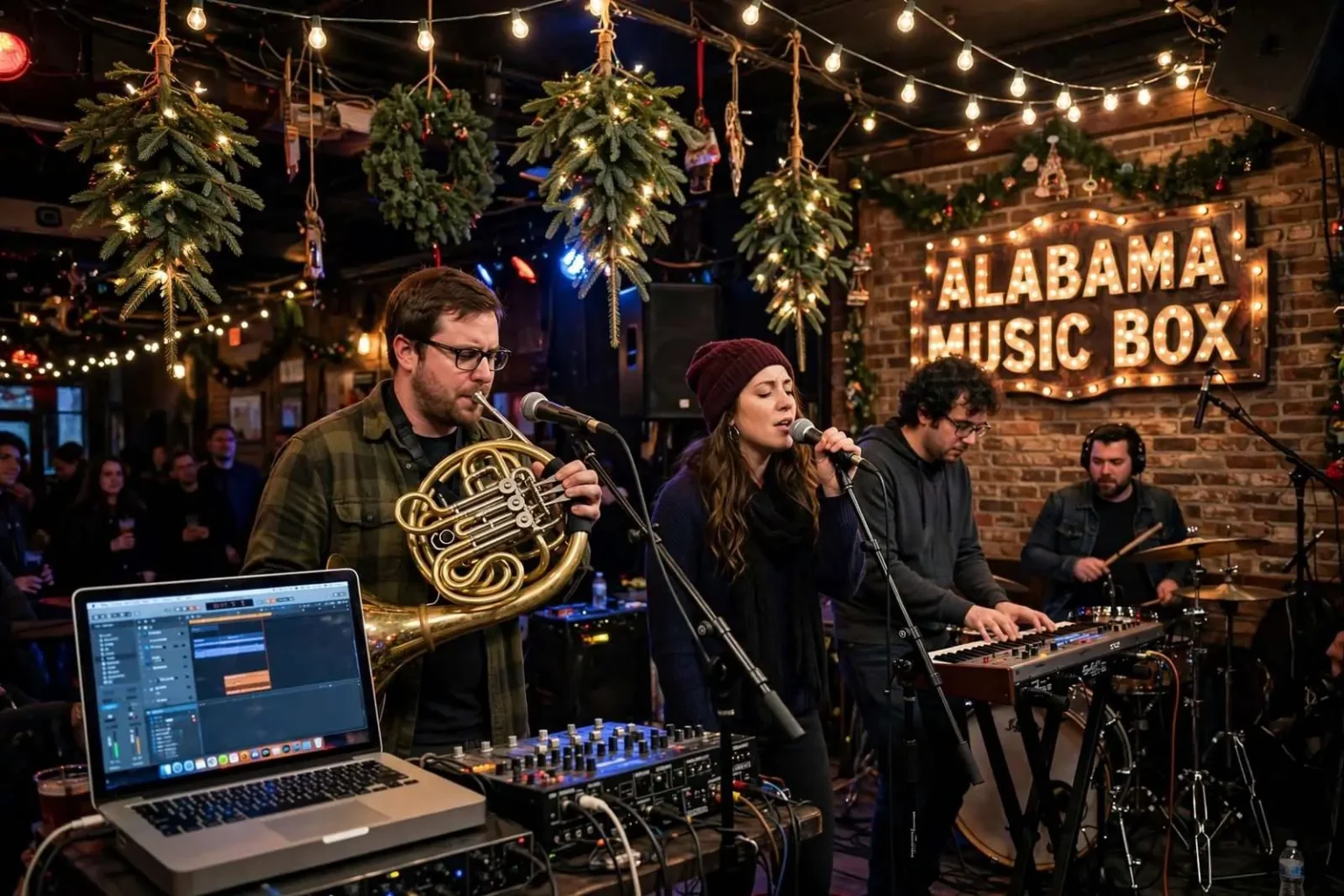
The Alabama Music Box traded its usual setup for holiday spectacle in late December 2013, with Christmas trees suspended from the ceiling and festive lighting overhead as Brooklyn’s French Horn Rebellion brought its brass-meets-electronics show to downtown Mobile.
The band, normally the project of brothers David and Robert Perlick-Molinari, toured that December at half strength — David sat out the run for health reasons. Robert carried on with an expanded backing lineup: keyboardist, drummer and a female vocalist whose parts a two-piece couldn’t otherwise cover. The reshaped group gave the holiday-date crowd a fuller sound than the stripped-down duo configuration the band often travels with, and the extras mattered on a night built around live manipulation rather than a fixed set of tracks.
For the Music Box, the booking fit the venue’s identity. The downtown room has long served as Mobile’s proving ground for touring indie and electronic acts — the kind of small stage where a band can experiment, test new arrangements, and meet the audiences that will follow it from city to city. Decking it out with hanging Christmas trees for a late-December show was as much a statement as a decoration: the venue treats its calendar as a year-round proposition, holidays included.
One horn, reinvented
The group’s signature move is right there in the name. Where the french horn usually lives in classical repertoire — concert halls, orchestras, brass quintets, and conservatory practice rooms — French Horn Rebellion runs it through live processing. Robert works from a Mac Mini wired into Ableton software, layering loops on the fly and bending each instrument’s sound well past recognition. Underneath it all: thudding bass, swirling synth chords and live drumming that keeps the electronic arrangements anchored to a human rhythm.
The approach puts the band in a distinctive corner of the electronic scene. Dance music built on laptops often faces the criticism that little on stage is actually being performed in real time; French Horn Rebellion’s answer is to put an acoustic instrument with centuries of orchestral history at the center of the rig and process it live, so that every night’s versions of the songs differ with the loops, filters and effects the performer chooses in the moment. The horn’s lines can become a synth stab, a bass pulse, or a smeared texture — or stay recognizably a horn, ringing out over the top of the mix.
The backing trio completed the sound. The keyboardist filled out the harmonic layers, the drummer gave the tracks their physical punch, and the vocalist carried the melodic parts that a two-piece lineup would have had to sequence or drop. With David home, the December shows were also an exercise in re-arrangement — pulling apart songs built for two and rebuilding them for five without losing the material’s identity.
An intimate night
Holiday travel kept the crowd smaller than the band might draw in another season, but those who came made up for it in enthusiasm. Robert jumped off the stage before the encore to slap high fives across the room, and the band lingered at the bar afterward, talking with fans and signing autographs.
Nights like that are what small-venue touring is for. A room at capacity on a summer Saturday rarely gives a band time or space to meet its audience; a December Tuesday in front of a few dozen devoted fans does. By the end of the night the band had worked the room from the stage to the bar, and the crowd had received the kind of access that turns casual listeners into loyal ones.
For Mobile’s indie-electronic faithful, it was a low-key but memorable stop on a tour warming up material ahead of bigger rooms — and a reminder that the Music Box could deliver touring acts worth braving a December night for.
That last point is the quiet argument the night made. Cities Mobile’s size often watch national touring acts pass between New Orleans and Atlanta, and the venues that keep those acts coming through town do it by offering something the interstates don’t: an attentive room, a professional stage, and a promoter willing to book a band built around a processed french horn in the last week of December. The suspended trees and the festive lights were the garnish; the substance was the booking itself.
The brothers and the band
French Horn Rebellion’s story starts with the instrument and the family. The Perlick-Molinari brothers built the project around Robert’s horn — an unusual foundation for a dance act, and one that has defined the band’s sound and its name since its earliest releases. The music leans on the tools of the Brooklyn electronic scene: synthesizers, sequencers, and software, with the horn threaded through the middle as both lead voice and running joke, a brass instrument refusing to stay in its classical lane.
Brothers as bandmates shape the project’s character. David and Robert have alternated between holding the project together as a duo and expanding it for tours and recordings, and the December run — with David sidelined and Robert fronting an expanded lineup — showed the flexibility that arrangement requires. The material survived the reconfiguration because, at its core, the band’s songs are built on parts that can be re-assigned: a horn line here, a vocal part there, synth layers and drum programming underneath.
The expanded lineup’s vocalist deserves particular note. Electronic acts that tour without a full band often rely on backing tracks for vocals; adding a singer for the run meant the Mobile audience heard the harmonies and melodic lines performed live, a difference that registers most clearly on the dance-floor hooks where recorded and performed versions tend to diverge.
Ableton and the live-electronic question
The Mac Mini-and-Ableton rig at the center of the stage represents a particular school of electronic performance. Ableton Live, the software suite built for both studio production and real-time manipulation, allows a performer to launch loops, retrigger samples, and reshape effects chains on the fly — a performance style closer to improvisation than to pressing play. Robert’s setup put that control at his fingertips while he played the horn, running its output through the software as he performed.
For the audience, the result is a show with visible cause and effect: a figure played on the horn comes back seconds later as a loop, is filtered, pitch-shifted, stacked, and finally rides over the drums and bass the backing musicians are driving. Nothing in the arrangement is fixed, which is why fans of live-electronic acts follow them from show to show — the songs are templates, and each night’s version is a new print.
The live drummer anchored it all. Electronic music performed entirely from machines can flatten rhythmically; a human drummer pushes and pulls against the grid in ways that keep a dance floor moving naturally, and the pairing of programmed bass and synths with live percussion is one of the more reliable formulas in the genre.
Mobile’s indie-electronic home
The Alabama Music Box has held a particular place in the Gulf Coast’s music geography. As the principal downtown room for touring indie, punk, and electronic acts, it gives bands on regional circuits a Mobile date and gives local audiences access to acts that would otherwise skip the city entirely. The room’s size — intimate by arena standards, spacious by living-room ones — puts performers close enough to the crowd that a pre-encore stage dive of high fives is a practical gesture, not a metaphor.
The late-2013 date arrived during a period when the national electronic scene was splintering productively: festival-scale EDM was drawing the headlines, but smaller rooms were cultivating acts — hybrid performers, instrumentalists with laptops, bands that crossed genre lines — that played to listeners who wanted musicianship with their beats. French Horn Rebellion sat squarely in that second camp, and the Music Box’s booking put Mobile in that current as well.
The small crowd also changed the sound of the night in ways regulars would recognize. A room that is not at capacity bounces less noise, and the Music Box’s system could run cleaner and more detailed than it does under festival crush — the horn’s processed overtones, the keyboard pads, and the drummer’s dynamics all landed with a clarity that bigger crowds smear. For the musicians on stage, a smaller house is also easier to read: the band could stretch a loop, hold a breakdown, and watch individual faces react instead of playing to an undifferentiated mass. Improvisation thrives on that feedback, and the performance bent toward it as the night went on — songs running longer than their recorded versions, transitions built on the spot out of whatever loops were still ringing in the software.
The night closed the way the best small-venue shows do: band and audience in the same conversation, autographs at the bar, and a tour bus idling outside a city that the act had, by the end of the evening, gained a reason to route through again. For the fans who braved a December night when half the town was traveling, the suspended Christmas trees and the processed horn made the case that Mobile’s music calendar doesn’t take the holidays off — and that some of the year’s most memorable shows happen in its quietest weeks.


