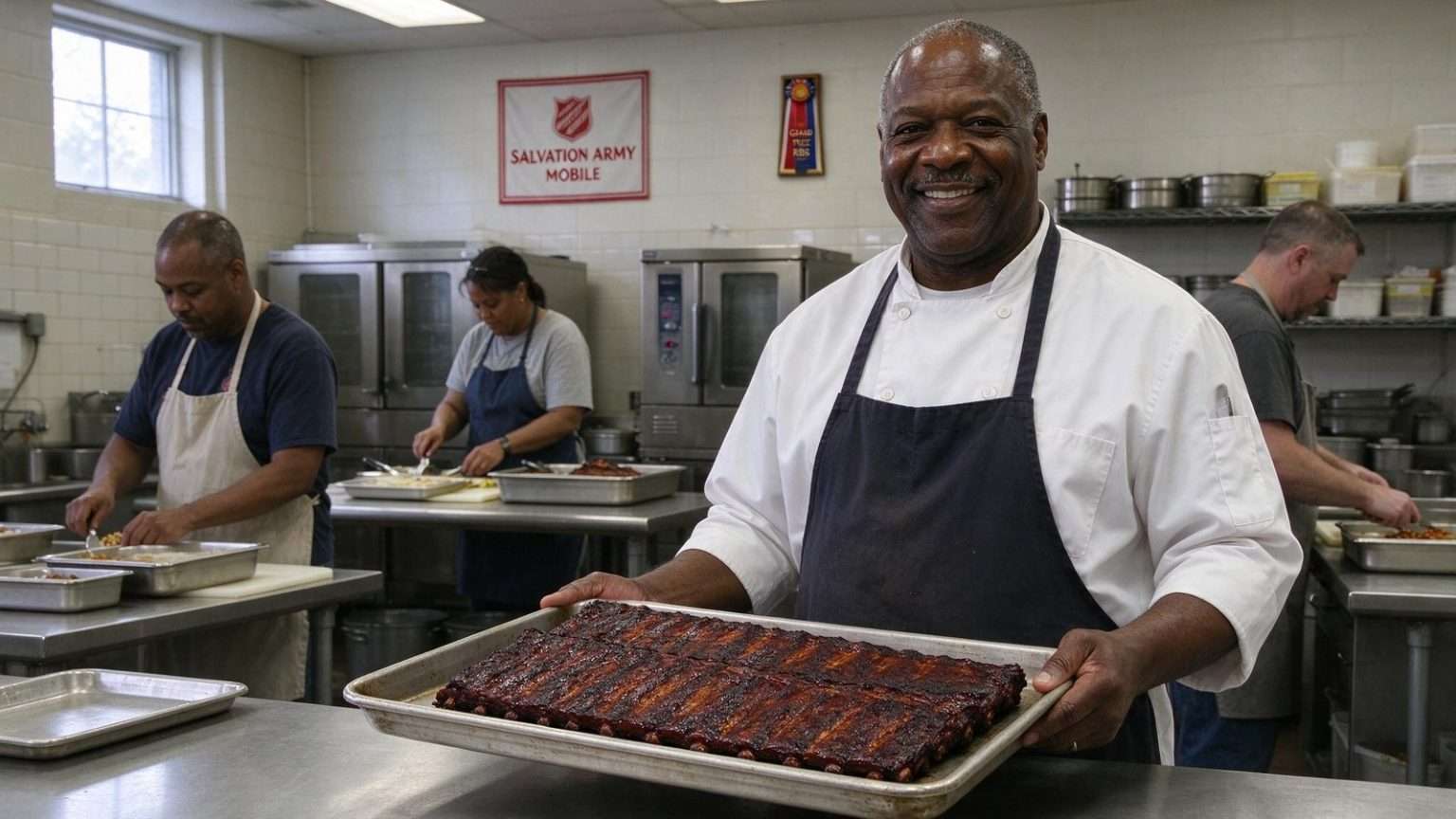
Slow-smoked barbecue ribs cooking on a grillSlow-smoked ribs like those prepared for the Salvation Army's Memorial Day weekend rib sale in Mobile.

Behind the doors of the Salvation Army’s Dauphin Street facility in Mobile, a kitchen once known mainly for feeding the homeless and marginalized has become a source of some of the best barbecue in the region. The man responsible is Cecil Morris, a former Salvation Army client who rose from dishwasher to Culinary Arts Manager and, along the way, became locally famous for his slow-smoked ribs.

Morris and his ribs have taken top honors in some of the area’s best-known cooking competitions, including the Bay Area Food Bank’s Gourmet Chef Challenge, the Point Clear Rotary Club’s Taste of Rotary, and the Volunteer Mobile Shrimp Cook-off. That reputation has helped transform the Salvation Army’s kitchen into something more than an institutional feeding operation. “We’re proud to serve more than just institutional fare,” said Major David Waite, the Salvation Army’s Area Commander for Coastal Alabama.

The popularity of Morris’s ribs led to the creation of an annual Memorial Day weekend rib sale, now in its second year, that gives the public a chance to taste the same barbecue that has won over judges and diners alike while supporting the Salvation Army’s mission in Mobile and Baldwin counties.

Morris’s path to the kitchen began far from a stovetop. Born in Mobile but raised in New York, he took his first drink at age 14 and was using crack cocaine by 16. When he returned to Mobile at 30, he was in the grip of full-blown addiction, homeless and eating out of grocery store dumpsters. Deep in depression and contemplating suicide, Morris found his way to the Salvation Army, first as a transient in the feeding line and later as a client of the organization’s Corps Salvage Rehabilitation Center.

Recovery did not come easily. Morris was dismissed from the program early on because of behavioral problems he attributes to years of street living and fear of the unfamiliar. But the Salvation Army gave him another opportunity, and this time it stuck. Like every new client assigned to the kitchen, Morris started as a dishwasher. As his recovery progressed, so did his career: he was hired part time as a cook, promoted to first cook, and within five years of walking through the Salvation Army’s doors, he had become Culinary Arts Manager. Today, Morris has 13 years of sobriety.

He has had other job offers over the years but has chosen to stay with the Salvation Army, saying he wants to give back to an organization that gave him a second chance. Morris sees himself as living proof for the clients coming through the program now, many of whom are facing the same struggles he once did. Alongside team members Oscar Smith, Lorraine Ledqux and Willie Harborson, most of them also in recovery, Morris now leads a kitchen that prepares meals for the homeless and marginalized across Mobile and Baldwin counties, while also showing off its skills to the wider community.

See also  The Hallers, Fighting for Apollo and Through the Sparks Set Triple Bill at The Blind Mule

That skill will be on display this Memorial Day weekend, when the Salvation Army holds its annual rib sale at 1009 Dauphin St. from 10 a.m. to 6 p.m. The menu includes ribs, sandwiches, potato salad and baked beans, and organizers encourage placing advance orders by calling 251-438-1625, extension 139. Proceeds support the Salvation Army’s programs for those in need in the Mobile and Baldwin County areas.

Downtown Mobile’s dining scene has also picked up a new addition. Margarita’s Bar, tucked just behind Three George’s and connecting to the Dauphin Street storefront just east of it, is now serving authentic Mexican fare in the Lower Dauphin Street (LoDa) entertainment district, marking the return of a South-of-the-border dining option to downtown Mobile. Owner Yolanda Garcia offers a traditional lunch menu, while evenings bring a rotating selection of tapas, including ceviche. Garcia says she spends much of her week outside the restaurant’s Wednesday-through-Saturday operating schedule sourcing ingredients for her dishes, including an in-house pico de gallo loaded with vegetables and a tangy brine. Reviewers who have sampled her tacos, both chicken and beef, describe them as standouts on a menu that is bringing a taste of Old Mexico back to downtown Mobile.

Probate courts in Alabama handle matters distinct from the trial courts that hear criminal and civil cases, including wills, estates, guardianships, and involuntary commitments for mental-health treatment. In Mobile County the probate judge is an elected official with broad administrative and judicial duties.

Behavioral-health care on the Gulf Coast is provided by a mix of community mental-health organizations, hospital systems, and private practitioners. Community centers play an especially important role in serving patients who might otherwise lack access to care, often coordinating with courts, jails, and social services.

Collegiate athletics are a major part of life in southern Alabama, where the University of South Alabama in Mobile fields the Jaguars across a range of sports. The university’s football program, which began competition in the 2000s, has become a rallying point for students, alumni, and residents and a source of regional pride.

See also  $5 Million Gift Boosts 'Transformative' Expansion of USA's Trauma Center in Mobile

Charitable and nonprofit organizations form a vital safety net across South Alabama, addressing needs from hunger and homelessness to disaster relief and holiday assistance. Groups such as The Salvation Army operate local corps that provide shelter, food, and seasonal programs funded largely by community donations.

Local government in the Mobile area operates through a combination of mayor-council or commission structures at the municipal level and a county commission in Mobile County, with elected officials handling budgets, public safety, infrastructure, and zoning. Baldwin County has its own commission and a collection of incorporated municipalities.

The natural environment is central to life on the Gulf Coast, where barrier islands, bays, rivers, and wetlands support fisheries, recreation, and storm protection. Coastal Alabama faces challenges common to low-lying regions, including hurricane exposure, erosion, and the management of fragile ecosystems.

The economy of the Mobile region is diversified across shipping and logistics, aerospace and shipbuilding, healthcare, tourism, and manufacturing. The Port of Mobile is one of the nation’s busiest seaports and a cornerstone of the local and state economy.

Mobile is the county seat of Mobile County in southwest Alabama and the state’s only saltwater port. Situated where the Mobile River meets Mobile Bay near the northern Gulf of Mexico, the city has long served as a commercial and cultural gateway between Alabama and the wider Gulf Coast. Founded in 1702 as Fort Louis de la Louisiane and ruled in turn by France, Britain, and Spain before joining the United States in 1813, Mobile carries a layered heritage distinct from the rest of the state.

Baldwin County sits directly east of Mobile County across Mobile Bay and is the largest county in Alabama by land area. It encompasses the Eastern Shore communities of Daphne, Fairhope, Spanish Fort, and Foley and stretches south to the beaches of Gulf Shores and Orange Beach along the Gulf of Mexico.

Alabama is a state in the southeastern United States bordered by Tennessee, Georgia, Florida, the Gulf of Mexico, and Mississippi. Often called the Heart of Dixie, it spans Appalachian foothills in the north and flat coastal plains in the south. Its largest cities include Birmingham, Montgomery, Huntsville, and Mobile.

The Gulf of Mexico borders Alabama’s southern edge and defines much of the state’s coastal identity. Alabama’s Gulf coastline, centered on Dauphin Island, Gulf Shores, and Orange Beach, supports a tourism industry built around beaches, charter fishing, and marine recreation, while offshore waters host shipping lanes and energy interests.

See also  Oyster Cook-Off, Pecan Festival and Brunch for a Cause: Early November Events Around South Alabama

The history of South Alabama is shaped by its position at the crossroads of cultures and waters. Indigenous peoples, including the Muscogee (Creek) and Choctaw, lived in the region for centuries before European colonization by French, British, and Spanish powers.

Healthcare in the Mobile area is anchored by several hospital systems and provider networks that serve patients across southwest Alabama, the Gulf Coast, and into parts of Mississippi and Florida. Large employers in the sector include regional health systems operating hospitals, clinics, and specialty centers, alongside university-affiliated providers.

Education in South Alabama spans public school systems in Mobile and Baldwin counties, a network of private and parochial schools, and institutions of higher learning including the University of South Alabama, Spring Hill College, and community colleges. Public-school governance rests with locally elected boards.

Local journalism serves as the connective tissue of communities like those across South Alabama, informing residents about government, schools, public safety, and the events that shape daily life. Outlets covering Mobile and Baldwin County help hold institutions accountable and give voice to neighborhood concerns larger media may overlook.

Local law enforcement across South Alabama is carried out by municipal police departments, county sheriff’s offices, and state agencies that together cover a mix of urban, suburban, and rural territory. City departments handle policing within municipal limits, while sheriff’s offices provide courthouse security, jail operations, and patrol in unincorporated areas.

The Federal Bureau of Investigation is the principal investigative arm of the United States Department of Justice, tasked with protecting the country against terrorist threats, foreign intelligence operations, cyber attacks, and major criminal activity. Established in 1908, the bureau operates a network of field offices across the country, each responsible for federal law-enforcement matters within its region.