From Julio Jones to the Next Wave: Why the Gulf Coast Keeps Producing Elite Athletes
From Julio Jones and DeMarcus Cousins to rising prospects like Lee Hunter and Bubba Thompson, the Alabama Gulf Coast continues to produce elite athletes across football, basketball and baseball at a remarkable rate.
Ask sports fans in almost any American city to name their hometown’s greatest football, basketball and baseball player, and most will struggle to come up with three names that could compete on a national stage. Along the Alabama Gulf Coast, the exercise produces a roster that would headline any all-time list in the country, a reminder of just how deep the region’s athletic pipeline runs.
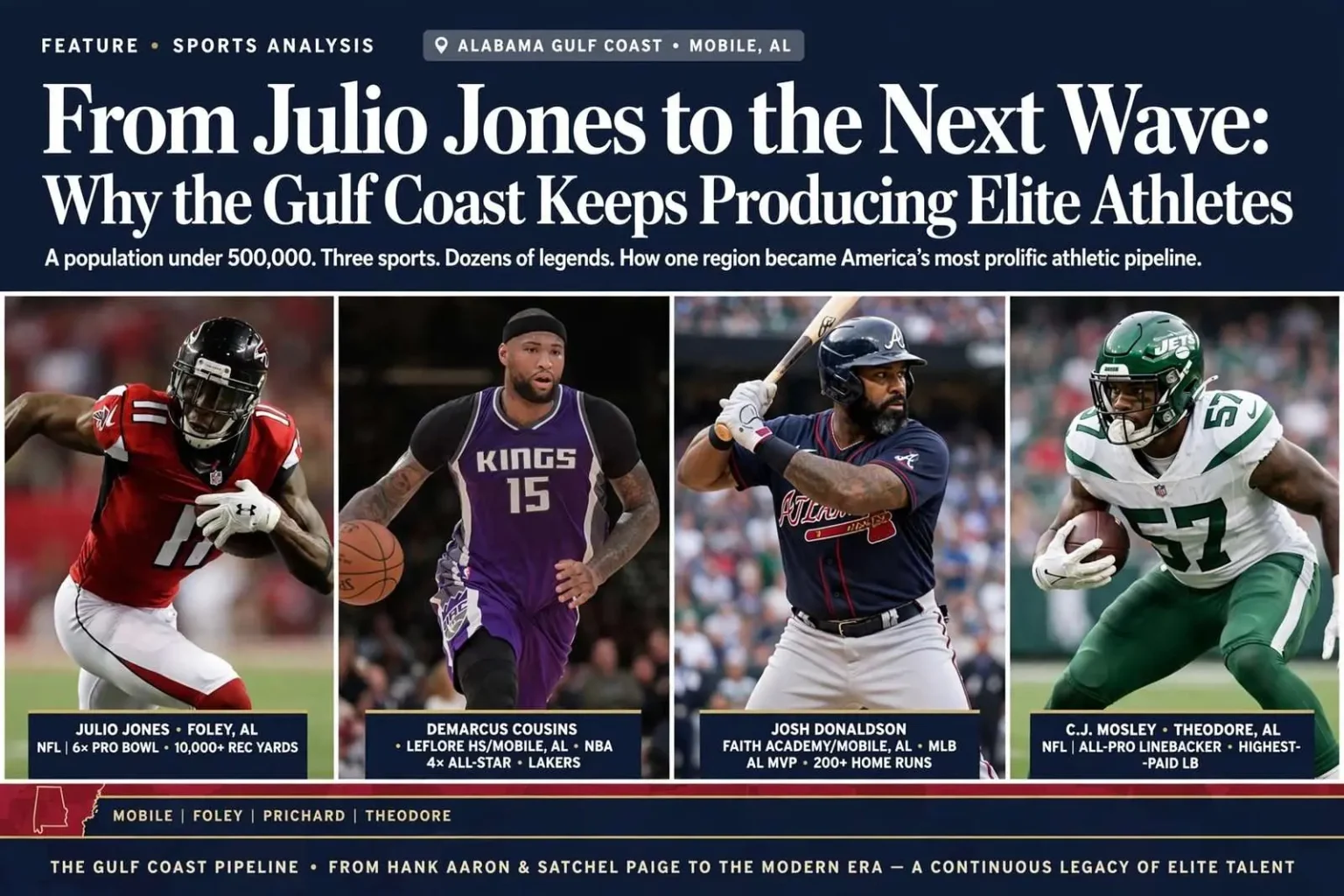
Start with football. Foley product Julio Jones spent more than a decade establishing himself as one of the greatest wide receivers in NFL history, a six-time Pro Bowler who reached 10,000 career receiving yards faster than any player the league has ever seen and who posted the highest career yards-per-game average in NFL history. His path to Canton someday seems all but assured.
In basketball, LeFlore High School product DeMarcus Cousins built a résumé that includes four NBA All-Star selections and, more recently, a contract with the Los Angeles Lakers. Before a pair of serious lower-body injuries slowed him down, Cousins was regularly discussed among the five best players in the world at his peak.
Baseball’s answer comes from Mobile’s Faith Academy, where Josh Donaldson developed into the type of two-way third baseman who earns an American League Most Valuable Player award. Donaldson recently belted his 200th career home run for the Atlanta Braves, part of an offensive and defensive package that has helped keep the club atop its division through the All-Star break.
What makes the Gulf Coast’s case even stronger is how it holds up historically. Jones and Cousins may well be the best their sports have ever produced from the region, even accounting for a deep bench of past standouts. Foley’s Ken Stabler and Vigor’s Robert Brazile are already enshrined in the Pro Football Hall of Fame, and former Vigor offensive lineman Willie Anderson built a career that many believe warrants a bust in Canton as well. Theodore product C.J. Mosley recently became the highest-paid linebacker in the history of the league, the capstone to a career that made him one of the NFL’s most decorated defenders.
The Paradox of a Small Metro
Consider the scale of what the region has produced. The Mobile metropolitan area counts well under half a million residents — a market smaller than dozens of American cities that have never produced a single Hall of Famer in any sport. Yet the Gulf Coast’s alumni roster spans the NFL, the NBA and Major League Baseball at their highest levels, and its Hall of Fame representation would embarrass metros several times its size.
The pattern stretches back more than a century in baseball alone. Mobile is the birthplace of Hank Aaron, the home-run king whose record stood for a generation; of Satchel Paige, the legendary pitcher whose career bridged the Negro Leagues and the majors; of Ozzie Smith, the wizard of shortstop enshrined in Cooperstown; of Billy Williams and Willie McCovey, Hall of Famers both. No city of comparable size in America has a baseball lineage that approaches it, and scouts have treated the region as prime talent ground for decades.
Football’s Gulf Coast legacy runs through the schools that recur in every conversation about the region’s pipeline. Foley produced both Stabler, the Raiders quarterback who directed one of the 1970s’ most feared offenses, and Jones, the receiver whose physical gifts redefined the position’s modern demands. Vigor — the Prichard high school that anchored the region’s football identity for decades — sent Brazile, the Oilers linebacker whose pass-rushing dominance earned him a place in Canton, and Anderson, the Cincinnati Bengals tackle whose durability and consistency over a dozen NFL seasons made his Hall of Fame case a perennial argument. Theodore’s line of greats runs through Mosley, the Alabama All-American whose professional career has been defined by tackling volume and defensive command.
The pipeline’s ingredients
Explanations for the phenomenon tend to converge on a few themes. The Gulf Coast’s climate allows year-round outdoor play — a meaningful edge over northern markets in the eras when development happened on sandlots and playgrounds. The region’s population density concentrates talent into a handful of high school programs, creating competitive environments where the best players sharpen each other rather than dispersing across hundreds of schools. And Mobile’s position as a port city has always made it a crossroads — culturally diverse, athletically hungry, and organized around institutions, from church leagues to recreation departments, that take youth sports seriously.
The high school coaching cultures matter too. Programs like LeFlore, Vigor, Foley, Theodore and Faith Academy have, across different eras, treated football and baseball as serious developmental enterprises — weight rooms in the summer, structured skill work in the fall, and schedules built around proving the region against statewide competition. The players who emerge from those gyms arrive at college campuses already hardened by a level of regional intensity that bigger metros often cannot match.
Julio Jones: The Standard
Jones’s career is the region’s modern football standard. Drafted in the first round out of Alabama after a high school career at Foley in which he was rated the best prospect in the nation, he spent his professional years producing at a pace the league’s record books had never recorded — the fastest to 10,000 receiving yards in NFL history, six Pro Bowl selections, and the highest yards-per-game average the league had ever seen. In an era loaded with great receivers, Jones’s combination of size, speed and contested-catch reliability made him the template that college programs across the country began recruiting toward.
What the numbers capture incompletely is the durability behind them. Receiver careers built on physical dominance tend to erode early; Jones played through injuries that would have shelved most players and still produced at an All-Pro level deep into his career. For the Gulf Coast’s young players, he is the local proof that a national ceiling exists — a kid from Foley whose path ran through Tuscaloosa to the top of the profession.
DeMarcus Cousins: The Peak and the Price
Cousins’s story carries the region’s basketball weight. At LeFlore he was a nationally ranked big man, and by his mid-twenties he stood among the NBA’s most dominant centers — a four-time All-Star whose scoring, passing and rebounding made him, in the conversation of his peak, one of the five best players in the world. The contract with the Lakers that followed his injuries represented both a franchise’s belief in what remained and the continuation of a career that injuries had bent but not ended.
His arc is also a lesson in how brutal professional basketball’s attrition can be. Cousins’s lower-body injuries — the kind that have ended less accomplished careers outright — struck at his absolute peak, and the league’s conversation about him shifted from MVP ballots to comebacks. That he remained employed at the sport’s highest level after all of it says something about how good he was when healthy; the Gulf Coast claim on basketball greatness rests substantially on that healthy stretch, and it is a strong claim.
Josh Donaldson: The Late Bloomer
Donaldson’s path to stardom was the least predictable of the three. A Faith Academy product and a catcher in his early professional years, he remade himself as a third baseman, rebuilt his swing, and exploded into one of baseball’s most complete players — an American League MVP award, multiple All-Star selections, and a defensive reputation that matched his bat. His 200th career home run for the Atlanta Braves, struck while the club held the top of its division through the All-Star break, marked the milestone of a career built on reinvention rather than early fame.
For the region’s baseball players — particularly the ones who are not national prospects at seventeen — Donaldson is the pipeline’s most instructive case. Talent from the Gulf Coast arrives at every level of development, and the region’s baseball history, from Aaron to Paige to Smith, is precisely a history of players whose greatness revealed itself on timelines no scout predicted.
C.J. Mosley rounds out the modern wave with a defender’s version of excellence. The Theodore product became an All-American at Alabama in the dynasty years, then translated his game directly to the NFL, where his tackling volume, coverage ability and defensive-calling authority made him the standard at inside linebacker — and eventually the highest-paid player in the league at his position. In a region that has produced Hall of Fame pass rushers and quarterbacks, Mosley’s rise represents the pipeline’s depth at every spot on the field.
Why the Claim Holds Up Historically
The strongest test of any region’s athletic claim is how it survives comparison across eras, and the Gulf Coast passes it with room to spare. Stabler’s Hall of Fame case rests on a decade of championship-caliber quarterbacking in Oakland, including a Super Bowl title and some of the most famous moments of the 1970s. Brazile’s rests on a run of consecutive All-Pro seasons that made him the defining linebacker of his era in Houston. Both came from the same stretch of the Gulf Coast — Foley and Prichard respectively — and both reached the same building in Canton, where Jones someday appears headed.
The baseball lineage carries the same weight. Aaron’s records made him a global sports figure; McCovey’s and Williams’s careers put them among their sport’s all-time greats; Paige’s career may be the most remarkable in baseball history, spanning the Negro Leagues’ glory years into the majors in his late forties. That lineage belongs to a single city of Mobile’s size, and it is the historical foundation on which the modern claims — Cousins among the game’s best big men, Donaldson as an MVP — stand.
Set the region’s roster against any American metro of comparable size and the comparison collapses quickly. Most cities of half a million people have produced, across a century of professional sports, a handful of major leaguers and an occasional Pro Bowler. The Gulf Coast has produced an all-time great at baseball’s most hallowed position of achievement, two Pro Football Hall of Famers with a third plausible, a basketball center discussed among the world’s five best at his peak, and a football receiver rewriting the league’s efficiency records — plus the deepest supporting cast of any region its size.
What sustains the pipeline
The question that follows every such list is whether the phenomenon is repeating, and the signs around the Gulf Coast suggest it is. The high school programs that produced this generation — Foley, Theodore, LeFlore, Vigor, Faith Academy and their contemporaries — continue to send recruits into SEC and national college programs every February, and Mobile’s private and public academies have expanded their athletic development in ways earlier eras never attempted. Club and travel structures in baseball and basketball have professionalized the region’s offseasons, and the coaching networks that developed Jones and Mosley remain in place.
The region’s college connection is a force multiplier. The University of Alabama and Auburn draw heavily from Gulf Coast high schools, and the exposure that comes with SEC football — national broadcasts, award voting, draft evaluation — converts regional talent into national prominence more reliably than smaller-conference routes. Jones and Mosley both arrived at Alabama as in-state products and left as the faces of national championship teams, a pathway that will keep pulling the Gulf Coast’s best athletes toward the sport’s highest level.
There is also the intangible: expectation. In a region that has produced this many greats, high school stardom is measured against a known standard, and young players grow up hearing the names — Aaron, Paige, Stabler, Brazile, Jones — as the local measuring stick. Athletes from places with no professional lineage play to leave; athletes from the Gulf Coast play to join a list, and the list has never stopped growing.
Ask the question again in a decade and the exercise will begin the same way: a receiver’s records, a big man’s dominance, a third baseman’s MVP, a linebacker’s contract — names from Foley, LeFlore, Faith Academy and Theodore, standing in for a stretch of the Alabama Gulf Coast that keeps producing athletes the whole country has to take seriously. The region’s answer to the hometown-greats question is not three names. It is a waiting list.