Entertainment Escambia County Florida
From Masonic Lodge to Concert Stage: The Story of Vinyl Music Hall in Pensacola
Housed in an 1897 Masonic lodge on Palafox Street, Vinyl Music Hall has grown into one of Pensacola's key live music venues and an anchor of the city's revitalized downtown.
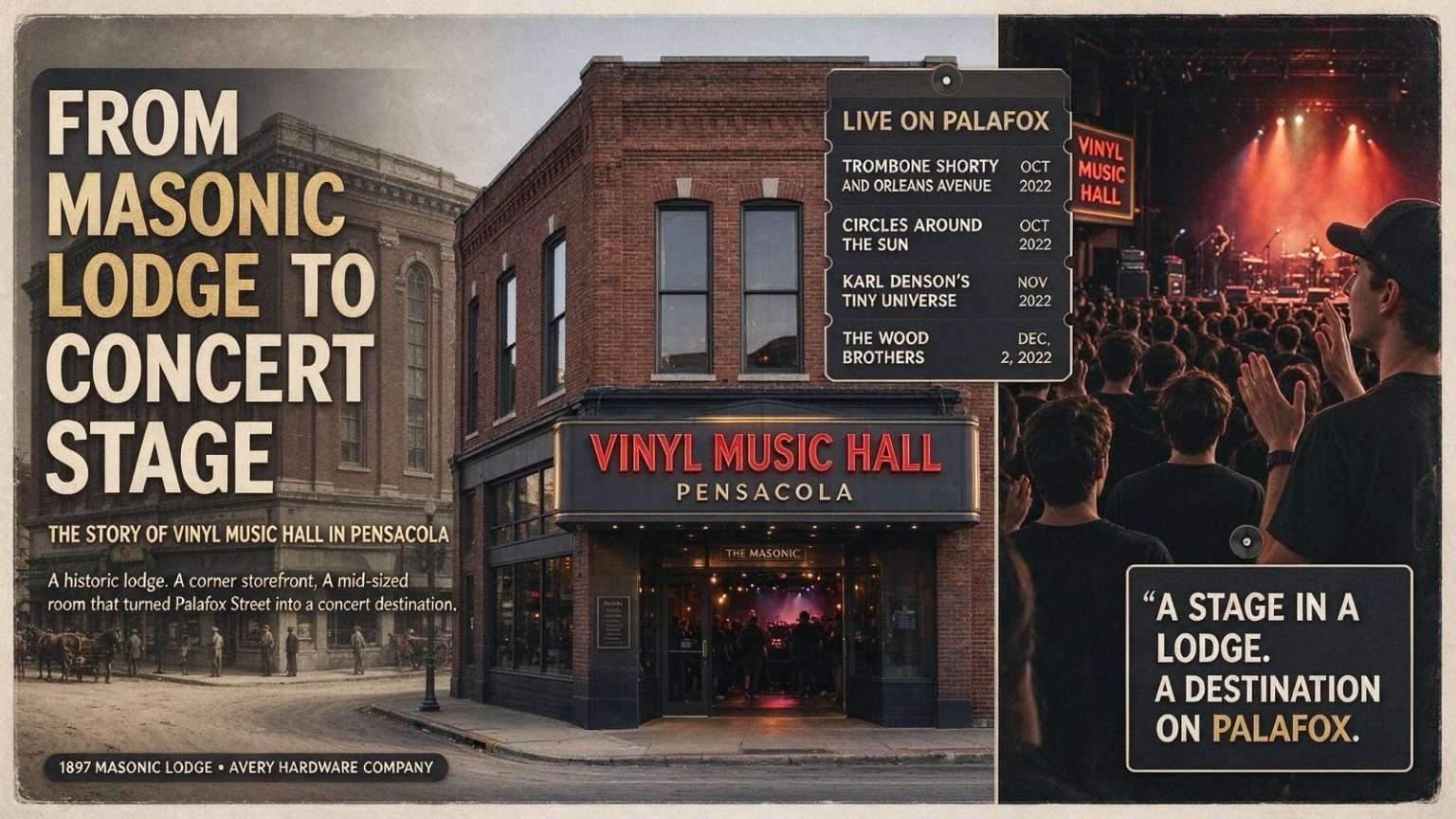
A hardware store once filled the ground floor of an 1897 Masonic lodge on the corner of Palafox Place and Garden Street. Touring bands play there now. Vinyl Music Hall in Pensacola has become one of the anchors of the city’s revived downtown and one of the best-known live music rooms on the upper Gulf Coast. The venue came about through a century-old building, two cousins and a street that changed a great deal around them.
Downtown Mobile and downtown Pensacola have both seen a steady revival, with new restaurants, bars, shops and music venues moving into older buildings. Vinyl Music Hall’s name turns up week after week on regional concert calendars, and it was one of the early pieces of that revival in Pensacola.
A Masonic Lodge Built to Pay Its Own Way
The building is called The Masonic. It went up in 1897 as a Masonic lodge, and the arrangement behind it was practical. The lodge met upstairs and rented the ground floor to Avery Hardware Company, whose rent helped pay for the lodge’s operations. Fraternal organizations in American towns and cities commonly did this in the late nineteenth and early twentieth centuries. A commercial storefront at street level helped pay for the meeting rooms above.
That fits the period. At the end of the 1800s Pensacola was a busy port, shipping timber and lumber from the longleaf pine forests of northwest Florida and south Alabama around the world. Palafox Street was the main commercial corridor, lined with banks, stores and offices, and much of the downtown architecture that survives today dates from that era and the decades right after it.
Like many downtown buildings in American cities, The Masonic had a long slow stretch in the twentieth century. It sat vacant for years before its ground floor came back to life.
The Levin Cousins Open the Doors
In 2010, cousins Evan and Harry Levin opened Vinyl Music Hall on the ground floor. They were betting that downtown Pensacola could support a dedicated room for national and regional touring acts, a mid-sized venue that is bigger than a bar stage but more intimate than an arena or a large theater.
Mid-sized rooms fill an important place in the touring business. Bands on their way up need places to play between small clubs and large halls, and established acts often like the energy of a smaller crowd. A city without a room like that tends to get passed over when tours are routed. Pensacola is well placed along Interstate 10 between New Orleans and the Florida Panhandle and Atlantic coast cities, and that makes it a natural stop if the right venue is there.
The 2018 Expansion
In 2018 the owners closed the hall for two months to renovate. The main addition was a second-floor mezzanine, which raised audience capacity from 526 to 860. The larger capacity was meant to help the venue attract more popular touring acts. For a booking agent, the number of tickets a room can sell often decides whether a show happens at all.
A mezzanine also changes how a show feels. It gives concertgoers another place to watch from, looking down on the stage and the crowd, and it lets the room hold more people without making the floor feel packed. The renovation kept the hall inside the historic building’s footprint while giving it room to grow.
Who Has Played the Room
In the fall of 2022 the hall hosted a varied lineup of touring acts, including:
- Trombone Shorty and Orleans Avenue, the New Orleans bandleader and his group, known for high-energy shows that blend brass band tradition with funk, rock and hip-hop.
- Circles Around the Sun, an instrumental band whose long, exploratory jams draw fans of improvisational rock.
- Karl Denson’s Tiny Universe, the saxophonist’s long-running funk and soul outfit.
The Wood Brothers, the roots trio known for its mix of folk, blues and Americana, were scheduled for Dec. 2, 2022, on their national tour. That lineup shows the kind of booking the hall is known for: jam bands, funk, roots music, rock and acts with devoted followings, the kind of shows people plan an evening or a road trip around.
An Anchor for Palafox Street
Since it opened, Vinyl Music Hall has been one of the anchors in turning Palafox Street into a lively, walkable entertainment district. Once dotted with empty storefronts, the corridor now has breweries, restaurants, bars and music venues, many in restored historic buildings.
Anchors do a lot for a downtown. A venue that brings in hundreds of people on show nights sends business to nearby restaurants before the show and to bars afterward. People who come for a concert see the street and come back for dinner, a Saturday market or a festival. Over time that foot traffic helps convince other businesses to invest, and a district starts to feed its own growth.
Palafox Street is also where Pensacola holds its biggest public gatherings. The street hosts the annual Mardi Gras parade and the New Year’s Eve Pelican Drop, when a large lighted pelican is lowered at midnight to ring in the new year. On those nights downtown is packed, and the venues along Palafox are part of the celebration.
Part of a Wider Arts District
Vinyl Music Hall is not the only cultural venue near the heart of downtown. The Saenger Theatre hosts touring Broadway productions, concerts and the Pensacola Symphony Orchestra. The Pensacola Museum of Art is in the city’s former jail, and the old City Hall is now the Pensacola Museum of History. Galleries, murals and public art are spread across the surrounding blocks, and on the third Friday of each month Gallery Night brings art walkers and street performers downtown.
On Saturday mornings the Palafox Market sets up along the street with farmers, bakers, artists and craftspeople, and many visitors pair a morning at the market with an evening show. With so many venues this close together, an out-of-town visitor can spend a whole weekend downtown without moving the car. Pensacola’s civic and arts leaders have worked toward that kind of concentrated district for years. Each venue, from the grand old theater to the rock club in the Masonic lodge, adds to the draw of the others.
A Street Steeped in History
Pensacola calls itself America’s First Settlement, a reference to the 1559 colony founded on Pensacola Bay by Spanish explorer Tristán de Luna y Arellano. The settlement was short-lived, but the city has flown the flags of Spain, France, Great Britain, the Confederacy and the United States over the centuries, and that history is visible downtown.
A short walk from Palafox and Garden is Plaza Ferdinand VII. In 1821 Andrew Jackson formally took possession of Florida for the United States there after Spain transferred the territory. Nearby, the Saenger Theatre, which opened in 1925, remains one of the city’s grand performance halls. Historic districts along the waterfront preserve even older buildings. Vinyl Music Hall fits that pattern of new uses in old buildings, with a nineteenth-century lodge now hosting twenty-first-century tours.
Planning a Night on Palafox
Vinyl Music Hall regularly books strong musical acts, and a show there is a good reason to spend an evening sampling the food, drinks and music along Palafox. For anyone planning a visit, a few general tips help:
- Check the calendar early. Popular touring acts can sell out, especially on weekends. The venue’s official website and ticketing outlets have current listings, door times and age policies.
- Make a night of it. Dozens of restaurants and bars are within a few blocks, so dinner before a show is easy to arrange. Reservations help on busy nights.
- Plan your parking. Downtown has street parking and parking garages, but big-event nights fill them fast. Arriving early or using a ride service can save frustration.
- Look beyond the headliner. Opening acts at mid-sized venues are often up-and-coming bands worth catching.
- Explore by day, too. Downtown’s museums, historic districts and waterfront parks make a daytime visit worthwhile before an evening show.
Why Venues Like This Matter
A live music venue’s value to a city goes beyond ticket sales. Venues give local musicians a place to open for national acts and learn from them. They give residents a reason to come downtown after dark, and that supports the restaurants and shops that make a downtown worth living in. They also give visitors a reason to stay the night, which matters in a region where tourism is a major part of the economy.
The revival of downtown districts from Mobile to Pensacola has depended on this kind of mix of food, drink, culture and nightlife in historic settings. On Palafox Street, the old Masonic lodge at Garden Street and the music venue on its ground floor have been part of that change since 2010.
Related coverage from South AL News
- How the Pensacola Arts Scene Was Built: Maria Goldberg Says It Didn't Just Happen
- Since 1977 on Palafox: How The Dog House Became a Pensacola Restaurant Institution
- From Big Stinky to Blue Wahoos: Collier Merrill on Rebuilding Downtown Pensacola
- From a Kitchen-Stove Homebrew to Award-Winning Beer: The Story of Alga Beer Company in East Hill Pensacola