From Orange Grove to Club Owner: The Journey of Mobile Rapper Pluto
Mobile rapper Pluto went from Orange Grove Projects and four years in the Navy to opening for Rick Ross and owning Club Infinity in Theodore.
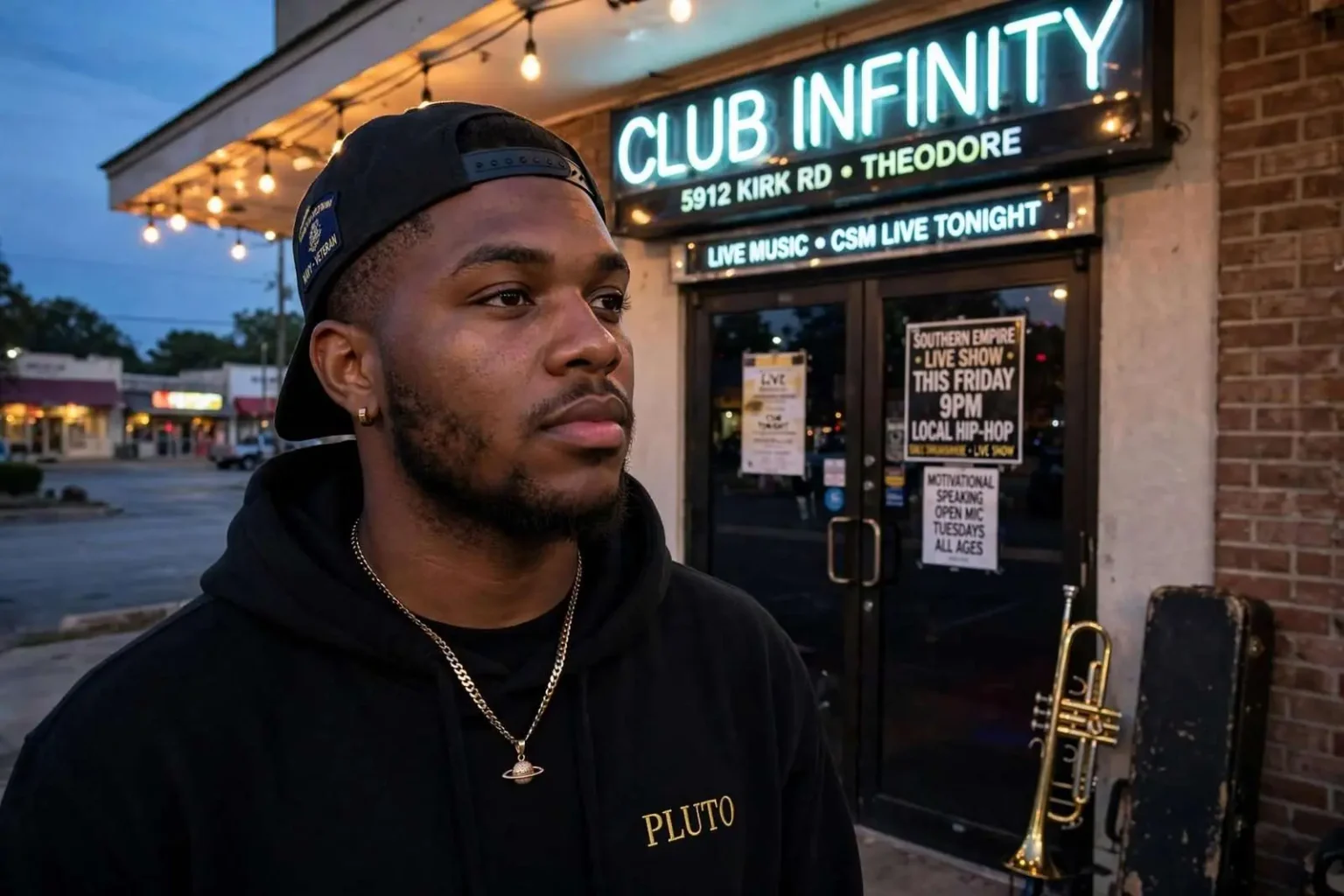
Mobile rapper Brent Parker — better known by his stage name, Pluto — has packed a lot of living into 25 years. His route through South Alabama music runs from the Orange Grove Projects to four years in the U.S. Navy and back home again, where he now raps, promotes shows and runs his own nightclub in Theodore.
Hard beginnings in Mobile
Parker grew up in Orange Grove Projects and a string of other low-income housing communities across Mobile. By his own account, his family sometimes crowded more than 15 people into three-bedroom homes, moved roughly 50 times before he turned 12, and went stretches without electricity or running water. He says the constant churn of evictions and the crime around him became part of everyday life, but he kept working — joining Mobile’s Bay City Brass Band at age 10, playing parades, weddings, funerals and school functions while also doing carpentry and roofing work alongside his uncles.
The Orange Grove housing community sits just north of downtown Mobile, one of the city’s oldest public housing sites, and its name carries weight in the city’s cultural history. Mobile’s housing communities have produced generations of musicians, athletes and entrepreneurs who came up amid hard conditions, and their stories are inseparable from the city’s broader cultural narrative. Parker’s account of those years — the crowding, the moves, the utility shutoffs — is part of that tradition, told in his own words about his own childhood.
The brass band work started young and never stopped paying dividends. Mobile’s brass band tradition runs deep: the city’s Mardi Gras heritage, the oldest in the country, fills the calendar with parades where brass bands are the engine of the celebration. A 10-year-old joining Bay City Brass Band was joining a working institution, and the gigs he described — parades, weddings, funerals, school functions — taught him the full range of occasions where music carries a community’s moments.
Music took hold in earnest in the sixth grade, when he began putting words to instrumentals and shaping himself into a rapper. The move from brass to rap is a natural one in a city where both traditions live side by side; the rhythm sense and performance instincts built in a brass band transfer directly to the stage presence a rapper needs.
Navy years and a return to the stage
At 19, Parker enlisted in the U.S. Navy and spent four years in uniform, traveling the world and performing for audiences of different nationalities along the way, according to his own telling of the story. Military service is a common thread in Mobile’s story — the region’s port, shipyards and military installations have fed generations of local families — and for a young man from the housing communities, the Navy offered structure, travel and a paycheck that his neighborhood circumstances never could.
The performing he did in uniform kept his musical identity alive through the service years. Coming back to Mobile with four years of discipline and world travel behind him, he returned to a local scene that was itself evolving, with clubs, studios and promoters building the infrastructure a homegrown artist needs to build a career without leaving the city.
Back home in Mobile, he pushed his rap career forward. In December 2010 that climb reached one of the city’s biggest stages, when Pluto took the opening slot for Rick Ross at the Mobile Civic Center. Opening for a star of Ross’s magnitude — a Miami rapper whose album releases dominated hip-hop charts for years — put the local artist in front of a full arena crowd, the kind of exposure that separates working regional acts from bedroom rappers.
The Mobile Civic Center has long been the city’s premier indoor venue for concerts and events, hosting touring acts that draw crowds from across the Gulf Coast. For a Mobile rapper, an opening slot there is a hometown landmark — the biggest room in the city, filled with the local audience that knows the artist’s name.
Listeners can hear his recorded side on tracks including “She Got It,” “What Would I Do” and “Mr. Magician Man.” The recordings document the sound he developed through the brass band years and the Navy years, a Southern rap style rooted in the Mobile scene rather than borrowed wholesale from Atlanta, Memphis or Houston.
Club owner in Theodore
These days Parker wears several hats. He owns Club Infinity at 5912 Kirk Road in Theodore, fronts his own live band, CSM, works as a promoter and motivational speaker, and is part of Southern Empire, a collective he describes as an effort to build unity in the community. He has also studied computer networking administration at Remington College.
The nightclub is the most tangible piece of the portfolio. Ownership of a venue changes an artist’s position in the local scene: instead of waiting for promoters to book him, Parker controls a stage, and the club gives other local acts a room to play and audiences a place to gather. Theodore, south of Mobile along the Highway 90 corridor, has its own nightlife demand from the growing communities of south Mobile County, and a club on Kirk Road sits within reach of both city and suburban audiences.
Fronting CSM keeps him in the live-music tradition where he started. Brass band kids understand something studio rappers sometimes miss: the stage is a craft, and a live band can hold a room in a way a DJ set cannot. The band gives Parker a performance identity distinct from his recorded catalog.
The motivational speaking and the Southern Empire collective round out a profile that looks less like a rapper’s career and more like a community builder’s. Young artists in Mobile’s housing communities face the same churn of poverty Parker described from his own childhood, and an artist who came through it — houselessness, moves, service, work — has credentials that speak to that audience in a way no outside speaker can.
Mobile’s hip-hop landscape
Parker’s career unfolds within a Mobile hip-hop scene that has produced working artists for decades without ever getting the national spotlight that Atlanta or New Orleans received. The city’s rap community runs on its own infrastructure — clubs, studios, promoters, DJs and word of mouth — and artists who make a living here do it through the kind of diversified hustle Parker embodies: shows, promotion, recordings and side ventures stacked on top of each other.
The scene’s relationship to Mardi Gras is distinctive. Mobile’s carnival season fills the city with staged events, ballrooms and street parties for weeks each winter, and local musicians of every genre work the season. An artist with a live band and a club has multiple doors into that economy, and the brass band foundation Parker built at 10 connects directly to the parade culture that dominates the city’s musical calendar.
The geography of the scene matters too. Orange Grove and the other housing communities sit minutes from downtown venues; Theodore and the southern county sit along the corridors where suburban audiences live. An artist who owns a club in Theodore, plays downtown and comes from the projects touches every part of that map, which is what makes his story resonate across lines that usually divide the city’s music audiences.
What the Navy years added
The four years Parker spent in the Navy also gave him something his neighborhood could not: proof of his own adaptability. Military service demands discipline under pressure, work with people from wildly different backgrounds, and performance — literal performance, in his telling — for audiences that did not share his language or culture. An entertainer who has held rooms full of strangers on foreign soil comes home with a confidence that reads on stage.
Veterans returning to creative careers also carry a practical mindset that serves them well in the music business. Parker’s subsequent moves — buying a club, forming a band, studying computer networking at Remington College, building a collective — suggest someone applying the same operational discipline to his own career that the service demanded. The Remington College coursework in networking administration fits that pattern: a technical skill with real employment value, studied while the music career developed.
The story he is building
At 25, Parker’s story is still in its middle chapters, but the shape is already legible. A childhood in the housing communities gave him the material; the brass band gave him the craft; the Navy gave him the discipline; and Mobile gave him the stages — from the Civic Center arena to his own club on Kirk Road. The tracks on his catalog record one version of that story, and the motivational speaking and Southern Empire work aim it at the next generation growing up where he did.
The larger lesson of his route may be the most valuable part. Success in music, as Parker’s career illustrates, is rarely a straight shot from recording to fame; it is a portfolio of work — performing, promoting, building venues, studying, serving — assembled over years in a hometown scene. For the young artists watching from Orange Grove and the communities like it, that model may be the most useful thing Pluto has produced.