

Mobile has been eating well for a very long time — longer, in fact, than it has been an American city. That is the premise behind “A Culinary History of Mobile,” a book by food tour operator Chris Andrews that traces three centuries of the city’s food story, from oysters and corn on the colonial frontier to the jambalaya pots and banana docks that made Mobile a Southern food capital in its own right.
Andrews, who owns and operates Bienville Bites Food Tours and Taste of Fairhope Food Tours, spent three years writing the book, a project that began in earnest when the pandemic shut down his tours and left him with time on his hands. Published by Arcadia Publishing, the company best known for its hyperlocal history titles, the book is organized not as an encyclopedia of restaurants but as a journey through time — twelve chapters, each tied to a specific period in Mobile’s history and each anchored to a restaurant that operates today.
“Almost like the food tours, the book gives just a taste from the restaurants that represent the connections of events and the culinary offerings of each period,” Andrews said.
Where it begins: oysters, corn and the first tables
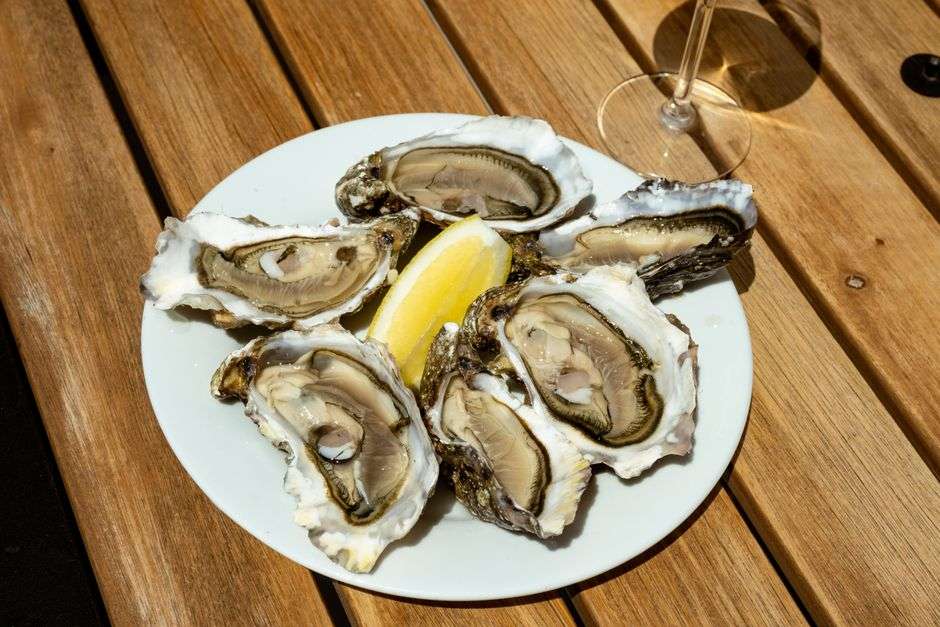
The story opens where Mobile’s food story does: in the 1700s, in a Native American world where oysters and corn were the twin pillars of the diet. Andrews ties that chapter to Wintzell’s Oyster House, the city’s venerable oyster hall, drawing a straight line from the shell middens of the colonial era to the half-shells still being shucked on Dauphin Street today.
It is also where the book makes its most confidant claim: that jambalaya belongs to Mobile, not Louisiana. “Every reference to jambalaya credits Mobile with the dish’s roots, not Louisiana,” Andrews said. “The first three uses I found were in Mobile.” It is a familiar argument for Mobilians — the same one made about Mardi Gras — and Andrews backs it with receipts. The first three printed jambalaya recipes he located appear in the May 1849 edition of the American Agriculturalist, in a dispatch by traveling food writer Solon Robinson; in the Gulf City Cookbook, published in 1878 by the women of St. Francis Methodist Church; and in the 1881 volume “What Mrs. Fisher Knows About Old Southern Cooking,” which rendered the dish as “Jumberlie.”
That last book carries one of the remarkable backstories in American food history. Its author, Abby Fisher, was born enslaved in South Carolina, married a Mobile man, and eventually settled in San Francisco, where friends who tasted her Southern cooking urged her to publish. Because Fisher could not read or write, her friends transcribed and named the book for her — and it became one of the most celebrated cookbooks in American history.
The first restaurants and the Greek table
Mobile’s first documented restaurant, by Andrews’s account, was the South Coffee Restaurant on Water Street between Conti and Government, which opened its doors in the 1830s — meaning the city’s restaurant tradition is nearly as old as the city’s printing press. “I tried to capture what was popular at the time,” Andrews said.
A later chapter tracks the enormous Greek influence on Mobile’s food scene, from the family restaurants that anchored neighborhood corners to the most celebrated of them all, Constantine’s Restaurant. Andrews ties the Greek chapter to Three Georges, the downtown landmark whose sweets case keeps that heritage in front of new generations.
War rations, banana boats and Prohibition
The book does not skip the hard chapters. During the Civil War, peanuts — a food nobody esteemed — sustained soldiers through the region’s campaigns, and Andrews ties that chapter to the A&M Peanut Shop, still selling roasted peanuts downtown. A chapter on Prohibition-era Mobile wanders through Cuba, sugar and rum, the offshore supply lines of a thirsty city.
Then comes the 20th century, and with it one of Mobile’s signature dishes. The early 1900s brought Bill Bailey’s famous restaurant on Fowl River and the creation of West Indies Salad, the chilled crabmeat dish that remains a Gulf Coast institution.
It also brought the banana docks. For nearly a century, bananas were an essential part of Mobile’s economy, and Andrews tells the story of Sam Zemurray, a Russian immigrant who bought ripe bananas off the boats and sold them from railroad boxcars at towns up the line as far north as Nashville. Zemurray built a banana empire on the strength of that trade — an empire chronicled in Rich Cohen’s book “The Fish That Ate the Whale” — and is credited with coining the term “Banana Republic” along the way.
The Clotilda connection
One of the book’s most affecting threads ties food history to the story of Africatown. Andrews credits journalist and filmmaker Ben Raines — who located the wreck of the Clotilda, the last slave ship to reach America — with much of the background he relied on. “Every food item they carried on board was documented,” Andrews said.
That thread surfaces at Kazoola Eatery & Entertainment on Dauphin Street, named by owner Mark Jackson — who grew up in Africatown — for a passenger on the Clotilda. It is the kind of connection the book is built to make: a restaurant that is also a memorial, a menu that is also a family history.
Alongside Kazoola, the book profiles the current icons of Mobile dining — Callaghan’s Irish Social Club, The Royal Scam, Squid Ink, the Dew Drop Inn and others — places Andrews considers the living heirs of the history he traces.
The writing life
Andrews is candid that writing the book was one of the hardest things he has ever done. When the country reopened after the pandemic, his tours came roaring back, and the book survived on late nights and stolen mornings. “I value my time with my family, having dinner, and going to ball games,” he said. “When the country opened back up after COVID-19, I had to get back to running the food tours. It was challenging.” Research and writing happened, he said, “often after midnight.”
Getting the manuscript over the finish line was helped by Arcadia Publishing, the world’s largest publisher of local and regional history titles. “They publish local cultural hometown history to help connect people to their communities, and this is what this book is about,” Andrews said. His inquiry about their interest was answered immediately, “and it was off to the races.”
The tours that started it
The book grew out of Bienville Bites Food Tours, which Andrews launched in 2017 as a way to tell Mobile’s history through its food — an idea, he says, that the book simply extends. His company also runs A Taste of Fairhope Food Tours across the bay, along with seasonal specialty offerings: haunted history tours running Thursday through Saturday in Mobile, a haunted cocktail tour in Fairhope, and a haunted trolley tour on Halloween night. Corporate holiday party food tours, he notes, “have become a thing,” with January increasingly popular for company celebrations once the December crush passes.
“The book is a natural progression from the history I’ve discovered from putting together the food tours,” Andrews said. “Hopefully, it will inspire people to connect periods in Mobile’s history with restaurants of today.”
That, in the end, is the book’s quiet ambition: to send readers back out into the city with new eyes — to see Wintzell’s and think of the 1700s, to see a banana in a produce stand and think of the docks, to sit down at Kazoola and remember a ship and the people who survived it. Mobile’s culinary history is not a museum piece, Andrews argues. It is a living menu, and every restaurant in town is serving a chapter of it.