From Troon to Point Clear: How Niall Fraser Helped Build Alabama’s Robert Trent Jones Trail and Found a Home at Lakewood
Lakewood Club director of golf Niall Fraser helped build 468 holes of the Robert Trent Jones Golf Trail before settling at the Grand Hotel in Point Clear.
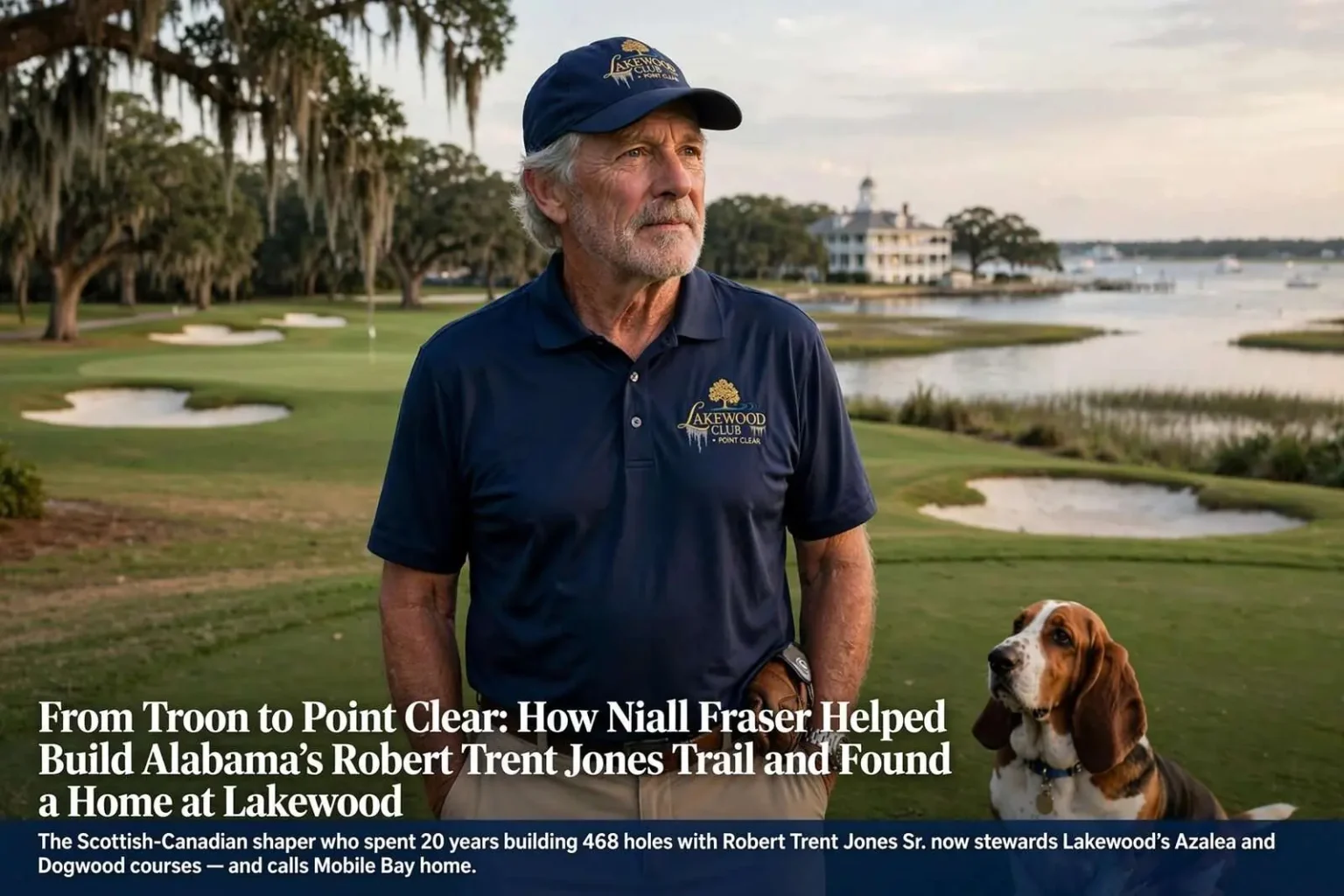
If you have ever played a round at The Lakewood Club at the Grand Hotel in Point Clear and wondered why the course looks the way it does — the angles, the bunkers, the way every hole frames the next — the answer may be walking the property with you. Niall Fraser, the club’s director of golf, spent more than two decades building and shaping golf courses alongside Robert Trent Jones Sr., the most prolific course architect of the twentieth century, before taking the helm at Lakewood and never leaving.
His route from the Scottish coast to Mobile Bay ran through small-town Canada, Michigan State turf school, and 468 holes of Alabama golf.
A name straight out of golf country
Fraser — pronounced “Neil” to American friends — was born in Regina, Saskatchewan, and moved to Edmonton as a boy. But the family’s roots are Scottish, and specifically from Troon, the Ayrshire seaside town whose Royal Troon Golf Club has hosted the Open Championship ten times, most recently in 2024. His parents, his older sister and a long roll call of relatives were all born there, and the town’s name itself is Gaelic for “nose,” a nod to a rocky point of land.
Fraser says of his Gaelic first name, which his Scottish family still uses in its home-country pronunciation, that he’s only seen it spelled this way in the States twice.
Family lore runs deep in the game. His mother played tennis, golf and track; his father was a platform diver and rugby player; an uncle was a noted Scottish golfer. His grandparents owned a dog track and a lumber company in Troon, and his grandfather served as Glasgow’s mayor in the 1930s. Hall of Fame golfer Colin Montgomerie lived next door to Fraser’s cousin Linda and her husband Stewart.
Athletically, Fraser tried everything. He graduated high school at 17, attended a Canadian Football League rookie advancement camp, and won the 40-yard dash, vertical jump and long jump events — then decided football wasn’t for him. He ski raced at a level two steps below the Olympics, and at 18 won the Canada Dry Long Drive Championship for Western Canada.
Turf school and a phone call that changed everything
Fraser played college golf at what he refers to as N.E. Oklahoma State, then went to work in course maintenance in Edmonton, pulling hoses across six holes at a time after dark during summer months. Three years as an assistant superintendent set up the next move: the 71-year-old head superintendent was weighing retirement, and the job was Fraser’s if he went to turf school.
In 1984 he chose Michigan State over Penn State and UMass, entering a class of 40 as its youngest member. The program required a six-month internship in a climate opposite the one he knew — they sent him to Palm Springs, where he managed Bent grass greens in 115-degree heat.
The lectures that mattered most came from visiting superintendents and architects, among them Robert Trent Jones Sr. Jones’s boutique design-build firm was expanding and needed people who understood grass and ground. Fraser says in November 1986 he had to decide what he was going to do, Mr. Jones hired five of them from Michigan State, and he went on the road building golf courses with Mr. Jones in 1986. He says it was old school construction, they learned to build from the ground up, the most important part was the finishing work, the icing on the cake.
Jones, Fraser recalls, never worked from detailed architectural plans. He walked the ground, and after the routing and drainage plans were set, he sketched each tee, bunker and green complex on napkins or scraps of paper. That field-first method is how Fraser learned golf course construction — and he still uses Jones’s vocabulary, describing a bunker peninsula as a “nose” and pointing to the 360-degree visuals that tie a hole together, lessons he demonstrated on the 18th of Lakewood’s Azalea course.
Building with the master
Fraser’s first project with Jones was MetroWest Golf Club in Orlando, followed by the Crumpin-Fox Club in Bernardston, Massachusetts, and The Legends Country Club in St. Louis. The work demanded adaptability: players were hitting the ball farther every season, forcing courses to lengthen landing areas and adjust hazards — while keeping the recreational golfer, and the dream of attracting major championships, in mind.
One demonstration became club history. Bellerive Country Club near St. Louis, original home of the 1965 U.S. Open, needed a renovation, and the board wanted its original designer — Jones — to do it. To make his case, Jones had Fraser hit a tee shot for the board. Fraser says Mr. Jones loved the long ball. Jones told them if his guy on a bulldozer can hit a driver 30 yards past the fairway bunkers, think of what the pros will do.
The road life had its comedies, too. Invited on a European golf trip by developer Bill Sandri — best courses, finest hotels, every tab picked up — Fraser got the bill for his share a month later and had to take out a loan. It took him four years to repay. He says never go on a trip like that with millionaires if you are a shaper.
The Alabama Trail
The call that defined Fraser’s career came from golf developer Bobby Vaughan. Fraser says he got a guy who wants to build some courses in Alabama, and he has the financial wherewithal to make it happen. The guy was Dr. David Bronner, CEO of the Retirement Systems of Alabama, and the vision became the Robert Trent Jones Golf Trail — a statewide collection of public courses built and managed by SunBelt Golf Corporation, conceived to give Alabama a tourism engine and the kind of national publicity money couldn’t buy.
Working with Vaughan, Jones and Roger Rulewich — Jones’s chief architect for 34 years — Fraser oversaw the design-build of 468 holes on 26 courses at 11 sites across Alabama. The build stretched across 13 years and transformed the state into a destination that golfers from around the world now plan trips around.
The Trail’s reach eventually included the Grand Hotel itself. The Retirement Systems of Alabama bought the Grand Hotel and Lakewood Golf Club in 1999, and the renovations rolled forward — Dogwood reopened in 2002, Azalea in 2005, the final project of Fraser’s two-decade run with the Jones firm. When the boutique business wound down after Jones’s death, Bronner and Vaughan came calling again. Fraser says they were looking for a director of golf for Lakewood, he accepted immediately, and never left.
Home at Lakewood
Today Fraser oversees two of the Southeast’s most respected courses — the Azalea and Dogwood layouts — on the grounds of one of America’s great historic resorts. Under his watch, Lakewood has hosted State Amateur, Alabama PGA and USGA events, and its practice grounds fill with high school teams and charity tournaments alike. He is a familiar presence at pickup paddle ball games and sunset watch parties, usually with photos of Jackson, his Basset Hound, close at hand.
Ask him what makes a golf course special and he answers like the shaper he is: it starts with the contour of the land, whether it’s hilly or flat, how much dirt and sand you’re going to need to shape the course. They were more interested in the finished shaping of the course, the visuals, and that’s what makes a course special.
His ties across the ocean remain strong — the trips home to Troon still feel like reunions, like the round at Royal Troon where four uncles and six cousins joined his group of 24 and he found himself hugging an aunt walking her dog on the beach beside the first hole. But his home, by his own account, is here now: a Scottish-Canadian shaper who helped build 468 holes of Alabama golf and chose the two on Mobile Bay as the ones worth keeping.
Related coverage from South AL News
- From the Fairway to the Oven: Lakewood Golf Pro Paul Cooney's Uncle Paul's Cookies
- Grandeur, Grits and Glory: Inside the Grand Hotel's 21-Year Run of Hospitality at Point Clear
- Grand Hotel at Point Clear Reaches Its Highest-Ever Finish in National Readers' Choice Awards
- Point Clear Real Estate Broker Mary Courtney Cane Grew Up Summering Over the Bay