

For 16 years, a trio of Southern friends has been piling into a motorcoach and chasing the far corners of America. Their adventures took them from the Florida Keys to Maine, from Niagara Falls to the Statue of Liberty, through Glacier and Yellowstone national parks, down into the Grand Canyon and Death Valley, into a hot air balloon over Napa Valley and out onto the San Juan Islands on a whale-watching trip. In the summer of 2022 they set out on what they billed as their “Last Hoorah”: a road trip due north to Michigan and its Upper Peninsula, a part of the country none of them had ever seen.
The travelers were Zeb Hargett of Fairhope, an entrepreneur and globe-trotter who planned the trip and served as navigator; Doug Weber of Gonzales, Louisiana, retired president of Weber Marine, a marine service company on the lower Mississippi River, who captained the motor home; and a writer from Hoover who signed on as, in his words, a deckhand and entertainment director. As Pat Conroy once wrote, “Once you have traveled, the voyage never ends… The mind can never break off from the journey.”
Rolling North to Bourbon Country
Their vessel was a 43-foot motorcoach with a master bedroom, two foldout beds, a shower and bathroom, and a small kitchen with a good-sized refrigerator, an ice maker and a dining nook. Weber drove solo from Gonzales to a campground in Pelham, Alabama, the day before, and the group met there and rolled out about 7 a.m. on a Thursday.
The pace of the trip quickly set itself, governed mostly by diesel consumption and campground availability. Weber had mapped out most of it in advance and made sure the fuel tank never dropped much below half full. Weber and Hargett handled the driving.
The first stop was Kentucky. Hargett, never one to miss a chance for a tasting, had arranged a tour of the Jim Beam distillery in Clermont, which sits, fittingly, on Happy Hollow Road. After touring the facility and sampling the products, the group headed to Louisville and the fabled Churchill Downs, home of the Kentucky Derby since 1875, for a look at the track. Dinner was at Matt Winn’s Steakhouse at Churchill Downs, named for the promoter who built the Derby into a national event, where the menu is matched by an impressive collection of rare bourbons.
Detroit, Frankenmuth and the Mighty Mac
The next morning brought them to The Henry Ford museum and Greenfield Village in Dearborn, just outside Detroit. The sprawling history museum began with Henry Ford’s personal collection of artifacts and has grown far beyond it, focusing on American industry, innovation and everyday life. Even the building’s facade is historic, echoing Philadelphia landmarks including Independence Hall. Inside, a vast exhibit hall holds trains, machinery and a large collection of automobiles, from early designs through the classic cars of the 1950s and 1960s to more modern models, fitting for a museum founded by one of Detroit’s automotive giants.
From there they headed north on Interstate 75 up the eastern side of Michigan’s Lower Peninsula, passing Flint, Saginaw and Bay City, and the village of Gaylord, which sits on the 45th parallel, halfway between the equator and the North Pole. A stop in Frankenmuth, the Bavarian-style town known as “Michigan’s Little Bavaria,” yielded homemade bread and two pounds of Michigan cherries from a farmers market.
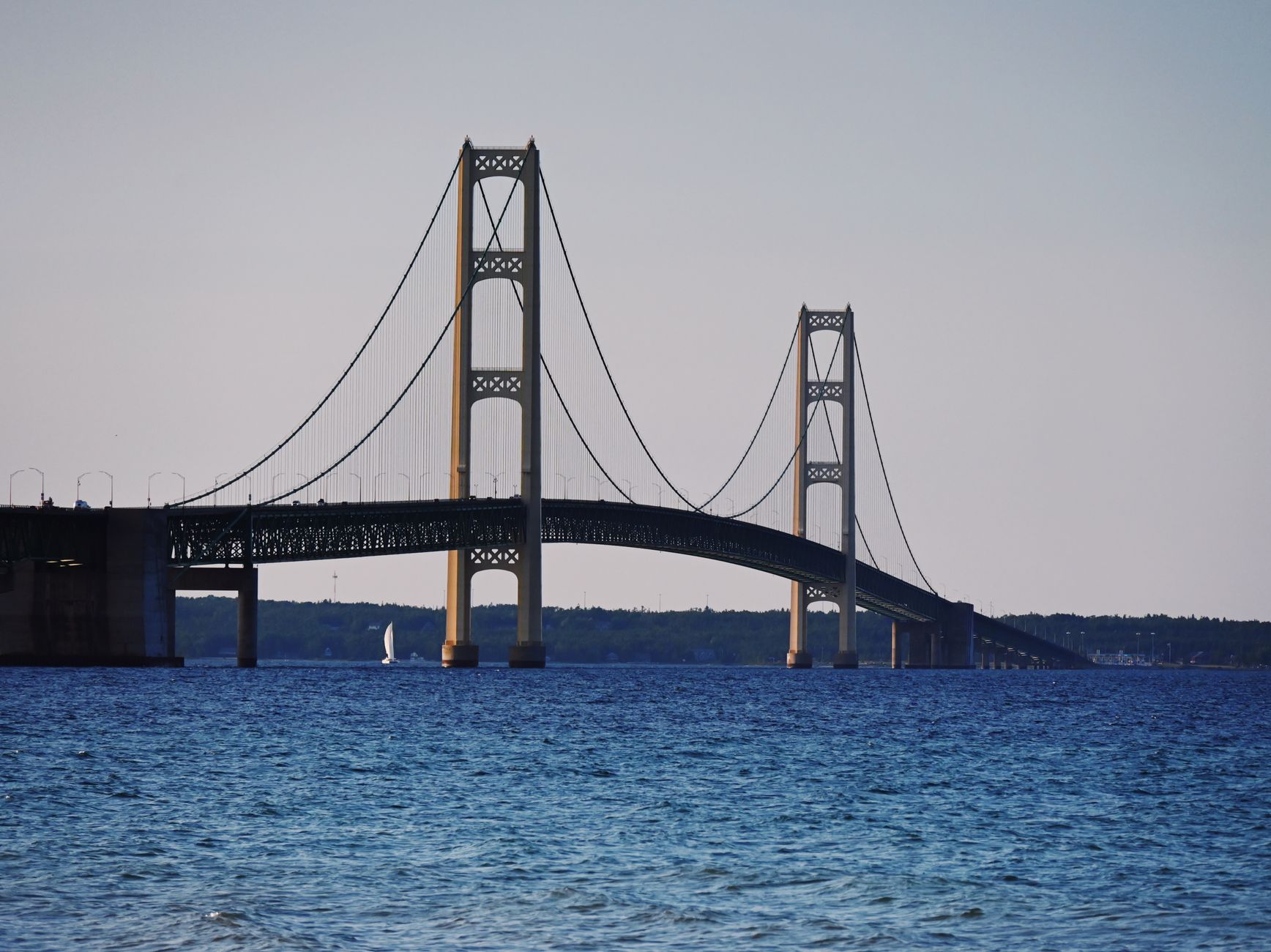
Then came the Mackinac Bridge. The suspension bridge linking Michigan’s Lower and Upper peninsulas stretches 26,372 feet, nearly five miles, across the Straits of Mackinac, and crossing it in a big motor home made for a white-knuckle ride. The group set up base camp at Straits State Park in St. Ignace for two days and celebrated with a campfire dinner of hot dogs, beans and chips.
Waterfalls, the Edmund Fitzgerald and the Soo Locks
A side trip took them to Tahquamenon Falls, one of the largest waterfalls east of the Mississippi and among the nearly 200 waterfalls scattered across the Upper Peninsula. Trails in the surrounding state park offer spectacular views of the amber-tinted water, colored by tannins from the cedar swamps upstream.
One of the trip’s highlights followed: the Great Lakes Shipwreck Museum at Whitefish Point, with Gordon Lightfoot’s ballad “The Wreck of the Edmund Fitzgerald” playing in everyone’s head. The ore carrier sank in a violent Lake Superior storm on Nov. 10, 1975, taking all 29 crew members with it. The museum complex includes a weather building, an underwater research building, a lifeboat museum, a store and a theater that shows a short film about the sinking and efforts to protect the wreck site. The ship’s bell, recovered from the wreck, cleaned and restored, is the centerpiece of the museum and a memorial to the men who were lost.
Next was Sault Ste. Marie and the Soo Locks, the parallel locks that allow ships to move between Lake Superior and the lower Great Lakes by overcoming the 21-foot drop of the St. Marys River. The locks are among the busiest waterway systems in the world. On the day the group visited, the only traffic was a sightseeing boat, but the engineering alone made the stop worthwhile.
Fudge and Horses on Mackinac Island
The travelers spent most of a day on Mackinac Island, a short ferry ride away in the Straits of Mackinac. The island is famous for fudge, with more than 17 fudge shops, and for the Grand Hotel, one of roughly 110 places to stay there. Fort Mackinac, an 18th-century military post perched on a bluff, is a major attraction, though reaching it requires a steep climb. Small museums, historic houses, restaurants and historic sites fill out the town. Cars have been banned on the island for more than a century, so visitors get around by bicycle, on foot or by horse-drawn carriage, which means watching where you step.
On the ferry back, the Alabamians fell into conversation with a man traveling with his wife and four daughters. When he learned where they were from, the talk turned to hunting and fishing, and he mentioned he was thinking about moving South. “The one requirement I have for dating my daughters is you have to own hunting land,” he said. It felt like home.
That night the resident entertainment director baked a cherry pie topped with ice cream, a repeat of a performance on an earlier trip through Washington state that had silenced doubts about his baking. The next morning the group crossed the Mackinac Bridge again, this time in a brisk crosswind that nearly made the pie a regrettable decision.
The Tunnel of Trees and a Town Like Fairhope
Heading southwest, Weber steered the coach along M-119, the famed Tunnel of Trees, a narrow scenic highway that winds beneath a canopy of hardwoods along the bluffs above Lake Michigan between Cross Village and Harbor Springs. It is widely considered one of the most beautiful drives in the country, though it is a snug fit for a 43-foot motor home.
They had heard that Harbor Springs, a historic summer resort town on Little Traverse Bay, shared a lot with Fairhope, so they parked near the downtown waterfront to see for themselves. The walkable downtown, two beaches within the city limits, green space and picnic areas were all busy with visitors, and flowers lined the streets. The resemblance to Fairhope was real.
The Long Road Home, and What Comes Next
From there it was time to head south, a trip of about 1,250 miles and nearly 20 hours of driving for Weber, and somewhat less for the others. Two days of truck stops, diesel and fast-food sandwiches followed, with an overnight stop at an urban campground in Indianapolis that proved hard to find amid road construction and poor lighting. They reached Pelham late on the second afternoon. Hargett headed home to Fairhope, the writer returned to Hoover, and Weber spent the night in the coach before driving the final leg to Gonzales alone.
Was it really the last hoorah? Weber said he planned to part with the motor home after 16 years and trade it for something more practical, perhaps a gyroplane or a small three-person submarine. His companions are not betting against another voyage.
Planning Your Own Michigan Road Trip
For Gulf Coast travelers tempted to follow their route, a few general tips:
- Timing: Summer and early fall bring the most reliable weather in northern Michigan, and fall color along the Tunnel of Trees and in the Upper Peninsula draws big crowds in late September and October.
- Reservations: Michigan state park campgrounds near popular spots such as the Straits of Mackinac fill quickly in summer, so book early.
- Mackinac Island: Ferries run from Mackinaw City and St. Ignace. Plan for walking, biking or carriages since motor vehicles are not allowed.
- Big rigs: Large RVs can cross the Mackinac Bridge, but high winds can bring restrictions, and narrow routes like M-119 call for caution.
- Must-sees: Tahquamenon Falls, the Great Lakes Shipwreck Museum, the Soo Locks and The Henry Ford make a strong itinerary for history and nature lovers alike.