

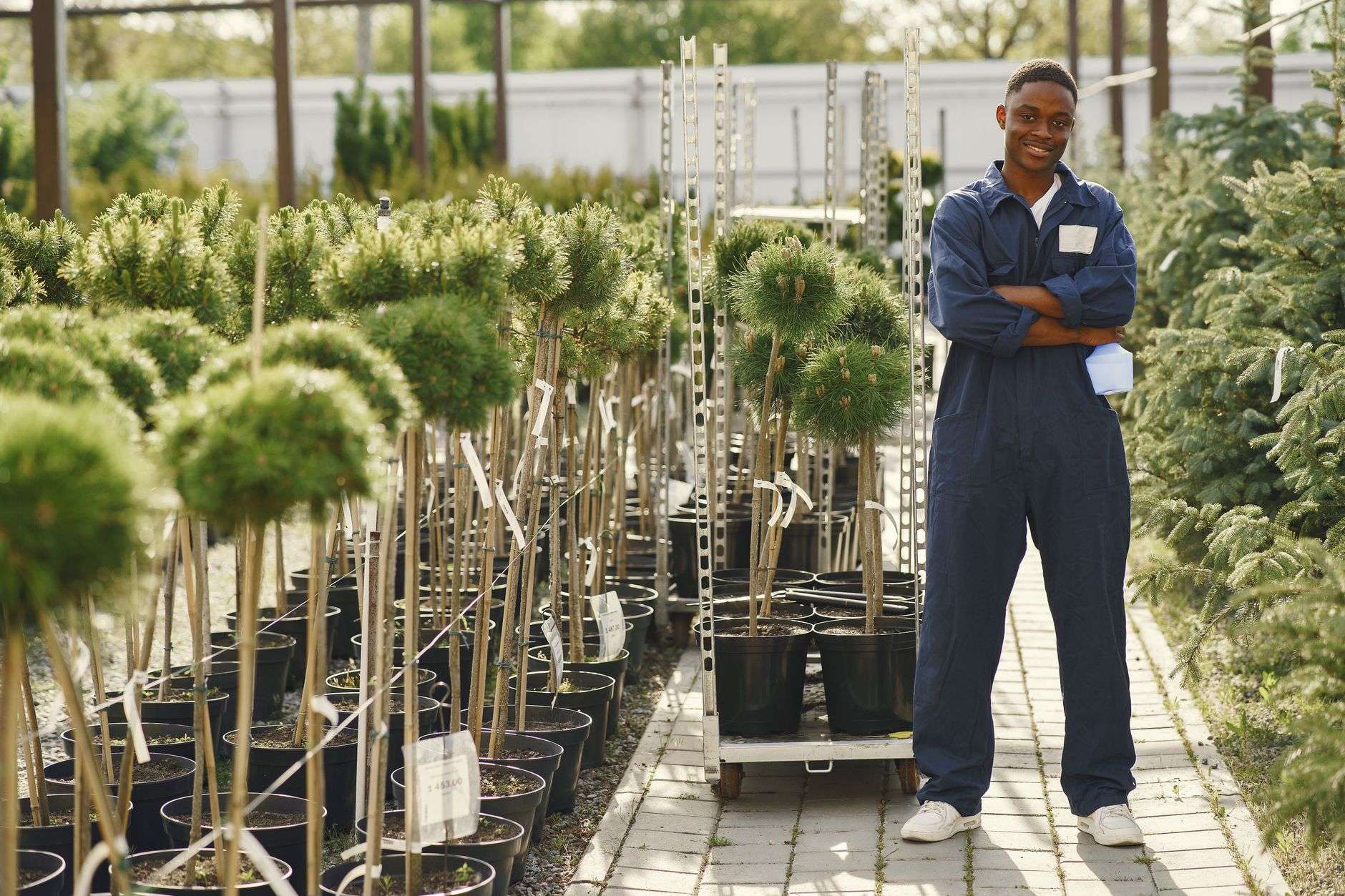
Terri Loftin rides a Softail Harley-Davidson, races a 22-foot Lindenberg sailboat and holds a fourth-degree black belt as the Alabama Master of Shorinji Kempo. She is also, by reputation, a fairy. Specifically, a plant fairy. At The Plant Fairie, her Fairhope plant nursery on Jubilee Trail, she seems able to coax almost anything to grow, from ageratum and begonias to coreopsis and on down the plant alphabet. For gardeners on the Eastern Shore, her greenhouses have become a destination for affordable, locally grown plants and practical advice from someone who does the work herself.
This profile of Loftin and her business was first shared in May 2024.
A Nursery That Grows What It Sells
What sets The Plant Fairie apart from many retail garden centers is that Loftin grows nearly everything she sells herself, through propagation. Rather than buying finished plants from wholesale growers and reselling them, she starts plants from seed or from cuttings taken from mother plants.
The process is hands-on and repetitive. Baby plants are raised under grow lights and gently misted until they are large enough to move into 6-inch pots. From there, they are stepped up into gallon containers as they grow. Two large greenhouses overflow with the results: houseplants, succulents, perennials, annuals, tropical vines climbing over every available structure, and even volunteer seedlings that sprout on their own beneath the benches. More blooming plants fill the sunny areas outside.
Loftin calls the operation a plant factory. It is also the kind of place where plant lovers can wander, browse, ask questions and discover something new. The inventory is so large that staff sometimes have to consult a plant identification app when a customer asks what color a particular plant’s blooms will be, a question that tends to draw a laugh around the greenhouse.
Customers enjoy visiting with Loftin because she is relaxed and knowledgeable, and because her prices are hard to beat. Growing her own stock, rather than buying and reselling, is what makes that possible.
Why Propagation Matters
Propagation is one of the oldest skills in horticulture. Growing from seed allows a nursery to produce large numbers of plants inexpensively, while cuttings produce new plants that are genetically identical to the parent, preserving a favorite color, leaf pattern or growth habit. Many popular houseplants, succulents and perennials root readily from stem or leaf cuttings, and a skilled grower can turn one healthy mother plant into dozens of offspring.
For gardeners, locally propagated plants have practical advantages. Plants grown in the same climate where they will be planted are already accustomed to local heat and humidity, and a small grower can tell customers exactly how a plant has performed in her own greenhouses and beds. On the Gulf Coast, where long, hot summers, heavy rains and occasional winter cold snaps can challenge plants shipped in from other regions, that local knowledge is valuable.
Fairhope is a fitting home for a grower like Loftin. The city has long been known for its flowers, and the colorful beds and hanging baskets maintained along downtown streets are one of its signature sights. That civic love of gardening carries over into residential neighborhoods, where many homeowners take pride in azaleas, camellias, hydrangeas and seasonal color. A nursery that raises its own plants fits naturally into that culture.
From Bay Minette to Auburn
Loftin grew up in Bay Minette, the Baldwin County seat. She earned an associate’s degree at what was then SouthWest State, now part of Bishop State, and went to work for the U.S. Army Corps of Engineers. Her career eventually led to a job as a draftsman for a civil engineering company.
That work pointed her toward her true interest. “I liked the landscape designer’s job of making the blueprints come alive,” she said. She went on to Auburn University to major in horticulture. Auburn’s College of Agriculture has long been one of the South’s leading centers for horticultural education and research, training generations of growers, landscape professionals and extension agents across Alabama.
A Mentor Who Changed Her Plans
After years of working in landscaping and at plant nurseries, Loftin decided in 1997 to open her own landscape business. While she waited for her license, she met Bruce Brakin, a nursery inspector with the Department of Agriculture, who became her mentor.
Brakin advised her not to become a landscaper, but to open a nursery instead. He then took her under his wing and taught her everything she needed to know to make it happen. Nurseries in Alabama are subject to state licensing and inspection, which is designed to keep plant pests and diseases from spreading through the nursery trade, so guidance from someone who knew the system from the inside was invaluable.
Loftin ran a nursery in Barnwell, the community just south of Fairhope, from 1997 to 2001. She then stepped away to raise her two sons. In 2012, she opened The Plant Fairie on Jubilee Trail, just off the Gayfer Road extension in Fairhope. She describes the business as a work in progress, and there is no shortage of work.
A Daily Workout Among the Greenhouses
A typical day at The Plant Fairie involves potting, planting, watering, rearranging, labeling, mixing soil and fertilizing, then doing it all again. Loftin handles most of it herself, carrying trays of plants from one area to another. Her fitness tracker regularly logs more than 10,000 steps a day just from her nursery chores.
Away from the greenhouses, she keeps just as busy. She rides her Harley with the American Legion Riders, the motorcycle program of the American Legion known for charity rides and support of veterans. She also races her sailboat at the Fairhope Yacht Club, one of the most active sailing clubs on Mobile Bay, whose regattas are a familiar sight off the Fairhope shoreline.
“I just like to have fun,” she said.
Her martial arts credentials are just as serious. Shorinji Kempo is a Japanese martial art founded in the years after World War II that combines self-defense techniques with an emphasis on personal development and helping others. Holding a fourth-degree black belt represents many years of training.
The Science and Therapy of Plants
Loftin loves being outdoors, and she believes many people overlook what is happening all around them in the plant world.
“Many people don’t realize the incredible science that is happening,” she said. “Being around plant energy has overwhelming benefits that go unnoticed. Physically, mentally, and emotionally, it’s healthy and therapeutic.”
Her philosophy on gardening is refreshingly simple, and it applies well beyond the greenhouse. “Everyone is born with a brown thumb,” she said. “Time and effort and trial and error is how you learn.”
That message is encouraging for new gardeners, who often assume that people with thriving gardens have some innate talent. In reality, most successful gardeners have simply killed their share of plants along the way and learned from each mistake.
Gardeners in the area who want to keep learning have plenty of resources beyond the nursery counter. The Alabama Cooperative Extension System, run through Auburn University and Alabama A&M University, offers research-based guidance on everything from soil testing to pest control, and its Master Gardener volunteer program trains residents to share that knowledge in their communities. A simple soil test, available through the extension system, is one of the most useful first steps any new gardener can take, since it shows what nutrients a bed actually needs before money is spent on fertilizer. Combined with a willingness to experiment, the kind of trial and error Loftin describes, those tools can turn even the brownest thumb a little greener.
Visiting The Plant Fairie
The Plant Fairie is located at 21085 Jubilee Trail in Fairhope. To find it, travel along the Gayfer Road extension and take the first left after crossing Greeno Road. At the time of this profile, the nursery was open Monday through Saturday from 9 a.m. to 5 p.m. Hours can change seasonally, so it is wise to confirm before making a special trip.
A few tips for making the most of a visit:
- Take your time. With two greenhouses and outdoor growing areas, there is a lot to see.
- Ask questions. Loftin’s experience with what grows well in Baldwin County is one of the nursery’s biggest assets.
- Know your conditions. Before shopping, note whether your planting spot gets full sun, partial shade or deep shade, and whether it stays wet or dries out quickly.
- Come prepared to carry plants home. A sturdy box, crate or old towel in the back of the car helps keep pots upright and soil off the upholstery on the ride back.
- Look under the benches and along the edges. Some of the most interesting finds in a working nursery are the volunteers and newly potted plants that have not yet made it to the main display.
- Think seasonally. Baldwin County’s mild climate allows for planting much of the year, but spring and fall are especially good times to establish perennials and shrubs before summer heat or winter cold.
For plant lovers on the Eastern Shore, The Plant Fairie offers something increasingly rare: a nursery where nearly every plant was raised on site by a grower who knows it personally. It is a one-of-a-kind place, run by a one-of-a-kind woman.