

Michelle Prouty wears a T-shirt that says “Plant People,” and it is less a fashion choice than a job description. The owner of Corner Copia Gardens has spent her life around plants — propagating them at age 5, selling them in elementary school, and eventually building one of Baldwin County’s most distinctive garden centers around the idea that plant knowledge is something to be shared, not hoarded.
Corner Copia sits at 13477 State Highway 181 in Fairhope, on the old Wilsey Nursery property where Prouty relocated in January 2021. It is a working nursery with an unusually wide conscience: the shop carries what she describes as the largest variety of native plants in Mobile and Baldwin counties, refuses to sell any invasive species, and maintains a dedicated birding section stocked with seed, feeders and birdhouses built by the South Alabama Land Trust.
From a cutting box to a courtyard
Prouty grew up in Spanish Fort and, as most people assume, studied horticulture. Her story took a winding road: she earned a degree in marketing and statistics from the University of South Alabama. But the plants were never far away. Her father built her a cutting box when she was a small child, and by fourth grade at Spanish Fort Elementary she was selling her own plants at the school’s Fall Family Festival.
After college, the passion resurfaced in 2015 as a container-garden design business for downtown Fairhope shops. Container gardening, she says, is a favorite discipline because it demands both an artistic eye and real plant knowledge — you have to understand the growth habits of everything you put in the pot. She built a greenhouse behind her mother’s five-acre property, started holding pop-up plant sales, and quickly found demand outstripping supply. Vendors began showing up to buy her plants, and one of them delivered the nudge that changed her life: with her depth of plant knowledge and willingness to teach, she could compete against the big-box stores. She opened Corner Copia Gardens on State Highway 104 in March 2017, and moved to the current property four years later.
What’s in the greenhouses
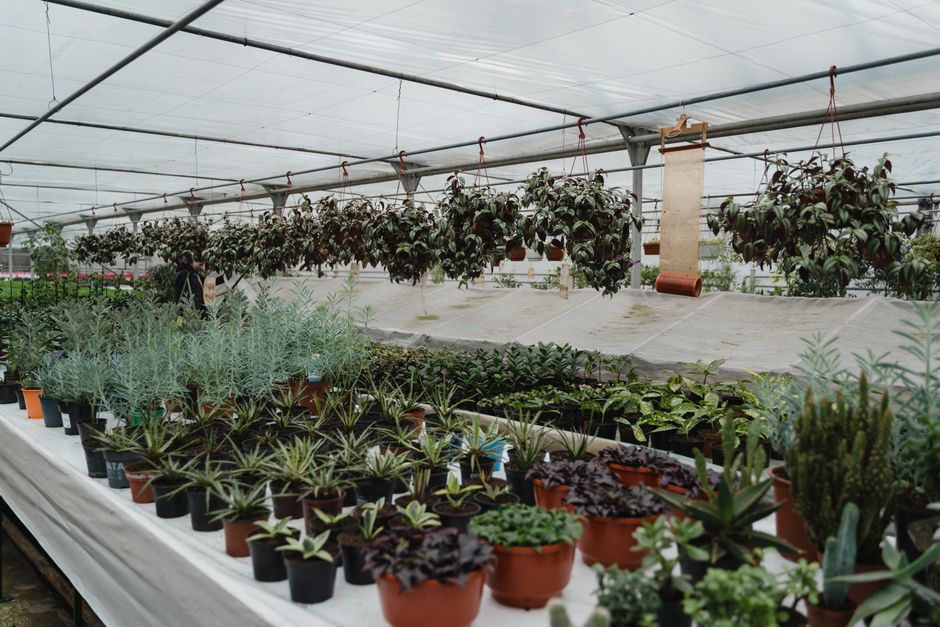
The center today has four greenhouses, a gift shop stocked with botanical goods, pottery, wind chimes and garden art, a corner store of soil, fertilizer and tools, and a courtyard shaded by statuary and fountains with outdoor seating. The inventory leans heavily toward natives — plants suited to Gulf Coast heat, humidity, sandy soils and salt air — and the staff, whom Prouty calls her “plant people,” are trained to walk customers through what to plant, where and when.
Her favorite section is the pollinator garden, planted with the native species that draw bees, butterflies and hummingbirds — from an ecological standpoint, she argues, the most important thing a gardener can do for the environment. Native plant advocates in Alabama have made the same case for years: natives evolved with local pollinators, need less water and fertilizer once established, and give migratory species the resources they depend on.
Classes, weddings and 30 acres of woods
Corner Copia has become as much a classroom as a store. The calendar of workshops includes fall gardening, flower printing, repotting and seed germination, and the most popular sessions — the Succulent Pumpkin classes — fill up with book clubs, girls’ nights out and office groups. For those events, Prouty teaches guests in minutes how to plant a mini succulent garden inside a pumpkin; all supplies are included, groups bring their own snacks and drinks, and the afternoon turns into a party.
The property surrounding the nursery holds 30 acres of woodlands, and Prouty has plans to develop nature trails with trees and plants identified and tagged, picnic tables and even event space. Visitors are welcome to bring a lunch and enjoy the grounds during business hours. The venue side is already growing: the center booked its first greenhouse wedding, with facilities manager George Davis — an experienced New Orleans event planner — overseeing it, and the Creek at Turkey Branch as the backdrop. Greenhouse weddings, Prouty notes, have taken off because at a nursery, the decorations are already there.
What to plant and when
Ask Prouty when to plant trees and shrubs on the Gulf Coast and the answer is immediate: November and December, when cooler weather lets roots establish without summer stress. For fall color she points customers to mums, pansies, snapdragons and petunias — annuals that, in a mild winter along the coast, can carry a bed all the way to spring.
That teaching instinct is what separates Corner Copia from the racks of a big-box garden aisle, and it is the reason a vendor’s challenge — that she could compete on knowledge and service — proved correct. Customers come back not just for plants but for the conversation about where the plants should go.
A native-plant destination for the coast
Interest in native landscaping has grown steadily across the Gulf Coast, as gardeners look for plants that stand up to hurricanes, droughts and salt air while supporting local pollinators. Corner Copia has positioned itself at the center of that movement in Baldwin County, both through its inventory and through its refusal to stock invasives — species known to escape cultivation and crowd out native ecosystems. Its partnership with the South Alabama Land Trust on birding products extends the same habitat-first philosophy to backyard wildlife.
For Prouty, the whole enterprise still comes back to the dream on her T-shirt: doing what you love. The cutting box her father built her has grown into four greenhouses, 30 acres of woods, a classroom and a wedding venue — and a “plant people” staff that, like their boss, assumes you will fall in love with gardening the moment somebody takes the time to show you how.