Alabama State Government Gulf Shores
Alabama Supreme Court Upholds $900,000 Verdict Against Walmart in Fake-ID Alcohol Sale Before Fatal Gulf Shores Crash
Justices affirmed a Baldwin County jury's award to the widow of an 80-year-old Indiana man killed in 2022 by an underage driver who bought alcohol at the Orange Beach Walmart with a fake ID.
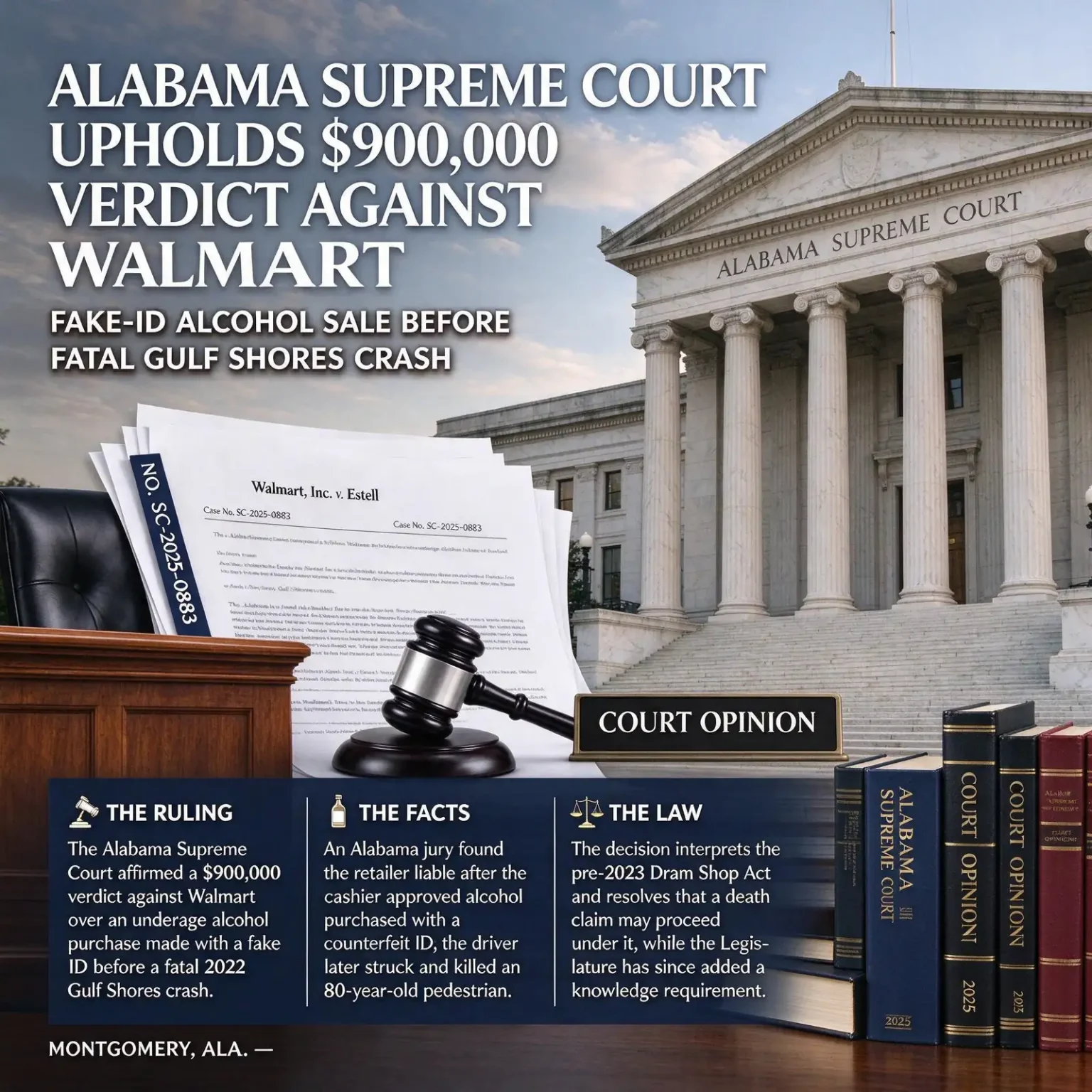
MONTGOMERY, Ala. — The Alabama Supreme Court on Friday let stand a $900,000 jury verdict against Walmart in the death of an 80-year-old Indiana man who was struck and killed on a Gulf Shores highway in 2022 by an underage driver who had bought alcohol at the company’s Orange Beach store with a fake ID.
The ruling in Walmart, Inc. v. Estell, case No. SC-2025-0883, affirms a judgment entered in Baldwin County Circuit Court after an August 2025 trial. In reaching that result, the justices rejected each of Walmart’s main arguments on appeal: that the victim’s widow did not have the legal standing to sue, that Alabama’s Dram Shop Act does not allow a claim for a death, and that the retailer should be shielded from liability because its cashier checked the buyer’s identification before ringing up the sale.
The decision also overturns a 92-year-old precedent that had stood in the way of death claims under the dram shop law, though its practical reach is limited: the Legislature rewrote the statute in 2023, and the new version did not apply to this case.
A spring break purchase and a fatal crash
According to the court’s opinion, the case began on March 15, 2022, when Jackson Walters, then a 20-year-old University of Alabama student in Baldwin County for spring break, went to the Walmart in Orange Beach and bought a bottle of champagne and a 12-pack of hard seltzer. He presented a Georgia driver’s license that listed him as 21. The license was fake; court records show he had paid $40 for it.
Store video shown to the jury indicated that the cashier held the ID for less than five seconds before handing it back and approving the transaction, a point the store’s general manager agreed with on the stand, the opinion says.
The next day, March 16, Walters drank at least four of the hard seltzers and then drove, he testified. He was heading north on Highway 180 in Gulf Shores when his vehicle struck James Reed, who was crossing the highway near 16th Street on a mobility scooter. Reed was taken to a hospital, where he died.
Reed, 80, and his wife, Bonnie Estell, were retirees from Indiana who were visiting the Gulf Shores area for spring break with their 11-year-old grandson. Court documents say Estell and the boy saw the collision from across the highway.
A police detective testified that Walters’ blood-alcohol content measured 0.11 after the crash, above Alabama’s legal limit of 0.08 for drivers 21 and older. Alabama law sets a far lower threshold of 0.02 for drivers under 21. Asked at trial whether his intoxication played a role in the crash, Walters answered, “Yes, sir, it did,” according to the opinion. He testified that the alcohol he drank that day was what he had bought at Walmart.
Walters faced a manslaughter charge in connection with Reed’s death, the opinion notes. The ruling does not describe how that criminal case was resolved.
The lawsuit and the trial
An Indiana court appointed Estell special administrator of her husband’s estate, and she sued Walmart in Baldwin County under Alabama’s Dram Shop Act, the state law that allows people injured by an intoxicated person to recover damages from whoever unlawfully sold that person alcohol.
The case was tried Aug. 11 through Aug. 13, 2025. Walmart’s defense rested largely on the argument that its cashier followed company training and procedures by checking the license, and that the fake was convincing enough to pass an ordinary inspection.
Estell’s side called Ronald Tobb, an expert in identification documents, who testified that the license carried three subtle signs it was not genuine: a crisp edge around the photo where a real license would have a feathered one, coloring that was fuller than it should have been, and a signature in the wrong place. Tobb said an ID-scanning service would have flagged the license as fraudulent “within three seconds,” according to court records.
The jury awarded Estell $900,000 in compensatory damages and nothing in punitive damages. The trial court denied Walmart’s motions for judgment as a matter of law, both during trial and after the verdict, as well as its request to alter or vacate the judgment. Walmart then appealed.
What the Supreme Court decided
The justices took up three questions, and Walmart lost on each.
- Standing. Walmart argued that Estell’s appointment as a special administrator under Indiana law did not give her the same authority as a personal representative under Alabama law. The court said the company had not pointed to any authority showing that her appointment was insufficient to let her pursue a claim over Reed’s death under the Dram Shop Act.
- Death claims. Walmart contended that no claim for wrongful death exists under the Dram Shop Act, relying on a 1934 Alabama Supreme Court decision, Webb v. French. The court overruled that case, writing that the Webb court “mistakenly equated all claims for death with the Wrongful Death Act” and “failed to account for the fact that the Dram Shop Act creates a different cause of action for death.”
- The ID defense. Walmart argued that a 1992 ruling, McLeod v. Cannon Oil Corp., protected a seller that checked an ID that looked valid. The court disagreed that the decision automatically shielded the company, noting that McLeod arose under a different statute, the Civil Damages Act.
Central to the outcome was the wording of the Dram Shop Act as it stood in March 2022. At that time, the law allowed a claim when alcohol was sold “contrary to the provisions of law” and did not expressly require proof that the seller knew, or should have known, that the buyer was underage.
The court pointed to the Alabama Alcoholic Beverage Control Board’s regulations, which at the time allowed sellers to accept only “a valid driver’s license of any state” as proof of age. Because Walters’ license was not valid, the court said, it was up to the jury to decide whether Walmart’s sale broke the law.
How the justices split
Justice Brad Mendheim wrote the main opinion. Chief Justice Sarah Stewart and Justices Shaw, Wise, Bryan and McCool joined it in full.
Justice Tom Parker concurred in part and in the result, writing separately to explain how he believed the outcome fit the text of the statutes on their face. “Ideally, our precedents should align with the text enacted by the Legislature and signed by the Governor,” he wrote. His opinion also noted that the Dram Shop Act has been amended since the 2022 sale.
Justice Will Sellers dissented. He argued that Walmart took appropriate steps to prevent an illegal sale and should not be held liable for missing flaws that even the plaintiff’s expert described as subtle.
“Without a reasonable, objective standard applicable in deciding whether the Dram Shop Act has been violated, the possibility exists of interpreting the Act so strictly that a person is punished based on a crime committed by a third party, namely, the underage purchaser of alcohol, even when that crime is entirely undetectable,” Sellers wrote. “Thus, Walmart was punished for not discovering something that even an expert might not notice at first glance.”
Justice Greg Cook recused himself from the case.
Efforts by news outlets to reach Walmart for comment on the ruling were not immediately successful Friday.
The law has since changed
The ruling applies the older version of the Dram Shop Act because that was the law on the books when the alcohol was sold. The Legislature substantially amended the statute in 2023 through Act No. 2023-25, which took effect April 19, 2023.
The amended law adds a knowledge requirement. It now gives a right of action against “any person who knowingly sells, furnishes, or serves alcoholic beverages to an individual contrary to the provisions of law, who was visibly intoxicated,” when that sale is the proximate cause of the injury. The statute defines “knowingly” as “knew or should have known under the circumstances.” The court’s opinion describes the change as expressly aimed at moving away from the strict-liability standard found in earlier case law.
That means a similar sale today would be judged under a different standard, one that asks what the seller knew or should have known and whether the person served was visibly intoxicated.
What it means for retailers and residents
For businesses that sell beer, wine and liquor in coastal Baldwin County, where spring break crowds and summer tourists swell the population for months each year, the case is a reminder of how much can turn on a few seconds at the register. The testimony at trial about ID scanners, and the dissent’s warning about holding sellers responsible for a forgery they could not reasonably detect, frame the debate that led lawmakers to change the statute.
Because the 2023 amendment governs sales made after it took effect, the court’s reading of the old law will mainly affect claims that arose before April 2023. Its decision to overrule Webb v. French, however, settles that the Dram Shop Act itself recognizes a claim for a death, a question that had been treated as closed for more than nine decades.
Alabama’s minimum legal drinking age is 21. Retailers and residents with questions about acceptable forms of identification and responsible alcohol sales can find guidance from the Alabama Alcoholic Beverage Control Board. The full opinion is available through the Alabama Unified Judicial System.