Gee’s Bend Ferry Becomes First All-Electric Vehicle Ferry in the United States
The Gee's Bend ferry in Wilcox County has become the first all-electric vehicle ferry in the United States after converting from diesel power.
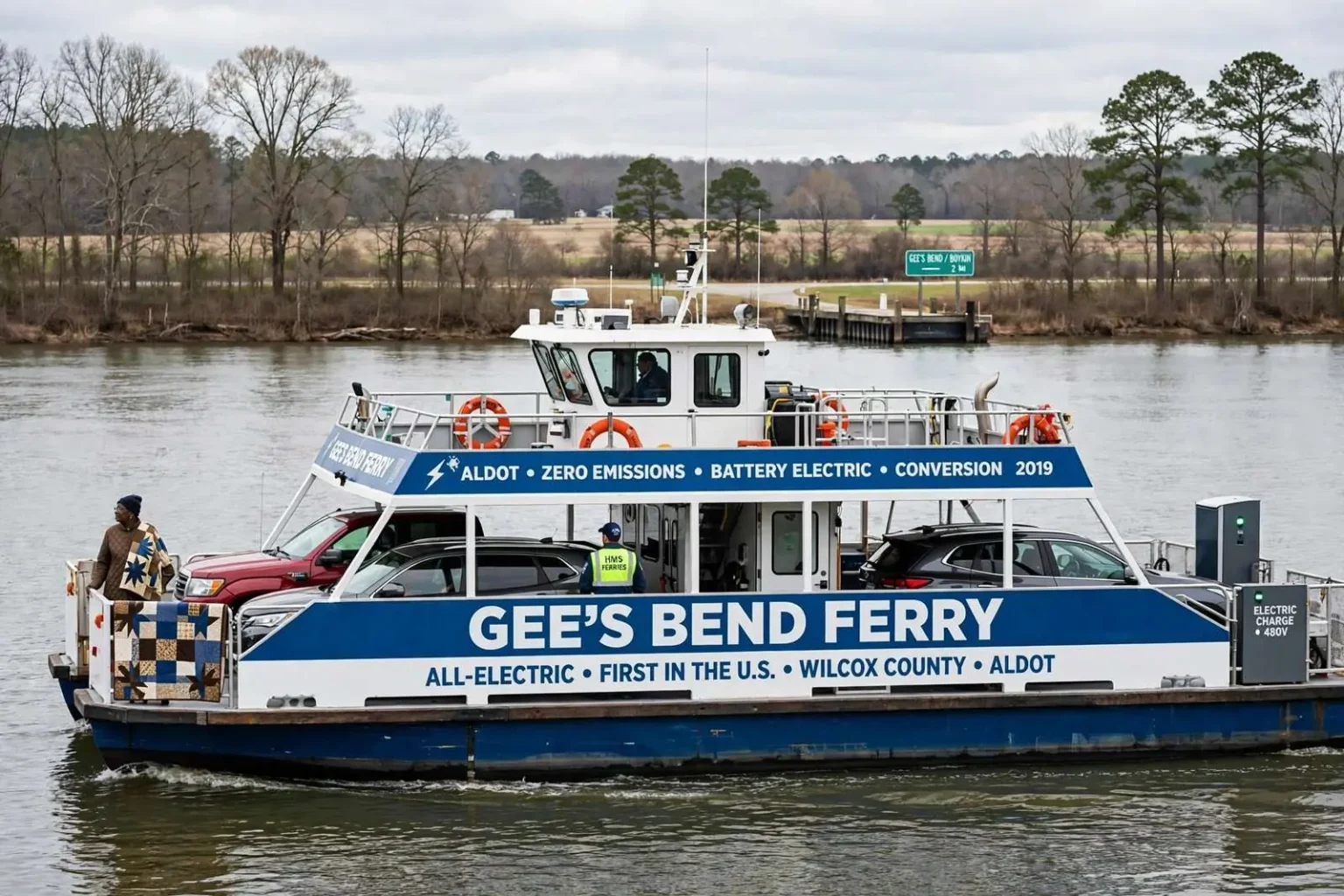
A ferry that carries drivers across the Alabama River in Wilcox County has earned a place in the transportation record books. The Gee’s Bend ferry is now the first all-electric vehicle ferry operating in the United States, according to the Alabama Department of Transportation’s Mobile office, which announced the milestone when the vessel returned to service.
The ferry came back into operation after undergoing a conversion from diesel power to an all-electric drive system. Officials with ALDOT confirmed the historic switch in early April 2019, marking what transportation leaders describe as a first for American vehicle ferries. The conversion replaced the vessel’s diesel engines and fuel systems with electric drive technology, allowing the boat to make its crossings without the noise, exhaust and fuel demands of the power plant it carried for years.
Electric propulsion changes the character of the crossing in ways passengers notice immediately. An electric ferry runs quietly, with none of the rumble and vibration of heavy diesel engines, and it produces no exhaust in operation. For a vessel that makes trip after trip across the same stretch of river every day, those differences add up — in fuel and maintenance costs for the operator, and in the experience of the drivers and passengers riding along.
Daily crossings on the Alabama River
The vessel provides daily service across the Alabama River at Gee’s Bend, the rural community in Wilcox County known nationwide for its quilting tradition and its isolated river peninsula. For residents, the ferry remains a vital link, sparing drivers the long drive around the river bend to reach schools, jobs, and services in neighboring communities.
That daily function is easy to underestimate from outside the county. The Alabama River wraps around the Gee’s Bend peninsula in a horseshoe curve, and without the ferry, residents face an extended drive around the river to reach the other side. The crossing compresses that trip dramatically, connecting the community to schools, medical care, groceries and employment on the far bank. For decades the ferry has been less a tourist attraction than a practical necessity for the people who ride it.
Although the ferry serves Wilcox County, the project falls under the Alabama Department of Transportation’s Mobile-area operations, which manage the vessel under contract. Day-to-day service is operated by HMS Ferries, a company that runs ferry systems in several states, bringing professional ferry management experience to one of Alabama’s most distinctive crossings.
A community known for its quilts
Gee’s Bend — formally known as Boykin — is a small community in one of Alabama’s Black Belt counties, a region of rich dark soil, small towns and persistent rural isolation. The community gained international fame for its quilts, the bold geometric works made for generations by the women of the area from whatever fabric was at hand. Those quilts, first photographed and later exhibited in major museums, turned worldwide attention on an isolated peninsula that many Americans had never heard of, and they remain a point of pride and a draw for visitors from far beyond Wilcox County.
The ferry itself carries a long history in that story. River crossings have linked the peninsula to the wider world for generations, and periods when the crossing was unavailable deepened the community’s isolation in ways residents still recall. The modern ferry’s return and continued operation is treated locally as an essential service, not an amenity — a reminder that transportation infrastructure in rural Alabama often comes down to a single, irreplaceable link.
A sign of things to come
The conversion positions the small Black Belt community’s crossing at the forefront of a broader shift toward electric transportation infrastructure. Diesel-to-electric repowerings of work vessels are still uncommon across the country, making the Gee’s Bend project a potential model for other river crossings considering cleaner technology.
The move aligns with a wider trend in transportation, as ferries around the world have begun shifting to battery-electric and hybrid-electric propulsion to cut fuel costs and emissions. What sets Gee’s Bend apart is that it put that technology to work first among American vehicle ferries — on a short, frequent crossing where the vessel’s regular route lends itself to electric operation. Short, repeated crossings are well suited to battery power, since the ferry returns to the same landing trip after trip and can recharge on a predictable schedule.
For a rural county crossing, the economics matter as much as the environmental ones. Electric drive systems have fewer moving parts than diesel engines, which can translate into lower maintenance costs over time, and electricity prices are generally more stable than diesel fuel prices — a meaningful consideration for a vessel that operates every day.
For now, the ferry continues its familiar routine — back and forth across the Alabama River — but it does so quietly, powered entirely by electricity rather than diesel engines. The passengers it carries see little change in their daily trip, which is precisely the point: the milestone arrived not with fanfare on the water, but with a crossing that looks the same as ever while quietly setting a first for the country’s ferries.
What the conversion involved
Converting a working vehicle ferry from diesel to electric drive is not a simple engine swap. The project involved removing the vessel’s diesel propulsion system and installing electric drive components along with the battery capacity needed to run the boat through a full day of crossings. Crews also had to ensure the charging infrastructure at the landing could support daily operations, so the ferry can recharge reliably between runs without disrupting the crossing schedule riders count on.
The work took the vessel out of service while the conversion was completed, which meant drivers who rely on the crossing had to plan around the longer overland route during the refit. For a community where the ferry is part of the daily routine, the return to service was itself news — and the fact that the boat came back as the nation’s first all-electric vehicle ferry made the reopening a milestone well beyond Wilcox County.
ALDOT’s Mobile office announced the achievement when the ferry returned to operation, and transportation officials noted the significance of the first: vehicle ferries across the United States have run on diesel and other conventional fuels for generations, and no American vehicle ferry had made the complete switch to all-electric power before this one did.
Electric ferries and the bigger picture
The milestone comes as transportation agencies nationwide take a harder look at electrification. Battery-electric technology has spread from passenger cars to buses, delivery fleets and now marine applications, driven by falling battery costs and the operational savings that electric drive can offer. Ferries are natural candidates: they run fixed routes, return to the same docks on a regular cycle, and spend much of their operating life at modest, steady speeds — all characteristics that suit battery power.
In that context, Gee’s Bend made a fitting proving ground. The ferry’s short crossing and frequent schedule give operators real-world data on how an electric vehicle ferry performs through a working day, information that did not previously exist at scale in the United States. Every trip the vessel makes adds to a body of experience that other operators — from state ferry systems to county-run river crossings — can draw on when weighing their own conversions.
For the people of Gee’s Bend, the change in propulsion comes secondary to the service itself. What matters to riders is that the boat runs on time, every day, connecting the peninsula to the communities across the river. The electric conversion promises to keep that service viable for years to come, with lower fuel exposure and reduced engine maintenance helping the crossing remain dependable on a budget.
The crossing also remains a living piece of the community’s story. The ferry has carried residents, students, workers and — in more recent decades — visitors drawn by the quilting tradition that put Gee’s Bend in museums across the country. Each generation of the vessel has carried that legacy across the river, and the electric ferry does so with a quiet that older crews and riders would find striking.
Transportation planners often describe rural infrastructure in terms of roads and bridges, but river communities know that a ferry can be as critical as either. When the crossing is running, Gee’s Bend is minutes from the far bank; when it is not, the geography of the river bend reasserts itself, and the peninsula becomes what it was historically: a place set apart by water. The certainty of a daily crossing underpins school attendance, shift work, medical appointments and commerce, which is why the vessel’s upkeep draws attention well beyond its size.
With the conversion complete and service resumed, the Gee’s Bend ferry now holds a distinction no other American vehicle ferry can claim, and it holds it in one of the least likely places — a quiet bend in the Alabama River in rural Wilcox County. It is a first that arrived without ribbon cuttings on the water, carried out by a state transportation department, a contracted operator and a small boat that simply kept doing its job, now with no diesel behind it. For a community that has spent generations turning practical necessity into art, there is something fitting about the nation’s electric ferry first beginning its daily rounds there.