After 15 Years on Death Row, Capital Murder Case Against Former Trooper George Martin Dismissed
A Mobile County judge threw out the capital murder case against former state trooper George Martin, who spent 15 years on death row, citing willful prosecutor misconduct in the 1995 death of his wife.
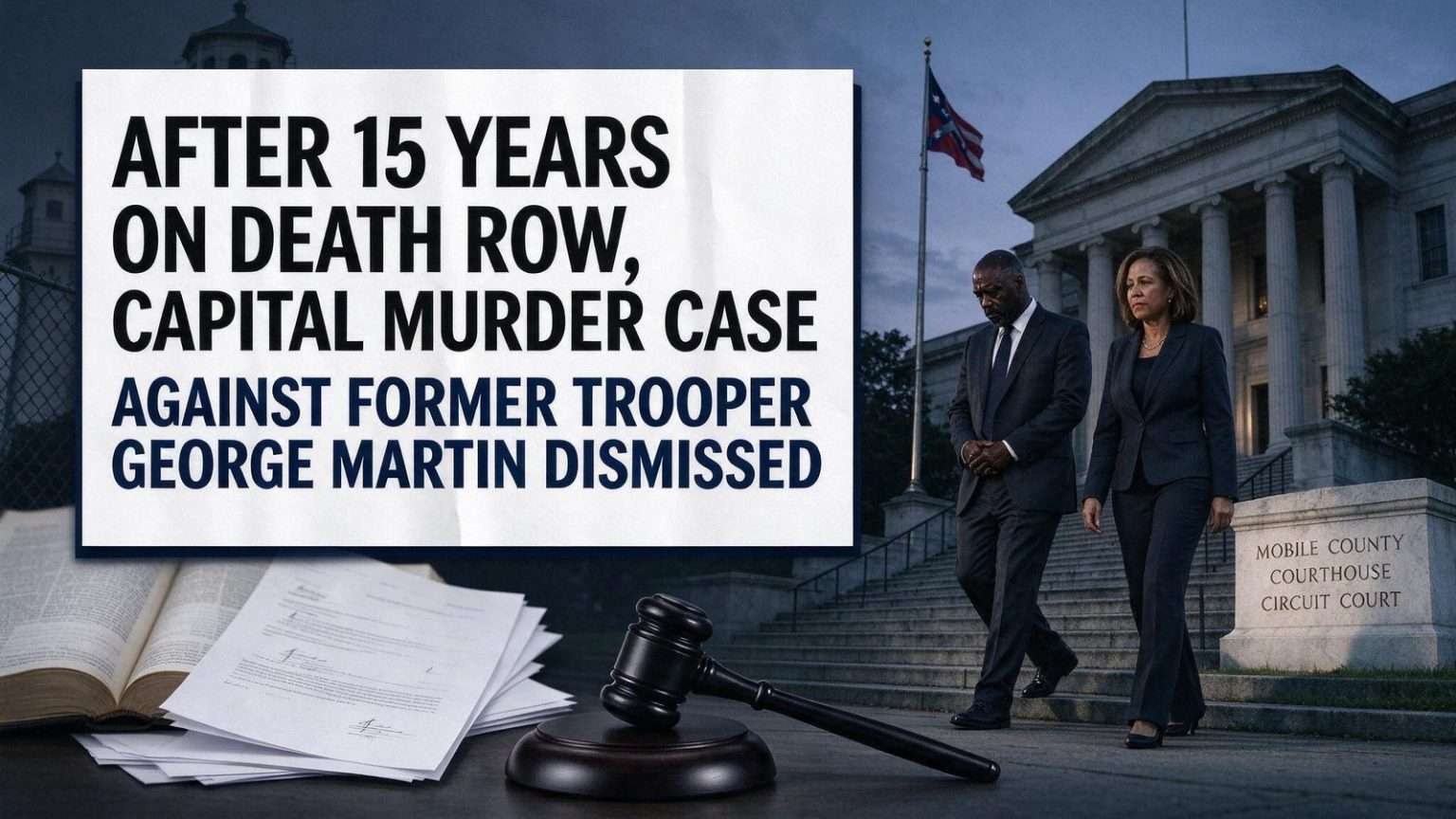
A Mobile County judge has thrown out the capital murder case against George Martin, a former Alabama state trooper who spent 15 years in solitary confinement on death row in the 1995 burning death of his wife, finding that prosecutors willfully withheld evidence that could have aided his defense.
Circuit Judge Robert Smith dismissed the charges, concluding that the state’s conduct had made a fair trial impossible so many years after the crime. The ruling followed Smith’s earlier decision to release Martin on bail pending a new trial, a decision already upheld on appeal along with several other findings favorable to the defendant. The state signaled it would seek to overturn the dismissal and retry Martin, meaning the case’s end, for now, may not be final.
The dismissal is a rare sanction in Alabama courts, where prosecutors’ missteps more often produce new trials than the complete abandonment of a prosecution. Smith’s order took pains to explain why this case, of all cases, crossed the line.
A 1995 death on Willis Road
The badly burned body of Hammoleketh Martin was discovered inside her Ford Escort along Willis Road in Tillmans Corner on Oct. 8, 1995. Tillmans Corner sits in the sprawl of southern Mobile County, where residential subdivisions and commercial strips radiate out from U.S. Highway 90, and Willis Road cuts through some of its quieter stretches. Investigators concluded that she had been burned alive.
Suspicion quickly fell on her husband. George Martin, then in financial difficulty, had steadily increased the life insurance on his wife until it reached $380,000 at the time of her death. The accumulation of coverage, taken out in increments rather than in a single policy, became a centerpiece of the state’s theory of motive.
What followed was an unusual prosecutorial shuffle. The Mobile County District Attorney’s office declined to prosecute the case at all. The Alabama Attorney General’s office took over and secured an indictment in the summer of 1999, roughly four years after the death. A jury convicted Martin in 2000 and recommended life in prison, but the trial judge, the late Ferrill D. McRae, overrode the jury and imposed a death sentence — an override permitted under Alabama’s judicial sentencing law, and one that placed Martin in solitary confinement on death row, where he would remain for 15 years.
‘Riddled with impropriety’
In his order, Smith described a prosecution “riddled with impropriety and missteps.” He found that assistant attorneys general had withheld potentially exculpatory material to which the defense was entitled, and that the passage of time had compounded the harm. Evidence that could have been chased, tested and rebutted in 1996 was effectively beyond recovery by the time anyone tried.
“Time has become the enemy of memory and life,” the judge wrote. “The prejudice suffered by Martin cannot be corrected by a new trial.”
Smith pointed to several elements of the state’s case, each of which, he found, had been compromised by the prosecution’s handling.
The first involved the testimony of a jailhouse informant who claimed Martin had confessed to him. The informant now said he no longer remembered the supposed admissions at all, an erosion of memory that left the state’s only direct evidence of confession in tatters. The judge noted that the purported confession occurred while the informant was a misdemeanor prisoner housed near capital defendants — a proximity that gave the informant, whatever his motives, access to the county’s most serious offenders and, potentially, material worth something to prosecutors.
The second involved the handling of a witness who told a Mobile police major that he saw a black trooper “fill up the car” at the scene. Martin is a small man, a physical fact that mattered to any identification built around the person seen at the vehicle, and notes reflecting the statement were never turned over to the defense. Compounding the problem, the witness had also identified a different trooper from a photo spread that included Martin — a fact that cuts against the reliability of his identification and that the defense, without the notes, had no fair chance to explore.
The third was a gas can. The victim’s sister told an investigator she had seen a gas can in the hatchback weeks earlier, yet a prosecutor argued in closing that no such can existed. The discrepancy between what the state’s own investigation had recorded and what its lawyer told the jury went to the heart of the arson theory, and the defense never had the benefit of confronting it.
“If the Martin case is not one which is appropriate for dismissal, there may never be one,” Smith wrote.
The quotation compressed the judge’s reasoning into a single standard: if the accumulated failures of a prosecution — withheld notes, an informant’s vanished memory, a closing argument contradicted by the state’s own file — do not justify dismissal with the passage of nearly two decades, the sanction exists in name only. Few Alabama trial judges have invoked it in a capital case, and fewer still after a jury has convicted and a judge has sentenced. Smith’s order now stands as one of the clearest statements of when that threshold is met, and it will be read against for years by lawyers on both sides of post-conviction fights across the state.
The ruling does not adjudicate Martin’s innocence or guilt. It adjudicates the state’s conduct. A dismissal with prejudice, like the one Smith entered, forecloses retrial in principle; the state’s announced intention to appeal means an appellate court will now decide whether Smith drew the line correctly.
What comes next
The ruling ends, at least temporarily, one of the longest-running capital cases in the county’s recent history. Fifteen years on death row, followed by years of post-conviction litigation, have made the Martin case a fixture of Mobile County’s legal landscape — cited by defense lawyers, studied by judges, and watched by a family that has now waited through three decades of court filings for a final answer.
Martin’s original defense was handled by Mobile attorneys Dennis Knizley and Ken Nixon, two of the best-known criminal defense names on the Gulf Coast. A Los Angeles attorney later took over his appeal and continues to represent him, bringing to the case the resources and persistence that capital post-conviction work demands. The handoff from a local trial team to a specialist appellate advocate is a common pattern in death penalty cases, where the legal questions shift from facts and juries to constitutional doctrine and records.
The state, for its part, has signaled it will seek to overturn the dismissal and retry Martin if the appellate courts allow. That path would require the Alabama Court of Criminal Appeals, and potentially the state Supreme Court, to find that Smith abused his discretion in imposing the ultimate sanction. Until those appeals are resolved, Martin remains out on the bail Smith previously set — free, for the first time in 15 years, while the litigation continues.
Smith was careful to frame the dismissal not as a technicality or a windfall, anticipating the criticism that dismissing a capital case over decades-old conduct would draw. His order reads, in places, like a reply to the argument that a convicted defendant should simply live with the outcome, whatever the courts later find about how that outcome was produced.
“This is not a windfall to Martin, who has served 15 years in solitary confinement on death row, and is certainly not a procedural device to allow Martin to escape justice,” he wrote. “While this is a rare sanction, it is the proper sanction in this case.”
The judge’s distinction matters. Alabama courts retain discretion to dismiss prosecutions outright when the state’s misconduct makes fair proceedings impossible, but the sanction is reserved for the most serious failures — exactly the kind Smith cataloged: exculpatory notes never turned over, an informant whose confession story dissolved into admitted non-recollection, and a closing argument that denied the existence of evidence the state’s own investigators had documented.
For the Mobile County criminal justice system, the order lands at a moment of heightened attention to old convictions and the reliability of jailhouse informants. Whether the appellate courts uphold the dismissal or send the case back for yet another trial, the record Smith compiled — testimony, notes, and two decades of litigation compressed into a single order — will remain the authoritative account of what went wrong in a prosecution that began on Willis Road in 1995 and has still not ended.
What the victims’ family, the defendant and the county are left with is the same uncomfortable arithmetic that has defined the case from the start: a death that has never produced a final judgment, a trial that produced a verdict the courts have since dismantled, and a question — what happened on Willis Road — that may now never be answered in a courtroom at all.