George Porter Jr. and the Runnin’ Pardners Bring Funk to the Alabama Music Box
Meters legend George Porter Jr. brings his Runnin' Pardners project to the Alabama Music Box in Mobile on Friday, July 13.
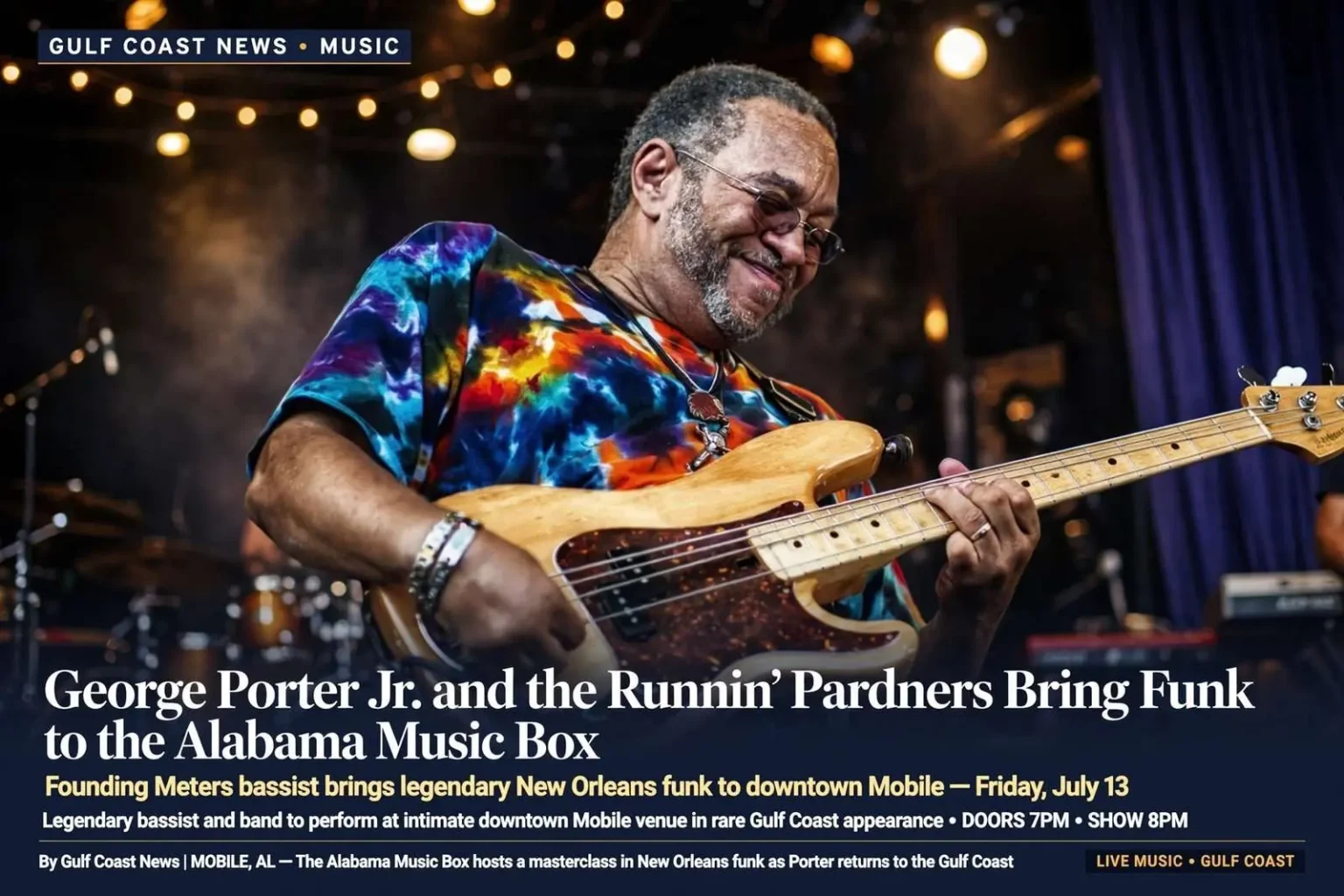
George Porter Jr., a founding member of the legendary New Orleans group the Meters, brings his Runnin’ Pardners band to the Alabama Music Box in Mobile on Friday, July 13. For Gulf Coast music fans, the date offers a rare chance to see, in a room the size of the Alabama Music Box, a musician whose bass lines helped define an entire genre — New Orleans funk — and whose influence runs through five decades of American popular music.
Widely regarded as one of the most influential bass players in American music, Porter Jr. helped shape the Meters’ signature New Orleans funk sound in the late 1960s and 1970s. The group emerged from New Orleans’ R&B scene, built around Porter’s bass, Art Neville’s keyboards, Leo Nocentelli’s guitar and Joseph “Zigaboo” Modeliste’s drums, and their instrumental records of that era — tight, greasy, rhythm-first — became the blueprint that countless funk, rock and hip-hop artists would follow. As session players, the Meters also backed some of the most celebrated recordings in New Orleans history, embedding Porter’s playing in the city’s musical bloodstream.
His bass lines have since been borrowed and sampled by artists ranging from Flea of the Red Hot Chili Peppers to Run-DMC, NWA, the Beastie Boys, Public Enemy and A Tribe Called Quest. That roll call spans two continents’ worth of genres — West Coast rap, New York hip-hop, Southern rock, funk revivalism — and explains why a musician who never chased pop stardom is nonetheless cited by name in interviews with many of the biggest acts of the past forty years. When hip-hop producers dug through the crates of the 1990s, the Meters’ catalog was among the most mined in existence, and Porter’s syncopated, melodic bass work was the reason.
A living legend on stage
The Friday show gives Mobile audiences a close-up look at a musician whose grooves are woven through decades of hip-hop and rock. Unlike arena acts that trade on nostalgia, Porter Jr. remains a working bandleader who plays steadily across the Gulf South, and the Runnin’ Pardners — his longtime band — carry the Meters’ repertoire and spirit into rooms where the audience can stand within a few feet of the stage. The Alabama Music Box, a downtown Mobile venue known for hosting national touring acts in an intimate setting, is precisely the kind of room where that proximity matters.
Porter’s live reputation rests on looseness and depth in equal measure. Setlists draw from the Meters’ catalog — songs such as the instrumentals that made the group famous alongside the vocal funk of their later records — alongside New Orleans R&B standards and the Runnin’ Pardners’ own material. Between numbers, he narrates the music’s history with the ease of someone who lived it, and audiences in Gulf Coast rooms have long responded to the combination of virtuosity and informality that defines the New Orleans tradition he represents.
The July 13 date also places the show squarely in Mobile’s summer season, when the city’s downtown venues draw crowds out for weekend music and the short drive from New Orleans makes appearances by Crescent City artists a recurring feature of the local calendar. The connection between Mobile and New Orleans runs deep musically — the two ports share brass band traditions, second-line rhythms and a century of back-and-forth among musicians — and a Porter Jr. show in Mobile functions as a homecoming of sorts for a sound the Gulf Coast shares.
The Meters and the sound they built
Understanding the Friday show’s significance means understanding what the Meters accomplished. Formed in the mid-1960s and originally known as the Neville Brothers’ backing band, the group signed to a New York label at the end of the decade and released a string of records whose instrumentals — built on Modeliste’s second-line drumming, Porter’s rolling bass and Nocentelli’s choppy guitar — created what is now called funk as immediately and identifiably as James Brown’s work in the same era. Their tunes became breakdance-era staples, and their rhythm-section vocabulary spread so thoroughly that modern listeners hear Meters-style grooves everywhere without knowing the source.
The band’s influence was formalized over time: induction into the Louisiana Music Hall of Fame, a Grammy Lifetime Achievement recognition for their label-era work, and a place in the standard histories of American music. Session work added to the ledger — the Meters famously backed Paul McCartney on a New Orleans visit, anchored recordings for Allen Toussaint and Dr. John, and collaborated with Robert Palmer and other artists who came to New Orleans to capture the city’s feel. Through all of it, Porter was the constant, the bass player whose note choices gave the band its signature sway.
Porter’s own story began in New Orleans, where he grew up around the city’s churches and clubs and played in family and school groups before co-founding the band that made his reputation. He has performed with the Meters, with the Funky Meters, with his own bands, and as a first-call session bassist across genres, and he remains among the most recorded and most sampled musicians in American history — a claim few players anywhere can make.
The Runnin’ Pardners
With the Runnin’ Pardners, Porter fronts a band built for the road: guitar, keys, drums and bass working through funk, R&B and New Orleans material with the authority of players who have spent years in this repertoire. The band gives Porter room to stretch — extended grooves, bass-led improvisation, the conversational interplay that made the original Meters a model for jam bands and funk groups alike — while keeping the focus on songs that audiences recognize from the first bar.
Gulf Coast audiences have followed Porter’s bands for decades, and rooms across south Louisiana and south Alabama regularly book his appearances because they reliably fill. The Alabama Music Box show fits that pattern: a national-calibre artist, an intimate room, and a crowd that mixes longtime fans with younger musicians who studied his lines secondhand through the hip-hop records that sampled them. For the latter group especially, hearing the source material performed by its author is a kind of live-music education unavailable on streaming services.
Mobile’s downtown music scene
The Alabama Music Box sits in downtown Mobile among the clubs and bars that anchor the city’s nightlife district, a walkable stretch where touring acts, local bands and festival after-parties share the calendar. Venues of its size occupy an important niche in the regional touring economy: large enough to pay national acts, small enough that audiences can hear a musician talk between songs. Porter’s July 13 appearance is the kind of booking that defines such rooms, and it reflects Mobile’s standing as a regular stop on the Gulf Coast circuit connecting New Orleans, the Mississippi Coast and the Florida panhandle.
Porter Jr. and the Runnin’ Pardners take the stage at the Alabama Music Box, with doors at the downtown Mobile venue ready for a weekend of funk. For Mobile audiences, the Friday show amounts to a master class in the bass-playing and bandleading that shaped American funk — performed by the man who wrote the book, in a room where every note can be heard up close, and in a city whose own musical traditions make it the perfect audience for what he and the Pardners bring.
Why the sampling legacy matters
The list of artists who have sampled or borrowed from the Meters’ catalog — Run-DMC, NWA, the Beastie Boys, Public Enemy, A Tribe Called Quest — traces the history of hip-hop itself. In the genre’s formative years, producers built tracks by looping funk drum breaks and bass figures from vinyl, and Meters records were among the most reliably fruitful sources. A bass line Porter played in a New Orleans studio in the early 1970s could surface a decade later as the foundation of a rap record that sold millions, introducing his playing to audiences who had never heard the original record and sending many of them back to the source.
Flea’s case illustrates the pattern on the rock side. The Red Hot Chili Peppers’ bassist has repeatedly credited New Orleans funk — and Porter specifically — among his formative influences, and the slap-and-groove vocabulary that runs through the band’s biggest records descends in part from the Meters’ rhythm-section approach. When artists of that stature cite the source, younger players follow the trail, which is how a 1970s New Orleans groove remains a living influence in the 21st century rather than a museum piece.
That living quality is the through-line of the Friday show. Porter does not present his catalog as history; he plays it as current work, reworked for the room, with the same improvisational looseness that made the original recordings feel effortless. Audience members who know the lines from hip-hop records and those who know them from the original LPs hear the same evening differently, and both leave having heard the connective tissue of American popular music performed firsthand.
The Gulf Coast connection
Mobile’s relationship with New Orleans music is older than either city’s recording industry. The two ports traded musicians along the rail lines for more than a century, sharing brass bands, blues, R&B and Carnival traditions that made the Gulf Coast a continuous musical region rather than two separate scenes. Mardi Gras — celebrated in both cities — ties them further: Mobile claims the oldest carnival in America, and the second-line rhythms of New Orleans funk are close cousins of the rhythms that drive Mobile’s own carnival season.
That shared heritage is why Crescent City legends play Mobile rooms as regularly as they play home dates, and why local audiences respond with the familiarity of people who grew up with the music. A Porter Jr. show at the Alabama Music Box is not an import event; it is a regional musician playing for neighbors, in a venue circuit that runs from the Frenchmen Street clubs of New Orleans through the coast casinos and bars to downtown Mobile and the panhandle. The Friday, July 13 date sits squarely in that circuit, and the crowd it draws will include fans from both states.
For the venue, hosting an artist of Porter’s stature on a summer Friday signals the kind of programming downtown Mobile has cultivated: national significance, intimate scale, and a genre — funk with New Orleans roots — that the Gulf Coast claims as its own. For the audience, doors opening into a weekend of funk offer something rarer than a tribute act or a revival tour: the founding musician himself, still touring, still playing the grooves that spread from a New Orleans studio to hip-hop records, rock arenas and bass guitars worldwide, brought to a Mobile stage where the tradition and the city that shares it meet face to face.