A teacher leads a discussion with high school students in a classroomA teacher engages students in a classroom discussion

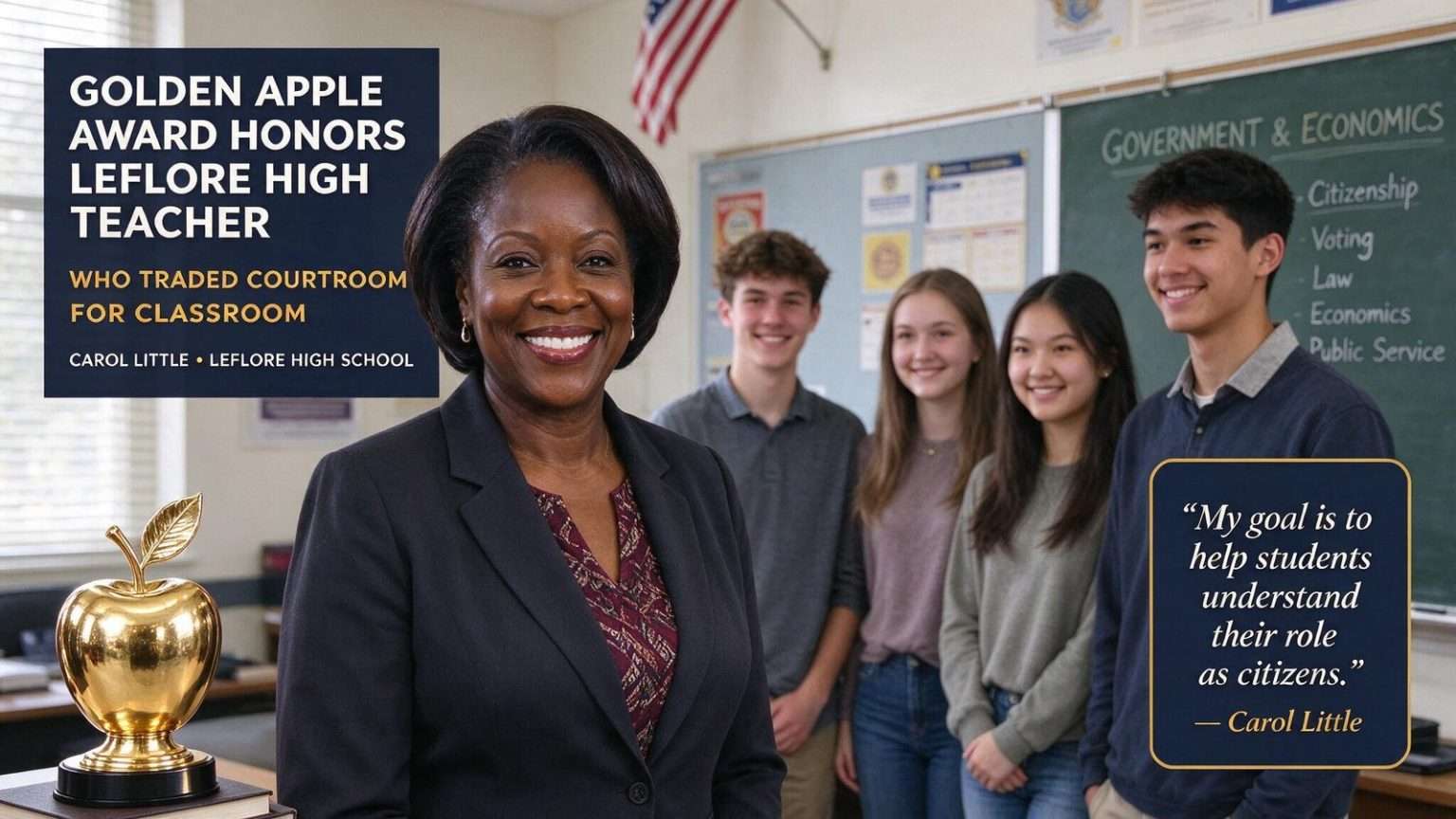
A Mobile educator who once argued cases in courtrooms and presided over a municipal bench is now being celebrated for the way she brings that real-world background into her high school classroom. Carol Little, who teaches government and economics at LeFlore High School, has been named a Golden Apple Award winner, one of the region’s most recognized honors for classroom excellence.

Little’s path to teaching was anything but conventional. Before stepping in front of students, she worked as a lawyer, served as an assistant city attorney, and later sat as a municipal judge. That combination of legal training and courtroom experience now shapes how she approaches her government classes, where she says her central mission is to help teenagers understand their role as citizens.

“The goal of a government class is to make sure students become responsible citizens,” Little said. “And I’m also a lawyer, so I understand the importance of voting and having our young people realize how important it is that they participate in our system.”

For Little, simply teaching the mechanics of government is not enough. She said she hopes her lessons plant a seed that grows well beyond graduation.

“Hopefully one of my students will come to me and say, ‘I’m running for office, and I learned I could run for office from taking your class, and realized how important it is’ — so that’s my goal in life,” she said.

Students at LeFlore say that approach has already made a difference. Doniceia Matthews, who nominated Little for the award, said Little’s influence extended across her entire time at the school. “The reason I chose Ms. Little was because she has motivated me and encouraged me all my years at LeFlore High School,” Matthews said.

LeFlore Principal Dr. Antonio Williams said Little’s background sets her apart from many classroom teachers, giving lessons on government and civic participation an authenticity that textbooks alone cannot provide.

“She brings a wealth of knowledge and experience and expertise to the classroom,” Williams said. “She’s able to bring a lot of real-world experiences into the lives of our students.”

The Golden Apple Award recognizes educators across the region for outstanding classroom instruction and dedication to their students, with winners typically nominated by students, parents or colleagues who have seen firsthand the difference a teacher has made. Little’s recognition adds to a growing list of honors for educators within Mobile County’s public school system.

School officials and colleagues have congratulated Little and LeFlore High School on the honor, noting that her work in the classroom reflects the kind of civic-minded instruction the award is designed to celebrate.

See also  Deputy Superintendent Hired a Lawyer as Scrutiny of 200 Phone Calls Intensified

This story unfolds across the distinctive landscape of South Alabama, a region defined by its pine forests, winding rivers, and Gulf Coastal Plain geography. The area’s communities—from the port city of Mobile to the agricultural heartlands of the Black Belt—share interconnected economies and histories shaped by timber, agriculture, shipping, and more recently, aerospace and advanced manufacturing. Local governance across county lines often coordinates on regional planning, workforce development, and infrastructure projects that affect residents throughout the southern tier of the state. The geography itself shapes daily life: low-lying coastal plains face hurricane exposure, while inland counties contend with river flooding and rural transportation challenges. Understanding the setting helps explain why local decisions carry weight far beyond municipal boundaries.

Economic activity in South Alabama reflects both deep-rooted industries and emerging sectors. The region’s forest products industry remains a cornerstone, while the Port of Mobile anchors global trade connections. Aerospace manufacturing has grown significantly around the Mobile Aeroplex at Brookley, and automotive suppliers feed assembly plants across the Southeast. Workforce development initiatives through community colleges and the Alabama Industrial Development Training program aim to align skills with employer needs. Broadband expansion and highway improvements—including the I-10 Mobile River Bridge project and I-65 corridor enhancements—address longstanding connectivity gaps that affect business recruitment and quality of life. Small businesses, agriculture, tourism, and the service sector round out a diverse regional economy that has weathered national downturns through a mix of resilience and adaptation.

Education across South Alabama spans a network of public school districts, community colleges, and universities serving diverse student populations. The University of South Alabama in Mobile anchors higher education with medical, engineering, and marine science programs, while Troy University, Faulkner University, and Spring Hill College provide additional four-year options. The Alabama Community College System—including Coastal Alabama, Bishop State, Reid State, and Lurleen B. Wallace Community Colleges—delivers workforce training, dual enrollment, and transfer pathways. K-12 districts navigate state accountability measures, teacher recruitment challenges, and facility needs across urban, suburban, and rural settings, with local tax referendums often determining supplemental funding for programs and capital improvements. Partnerships between schools, employers, and nonprofits aim to keep opportunity tied to place, so that graduates can build careers without leaving the region.

Sport occupies a central place in South Alabama’s community life, from Friday-night high school football that draws whole towns to the sidelines, to college athletics at the University of South Alabama and across the state. Mobile’s longstanding role as a cradle of football talent—producing legends who went on to the professional ranks—is a point of regional pride, reinforced by events like the Senior Bowl, which has showcased NFL hopefuls in the city for decades. Youth leagues, recreation departments, and booster clubs sustain participation at the grassroots level, while the area’s coastal setting supports fishing tournaments, regattas, and beach athletics that reflect the local environment. The economic and social lift from sporting events—hotel stays, restaurant traffic, and civic visibility—makes athletics a quiet but steady contributor to the regional identity and to the small-business economy that surrounds game days.

See also  Alabama Opens 2021 Alligator Hunt Registration, With 260 Tags Across Five Zones

Animal welfare organizations across South Alabama operate with limited resources and a steady stream of need. Municipal animal shelters in Mobile, Baldwin, and neighboring counties manage intake, adoption, and reunification efforts, often partnering with nonprofit rescues that provide foster networks, spay-neuter assistance, and transport to out-of-region adopters. Volunteer-driven groups fill gaps that public funding cannot, relying on donations, fundraisers, and grant support to keep operations running. The Gulf Coast’s position as both a tourist destination and a growing residential region has increased demand for pet services, while rural areas contend with stray and feral populations that strain capacity. Community education on responsible ownership, microchipping, and low-cost veterinary care has emerged as a practical lever for reducing shelter overcrowding. Efforts like local giving campaigns demonstrate how resident participation can translate directly into care for animals that might otherwise go without.

As this situation continues to develop, stakeholders across the affected communities will monitor outcomes and adjust responses accordingly. The interconnected nature of South Alabama’s counties means that decisions in one jurisdiction often ripple outward, affecting neighbors in ways that underscore the value of regional communication and coordinated planning. Residents seeking to stay informed can engage with local government meetings, school board sessions, and community forums where these matters are discussed in public. The ongoing dialogue between officials, experts, and citizens reflects the democratic processes through which the region navigates change while preserving the character and resilience that define its communities. Continued attention from local news outlets helps ensure that decisions remain transparent and that the people most affected have the information they need to participate in shaping what happens next.

Healthcare delivery in the region contends with the dynamics of a largely rural service area anchored by regional medical centers. USA Health’s University Hospital and Children’s & Women’s Hospital in Mobile provide tertiary care, while community hospitals in Baldwin, Escambia, Monroe, Clarke, and other counties serve as critical access points. The expansion of telehealth, federally qualified health centers, and rural health clinics addresses provider shortages that have long challenged underserved areas. Public health departments coordinate on immunization, disease surveillance, maternal health, and emergency preparedness, often in partnership with the Alabama Department of Public Health and federal HRSA-supported programs. Access to care remains a defining issue for the region, influencing everything from economic development pitches to quality-of-life rankings that prospective residents weigh when deciding where to live and work.

See also  Satsuma First Responder Tests Positive for COVID-19 Antibodies, Negative on Follow-Up Swab

The cultural fabric of South Alabama weaves together Indigenous heritage, colonial-era settlements, Civil War history, civil rights milestones, and enduring folk traditions. The region’s Mardi Gras traditions—centered in Mobile as the birthplace of North American Mardi Gras—coexist with community festivals celebrating shrimp, peanuts, watermelons, cattle, and maritime heritage. Historic districts in Mobile, Fairhope, Monroeville, and elsewhere preserve architectural character while supporting heritage tourism. The Alabama Historical Commission, local preservation societies, and the Alabama Trust for Historic Preservation work to protect significant sites. Oral history projects and university archives document the stories of communities shaped by agriculture, timber, shipbuilding, and the ongoing negotiation of identity in a rapidly changing South. These traditions not only enrich daily life but also anchor a sense of place that newcomers and longtime residents share.

The environmental context of South Alabama is inseparable from its waterways and Gulf coastline. The Mobile-Tensaw Delta, one of the nation’s most biodiverse river systems, filters freshwater into Mobile Bay while supporting fisheries, recreation, and flood mitigation. Coastal communities face recurring hurricane exposure and long-term sea-level considerations, shaping building codes, insurance markets, and emergency planning. Conservation efforts by organizations like the Alabama Coastal Foundation, The Nature Conservancy, and state agencies work to preserve critical habitat while balancing development pressures. Water quality monitoring, oyster reef restoration, and living shoreline projects represent collaborative approaches to sustaining the natural resources underpinning both ecology and economy. Inland, working forests and farmland form the backbone of a rural landscape where land use decisions carry generational significance.