
Gov. Ivey Sticks With Trump as Impeachment Hearings Go Public — Speaking From Mobile’s Austal Shipyard
Gov. Kay Ivey voiced continued support for President Trump during a visit to Austal in Mobile as public impeachment hearings began.
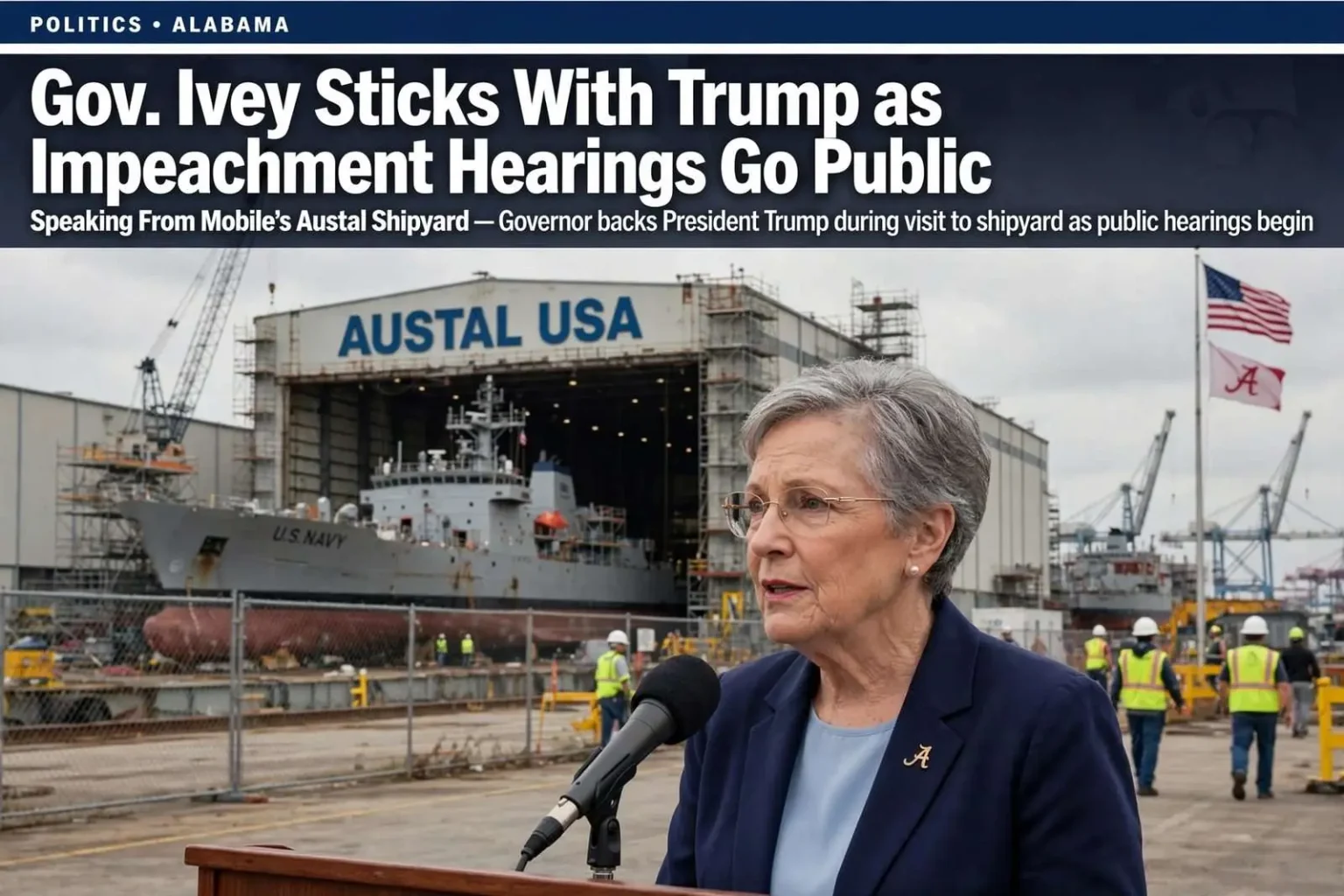
As congressional impeachment hearings moved into their first day of public testimony, most Republicans were standing firmly behind President Donald Trump — and Alabama’s governor was no exception. Gov. Kay Ivey offered her assessment Wednesday morning during a visit to Austal in Mobile, where the defense contractor builds vessels on the Mobile River. Asked about the hearings, she said she still supports the president.
“There is a lot of work that Congress ought to get done and they’re not doing a whole lot of it,” Ivey said, “but President Trump is getting things done for us, especially here in Alabama and I’m proud of that.”
The governor’s remarks came as the inquiry in Washington shifted into a new phase, with witnesses testifying in open session after weeks of interviews conducted behind closed doors. For Alabama’s state leadership, the moment arrived during a working visit to one of the Gulf Coast’s most important industrial sites, and Ivey used the question to draw a contrast between what she described as congressional gridlock and a White House she credited with delivering for her state.
A Yard Where Federal Policy Hits Home
The governor’s stop highlighted the stakes Alabama officials see in federal shipbuilding work: Austal’s Mobile operations are among the region’s largest industrial employers, making Washington policy fights a recurring topic whenever state leaders visit the yard. Decisions made on Capitol Hill about defense budgets, shipbuilding priorities and contract funding ripple directly through the paychecks of a workforce that spans the Mobile River waterfront.
Austal USA operates a major shipyard on the Mobile River, where it constructs vessels for the United States Navy. The company is the American arm of Austal, an Australian shipbuilder with a global footprint, and its Mobile facility has grown into one of the cornerstones of the region’s manufacturing economy. The yard’s production lines have turned out classes of Navy ships that are built nowhere else in the country at scale, tying Mobile’s industrial identity closely to the ebb and flow of federal defense spending.
That dependence explains why governors, senators and other elected officials routinely make the short trip to the shipyard when they want to talk about jobs and the national economy. A budget standoff, a government shutdown or an impeachment fight in Washington is never an abstraction in a community where so many families draw their income from federal contracts, and Ivey’s answer reflected the political arithmetic that Alabama’s Republican leadership has followed throughout the Trump presidency.
The Political Backdrop
The impeachment inquiry centered on the president’s dealings with Ukraine, and its move to public hearings marked one of the most closely watched stretches of the congressional calendar. Democrats argued the hearings would let the public judge the evidence for itself, while Republicans denounced the process as politically motivated and defended the president at every turn. Alabama’s all-Republican congressional delegation stood firmly in the president’s corner throughout the proceedings, echoing the position Ivey articulated at the shipyard.
Ivey, a Republican who ascended from lieutenant governor to the state’s top office in 2017 and won election in her own right the following year, has aligned herself closely with the Trump administration on policy matters ranging from regulatory rollbacks to federal disaster support. Her emphasis on Congress failing to complete its work is a familiar refrain among the president’s allies, who have pointed to legislative gridlock on issues such as infrastructure and immigration as evidence that Washington’s attention is consumed by investigations rather than governing.
At the same time, the governor’s message was aimed less at the constitutional debate than at the practical question of federal investment in Alabama. From shipbuilding to highway funding to military installations across the state, Alabama benefits enormously from federal dollars, and state officials of both parties have long made protecting that flow a central part of their Washington advocacy.
Why Austal Matters to Mobile
The shipyard’s presence has reshaped Mobile’s industrial landscape over the past two decades. What began as a modest operation expanded into a sprawling complex of production halls and waterfront piers, drawing skilled tradespeople — welders, pipefitters, electricians and shipfitters — from across the Gulf Coast. The yard’s growth also spawned a network of suppliers and subcontractors across the region, from machine shops to marine services firms, multiplying the economic footprint far beyond the gates.
Shipbuilding is a business of long cycles. Contracts awarded by the Navy commit a yard to years of sustained work, which is why announcements about future vessel programs generate such intense local interest, and why uncertainty in Washington — whether from budget fights or political turmoil — draws scrutiny from workers and economic developers alike. Each multiyear award means steady hiring projections; each lapse or delay puts planning on hold.
Mobile’s leaders have frequently framed the city as a rising center of American shipbuilding, and the yard on the Mobile River is the anchor of that claim. The facility sits alongside one of the nation’s busiest ports, with access to deep water, a skilled labor pipeline developed through area training programs, and a transportation network that moves finished vessels and heavy components with relative ease. Those advantages have made the Gulf Coast a serious competitor to the traditional shipbuilding hubs of the Northeast and the Chesapeake Bay region.
The Governor’s Travel Schedule
Visits to major employers are a staple of any Alabama governor’s calendar, and Ivey has made economic development announcements a signature of her administration. Her appearances at industrial sites across the state typically pair a policy message with a reminder of the state’s business-friendly posture, and the Austal stop fit that pattern: a factory floor backdrop, a friendly audience of workers and managers, and a chance to connect national politics to local paychecks.
The appearance also carried weight because of the timing. With impeachment hearings dominating television coverage and the 2020 election season already taking shape, every public comment from a Southern Republican governor was being measured against the national debate. Ivey’s formulation — backing the president while scolding Congress for inaction — mirrored the talking points of the state’s congressional delegation and gave local media a clean quote that tied Mobile’s economy to the president’s agenda.
For the workers in the yard, the visit was less about partisan theater than about continuity. Federal contracts sustain hiring plans, and governors who champion those contracts in Washington are viewed as allies regardless of the news cycle. Ivey has traveled to the shipyard repeatedly during her tenure, and her administration has supported workforce training initiatives designed to keep the region’s shipbuilding talent pipeline full.
What Comes Next
The public hearings were expected to run for days, with witnesses from the diplomatic and national security establishment testifying before the House Intelligence Committee and allied panels. Whatever the outcome, the process was all but certain to extend through the end of the year, keeping Washington’s focus on the inquiry rather than on the legislative agenda Ivey and other Republicans said should take priority.
In Alabama, meanwhile, the stakes of federal policy will remain on display at the Mobile River. Every appropriations cycle brings decisions about shipbuilding accounts that shape the yard’s workload for years to come, and state officials will keep pressing the state’s case in Washington no matter how turbulent the capital becomes. For a region that has bet heavily on maritime industry, the message from the governor’s shipyard stop was that Alabama intends to stay on the president’s side — and to keep the federal work coming home to Mobile.
A Recurring Stage for Alabama Politics
The shipyard has long served as a backdrop for political figures of both parties, a visible symbol of the region’s manufacturing ambitions. Governors have cut ribbons there, members of Congress have toured the production lines while pressing Navy officials on future contracts, and defense secretaries have stopped in to see vessels under construction. Each visit reinforces the same underlying reality: Mobile’s economy is tied to Washington’s choices, and local officials want those choices made in the region’s favor.
That dynamic gives Alabama’s political leaders a practical incentive to stay close to whichever administration controls the Pentagon’s budget. Presidential administrations set the spending priorities that determine which ship classes get funded and in what numbers, and a governor who can claim a productive relationship with the White House has a stronger hand when advocating for her state’s industries. Ivey’s praise for the president’s record on Alabama was, in that sense, also a pitch for continued federal commitment to the Gulf Coast’s shipbuilding sector.
The impeachment fight did not change that calculus for Alabama’s Republican officeholders, who have remained uniform in their defense of the president since the inquiry began. Public polling in the state has consistently shown strong support for Trump among Alabama voters, and with a presidential election approaching, few Republican politicians in the state saw political risk in standing with him. Ivey’s comments placed her squarely within that consensus while giving them a distinctly Alabama framing — one built on contracts, jobs and federal investment rather than on the constitutional arguments playing out in the hearing room.
For now, the yards on the Mobile River continue their work regardless of the headlines. Ships under construction take years to complete, welders report to their shifts, and the rhythm of industrial production goes on even as Congress argues. But the episode was a reminder of how closely connected the two worlds are: a question asked of a governor on a shipyard visit can become part of a national news cycle, and a vote cast on a spending bill in Washington can echo through hiring halls on the Gulf Coast for a decade.


