Grand Bay Woman, 32, Killed in Single-Vehicle Crash on Boe Road
ALEA says 32-year-old Amanda Willis of Grand Bay died in a single-vehicle crash on Boe Road west of Mobile.
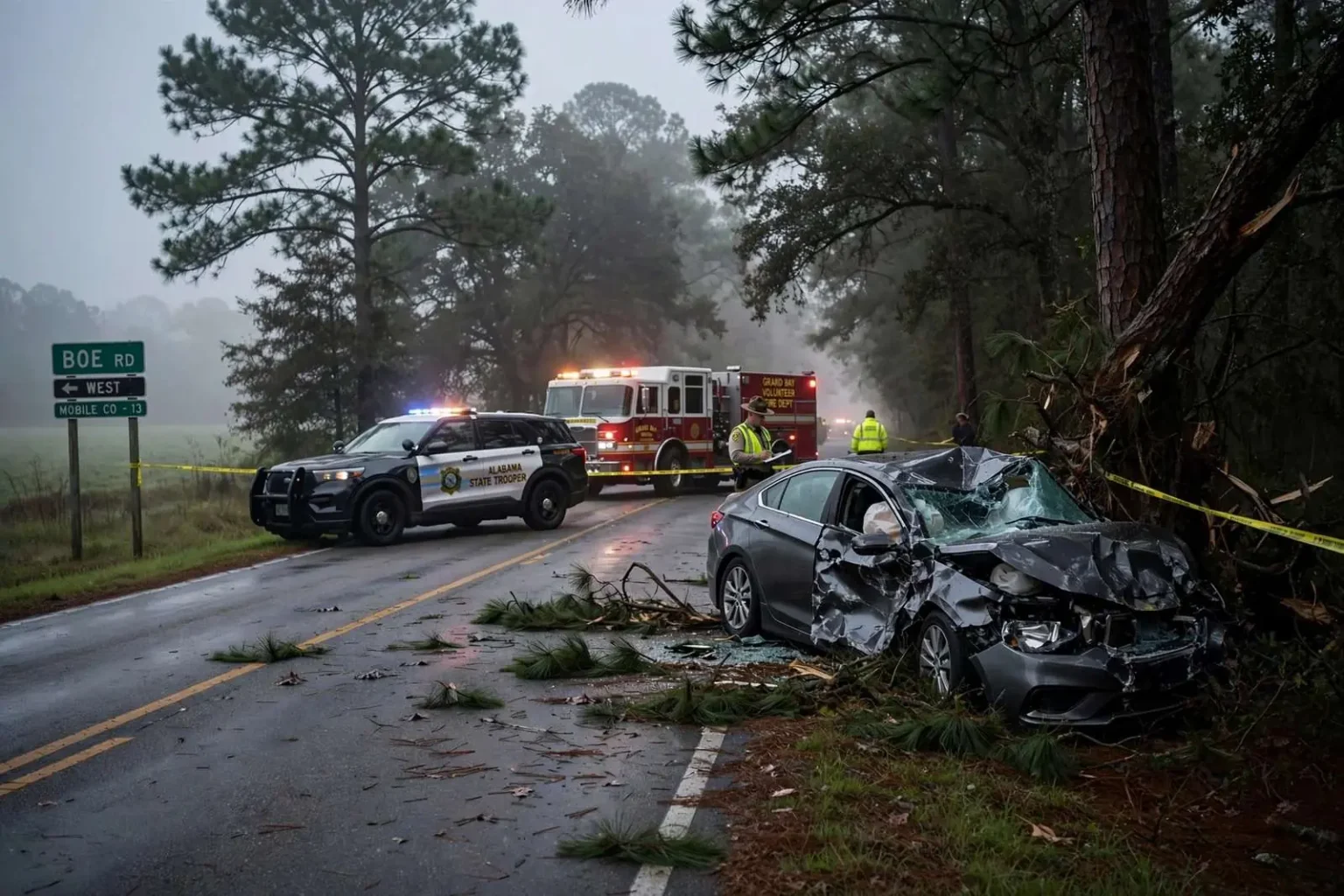
A 32-year-old Grand Bay woman died early Monday morning when the car she was driving left Boe Road and struck a tree just outside the Mobile city limits, according to the Alabama Law Enforcement Agency. ALEA identified the victim as Amanda K. Willis. Troopers said she was pronounced dead at the scene of the single-vehicle crash.
The wreck occurred on Boe Road, about five miles west of the Mobile city limits, in a rural stretch of western Mobile County near the Grand Bay community. Investigators said Willis was not wearing a seatbelt at the time of the crash. The timing — in the early morning hours of a Monday — put the collision among the types of run-off-road crashes that troopers see most often on dark, two-lane rural roads.
How the investigation works
ALEA’s Highway Patrol Division is continuing to investigate the collision. When a crash involves a fatality, troopers document the scene in detail, measuring the vehicle’s path, examining the roadway for skid marks and yaw marks, and photographing the final resting position of the car. Investigators also look at the vehicle itself for mechanical issues and, where warranted, seek toxicology testing to determine whether impairment played a role.
That work takes time, and ALEA typically does not release a final cause determination until its investigation is complete. Factors investigators weigh in run-off-road crashes include speed relative to the curve of the road, roadway conditions at the time, visibility, driver distraction or fatigue, and the use of occupant restraints. In this case, officials confirmed only the basics: the vehicle left the roadway, struck a tree, and the driver was unrestrained.
Seatbelts and rural road risk
Alabama has required seatbelt use for front-seat occupants since 1982 and made it a primary enforcement offense in 1999, meaning a trooper or officer can stop a vehicle solely because a driver or passenger is unbuckled. State law also requires passengers to be restrained, and child safety seats are mandatory for young children. Safety officials repeatedly stress that belts remain the single most effective way to survive a crash, because they keep occupants inside the vehicle’s protective structure and prevent ejection.
Rural roads like those in western Mobile County carry a disproportionate share of Alabama’s traffic deaths. Two-lane roads without medians, curves that tighten on approach, trees and utility poles close to the shoulder, and limited lighting at night all combine to make a momentary mistake far more consequential than it might be on a divided highway. When a vehicle leaves the road in that environment, the first fixed object it meets is often a tree — precisely what happened on Boe Road early Monday.
The Grand Bay community
Grand Bay is an unincorporated community in southern Mobile County, near the Mississippi state line, with a long history tied to agriculture and the rail line that runs through the area. Residents there depend on a network of rural two-lane roads, including Boe Road, to reach schools, churches and businesses in Mobile and in neighboring communities. Fatal crashes on those roads touch close-knit neighborhoods where many families have lived for generations.
News of a fatal crash early on a weekday morning also serves as a reminder for commuters in the area. Early-morning hours carry elevated risk on rural routes: darkness makes curves and intersections harder to judge, wildlife crossings are more common, and drowsiness can set in for drivers who started their day before sunrise. Law enforcement agencies across the region regularly urge drivers to slow down, buckle up and stay alert during those hours.
What comes next
Once troopers complete their investigation, the findings are typically compiled into a report that may be used by the Mobile County District Attorney’s Office if any charges are warranted. In many single-vehicle fatal crashes, no charges result, and the case stands as a record for the family and for state crash statistics. ALEA’s data feeds into federal highway safety programs that guide where Alabama invests in rumble strips, improved signage, shoulder widening and other countermeasures.
For now, the investigation remains active, and ALEA has not indicated that additional vehicles were involved. The agency’s Highway Patrol Division handles crash investigations across the state, and troopers assigned to the Mobile area cover one of the busiest stretches of roadway in Alabama, from the interstate corridors to the back roads of the county’s rural southern end.
Any driver who travels Boe Road or similar county roads can take the circumstances of this crash as a direct reminder of what safety officials emphasize after every fatal wreck: seatbelts save lives, and on a dark rural road, there is little margin for error. The loss of a 32-year-old resident in a crash that may have been survivable with a belt fastened is the kind of outcome that traffic-safety advocates across Alabama work to prevent.
Responding to a fatal crash in a rural area
When a 911 call reports a serious wreck in western Mobile County, the response typically involves sheriff’s deputies, volunteer or municipal fire units, and ambulance crews converging on a location that can be miles from the nearest hospital. In fatal crashes, the scene also becomes a temporary investigation zone: the roadway may be closed for a time, and the Mobile County Coroner’s Office responds to handle the deceased. Pronouncement at the scene, as happened in this case, reflects the severity of the injuries involved.
Rural crash response also highlights the work of volunteer fire departments in communities like Grand Bay, whose members are often the first on scene at wrecks far from a paid station. These departments handle everything from securing the vehicle against fire to helping stabilize patients until an ambulance arrives. Their role in the aftermath of crashes on roads like Boe Road is a quiet constant of life in unincorporated Mobile County.
Supporting the family and the community
In the days after a fatal crash, families face a series of difficult steps — arranging funeral services, dealing with insurance, and retrieving personal property from the vehicle once investigators release it. Victim services specialists and coroner’s office staff often help families navigate that process. In small communities, churches and neighbors typically step in quickly, and the loss of someone young is felt broadly among those who knew her.
Residents who witnessed the crash or who were in the area early Monday and saw anything relevant can provide that information to ALEA, which accepts tips through its Highway Patrol posts. Witness accounts of vehicle speed or driving behavior before a crash can materially help investigators reconstruct what happened, particularly on rural stretches where there are rarely cameras or other external records.
A continuing pattern troopers want to break
Alabama records hundreds of traffic deaths each year, and state and federal safety agencies consistently identify the same leading contributors: unrestrained occupants, impairment, speed and distraction. Campaigns such as the national Click It or Ticket effort, which Alabama joins during enforcement waves, aim to raise belt use through both education and citations. Local agencies supplement those campaigns with posts about the crashes they respond to, hoping a concrete example resonates more than a slogan.
Engineering improvements are also part of the long-term answer. Wider paved shoulders, centerline rumble strips, better curve warning signage and clearing trees back from the right-of-way have all been shown to reduce run-off-road fatalities on rural roads. Funding decisions about where those improvements go are informed by crash data — which is why the careful documentation of every fatal wreck, including this one, matters beyond the individual case.
Until that work reaches every mile of two-lane road in Mobile County, the burden falls on drivers. Troopers’ advice after crashes like Monday’s on Boe Road is simple and consistent: buckle up every trip, adjust speed to the road and the hour, and never assume a familiar route is risk-free. It is advice that, taken seriously, prevents the next early-morning tragedy in communities like Grand Bay.
What drivers in the area should know about Boe Road
Boe Road serves as one of the local connectors in the rural landscape south of U.S. Highway 90 in western Mobile County, threading past homes, fields and wooded parcels between the Grand Bay area and points closer to the city. Like many county roads of its kind, it carries a mix of commuter traffic in the early morning and evening, school buses during the year, and slow farm and utility vehicles at other hours. There is no median, no lighting over most of its length, and trees standing near the shoulder along portions of the route.
Drivers unfamiliar with the road are often surprised by curves that arrive with little warning, and in wet weather the pavement can hold standing water at low spots. Local residents tend to know those spots by heart, but visitors, delivery drivers and new commuters do not. That mix of familiarity and inexperience on the same narrow road is one reason agencies urge extra caution on routes like this one, particularly in the dark hours when Monday’s crash occurred.
Anyone with information about the crash — including anyone who may have seen the car before it left the roadway — is encouraged to contact ALEA’s Highway Patrol Division. Details that seem minor to a witness, such as the color of a vehicle or the time it passed a landmark, can help troopers complete their reconstruction of the crash and give the family a clearer account of what happened.