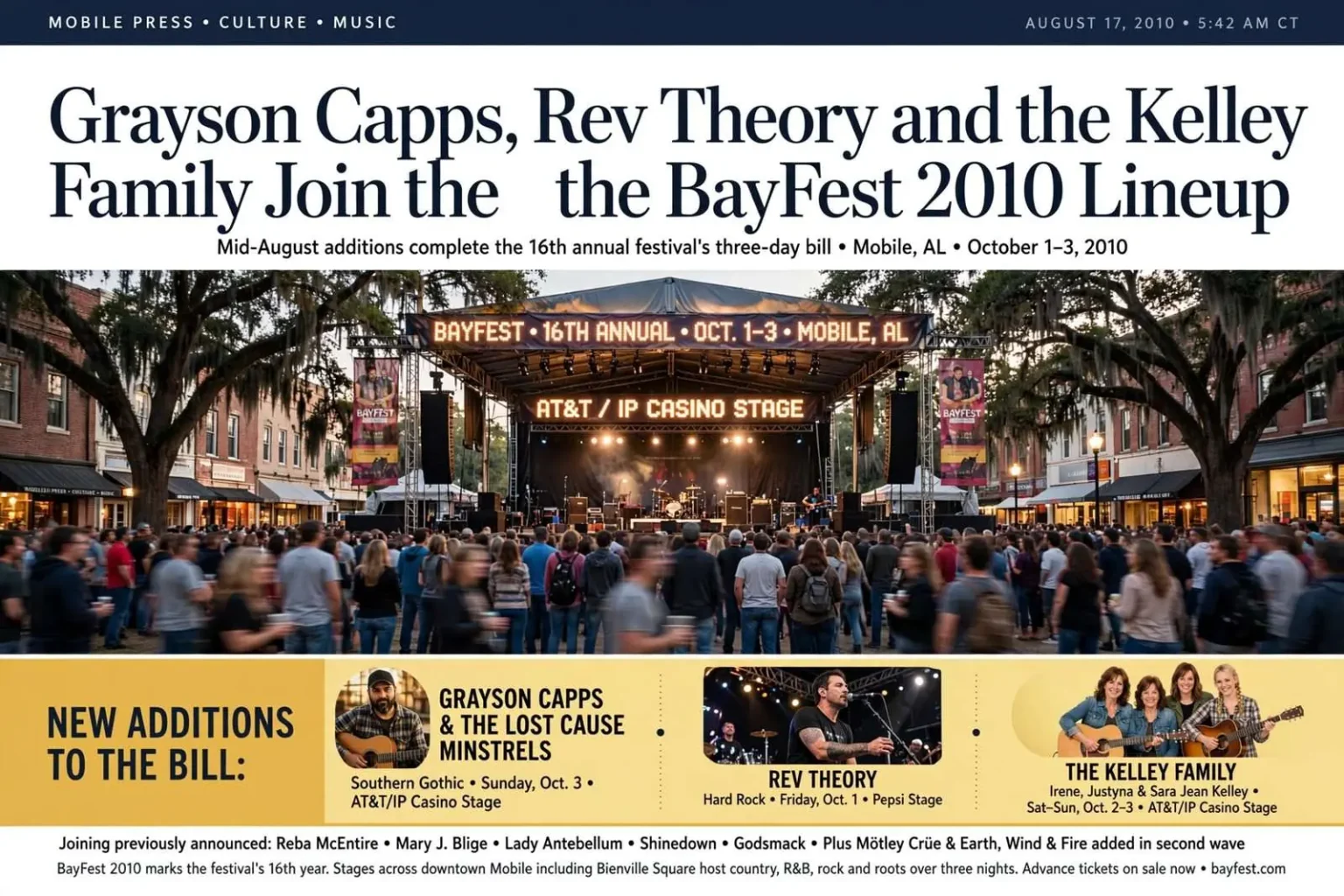
BayFest organizers announced a fresh batch of acts for the 16th annual festival in mid-August 2010, adding Grayson Capps and the Lost Cause Minstrels, Rev Theory, and three members of the Kelley family to an October bill that already included Reba McEntire, Mary J. Blige, Lady Antebellum, Shinedown and Godsmack. The additions filled out a lineup that spanned country, R&B, hard rock and Southern songwriting, timed to the festival’s three-day run along Mobile’s downtown streets. BayFest, staged each October across multiple stages in the blocks around Bienville Square and the central business district, had grown by its sixteenth year into one of the largest music festivals on the Gulf Coast, drawing crowds measured in the tens of thousands across a weekend.
A country dynasty on one stage
Singer-songwriter Irene Kelley drew her slot on the AT&T/IP Casino Stage Saturday, October 2. Her path ran from a Pennsylvania rock band — she was ejected after deciding country music was her calling while watching Dolly Parton on television — to a songwriting career that placed words on records by Loretta Lynn, Trisha Yearwood, Claire Lynch, Ricky Skaggs and Alan Jackson. Few résumés in Nashville mix those names; Lynn and Skaggs anchor country’s traditionalist wing, Yearwood and Jackson defined the genre’s commercial mainstream, and Claire Lynch is among bluegrass’s most decorated vocalists. Kelley’s pen had touched them all, making her festival set a showcase of songs the audience already knew without necessarily knowing her name.
Her 1982 song “Pennsylvania Is My Home” was nominated as that state’s song, and by 2010 she was promoting her album Thunderbird. The nomination gave her an unusual piece of official recognition — a songwriter’s honor typically reserved for much older, established anthems — and Thunderbird marked her return to recording her own material after years of writing for others. Her Saturday booking placed her squarely in the festival’s singer-songwriter tradition, where audiences willing to wander between stages could catch careers in progress.
Joining her October 2 was daughter Justyna Kelley, then 23, whose debut Over the Moon recalled Joni Mitchell’s seventies heyday with hooks in the Sheryl Crow and Colbie Caillat vein. The comparison positioned the younger Kelley at the intersection of folk-songwriter craft and radio-ready pop, a blend that matched the festival’s broad programming and gave the family’s Saturday showcase a two-generation span. Youngest daughter Sara Jean Kelley performed Sunday, October 3, blending traditional country, bluegrass and blues on her 1969 Gibson B25 — a vintage acoustic instrument with the warm, woody tone that bluegrass and old-time players prize. With all three Kelleys on the bill, the festival’s weekend effectively hosted a family songbook in two sittings.
Hometown hero and hard rock
Grayson Capps and the Lost Cause Minstrels — featuring Corky Hughes on lead guitar, Chris Spies on Hammond B-3, Christian Grizzard on bass and John Milham on drums — took the same stage Sunday, October 3. A University of South Alabama alumnus who spent more than a decade in New Orleans, Capps had built a reputation on Southern Gothic songwriting across four studio albums and was recording new material slated for early 2011. His songs, steeped in the characters and shadows of the Gulf South, had earned him a devoted following in both his adopted New Orleans and his hometown, where his festival appearances carried the feel of a homecoming. The Hammond B-3 in the band’s lineup gave the Minstrels a thick, organ-driven roots-rock sound that distinguished them from standard guitar-bass-drums blues acts, and Hughes’s lead work had long been part of the band’s signature.
Rev Theory closed out the additions Friday, October 1 on the Pepsi Stage, working that summer with producer Terry Date — known for Deftones and Soundgarden — on the follow-up to their 2008 album Light It Up. The band’s hard-rock catalog had already reached a mass audience through sports arenas and television, and a new album under Date’s production signaled heavier, more ambitious ambitions for the follow-up. Their Friday slot put them on the same night’s card as the festival’s biggest hard-rock draw, giving fans of loud guitars a full evening on the Pepsi Stage’s end of downtown.
A second wave of headliners
A week later, festival officials confirmed an even bigger second wave: Mötley Crüe and Earth, Wind & Fire joined the bill, adding arena-scale star power to the October lineup and extending the festival’s reach across rock and R&B audiences. The pairing of a Sunset Strip hard-rock institution with one of funk and soul’s most decorated bands was characteristic of BayFest’s multi-genre strategy — the festival deliberately books across musical families so that family members with different tastes can share the same weekend. With McEntire and Blige already anchoring the country and R&B nights, Shinedown and Godsmack carrying the hard-rock stages, and Lady Antebellum representing country’s pop mainstream, the 2010 edition had assembled one of the most commercially eclectic lineups in the festival’s history.
What the additions meant for the festival
The mid-August announcements served BayFest’s usual rhythm: a headline roster revealed early to drive ticket sales, followed by waves of supporting acts that keep the festival in the news through late summer. For Mobile, the economic stakes are substantial. The festival fills downtown hotels, restaurants and bars across its three nights, and its stages — spread through the downtown core — turn the central business district into a walkable festival ground that few cities the size of Mobile can assemble. Local acts benefit as well: slots like Capps’s Sunday afternoon set put hometown musicians in front of the festival’s largest crowds, alongside the touring names that draw them downtown in the first place.
The 2010 season was the sixteenth for an event that began in 1995 as a civic effort to give Mobile a signature downtown festival, and its longevity was itself part of the story. Gulf Coast festivals had come and gone with the economy and the weather — the 2010 season shadowed by the year’s oil spill uncertainty, which had dented tourism bookings across the coast — but BayFest’s organizers kept building the bill through the summer, betting that a strong lineup would hold attendance. The addition of familiar regional acts like Capps alongside national headliners was part of that calculation: hometown draws bring loyal local audiences regardless of the tourism climate.
For attendees, the practical upshot of the two announcement waves was a schedule that rewarded planning. The Kelleys’ split between Saturday and Sunday, Capps’s Sunday homecoming set and Rev Theory’s Friday opener meant a festivalgoer could build an entire weekend around the new additions without ever missing the headliners. Advance tickets, as in past years, were priced well below gate prices, and organizers urged early purchase — the standard advice for a festival whose single-night crowds had long since outgrown any single stage.
By the time October arrived, the 2010 lineup read as a snapshot of Gulf Coast musical tastes: country queens and R&B legends, two of hard rock’s biggest tours, a Nashville songwriter dynasty with Mobile-adjacent roots, and a hometown Gothic storyteller with his B-3 whirring behind him. It was, organizers suggested, exactly what a sixteenth birthday party for the festival should look like.
The Kelley family’s weekend also illustrates how BayFest’s stage structure rewarded acts that could draw across two days. The AT&T/IP Casino Stage, one of the festival’s principal country and roots venues, hosted both the Saturday and Sunday portions of the family’s performances, letting festivalgoers who caught one set make a point of returning for the other. Irene Kelley’s songwriter credentials, Justyna’s pop-leaning debut and Sara Jean’s bluegrass-and-blues blend covered a surprising amount of musical ground for three performers sharing a surname, and each drew from the others’ audiences across the weekend.
Capps’s Sunday slot, meanwhile, carried the weight of a local expectation. Musicians who leave Mobile and make a name elsewhere return to the festival with a particular kind of billing — not a headliner’s slot, but a stage and a time that hometown audiences treat as a statement. His decade in New Orleans, where he recorded and performed through the years bracketing Hurricane Katrina, had made his songwriting a fixture of the Crescent City’s roots scene, and his four albums to date had established the Southern Gothic voice that critics had compared to the darker tradition of Gulf Coast storytelling. The album he was recording during the fall of 2010, slated for early 2011, gave the festival set the added interest of new material.
Rev Theory’s Friday appearance fit the festival’s pattern of pairing national hard rock with regional audiences in the middle of a tour cycle. The band’s summer studio work with Terry Date put their follow-up album in production as the festival approached, meaning Mobile audiences would hear a band mid-transformation — playing the catalog that made them while road-testing what the new producer collaboration might yield. For the festival’s younger audience, the Pepsi Stage’s Friday lineup was the weekend’s starting gun.