
Great Food Truck Race Trucks Roll Into Mobile for a Weekend of Downtown Filming
Let There Be Bacon, Lone Star Chuckwagon and The Middle Feast bring the Great Food Truck Race to downtown Mobile for a filmed weekend.
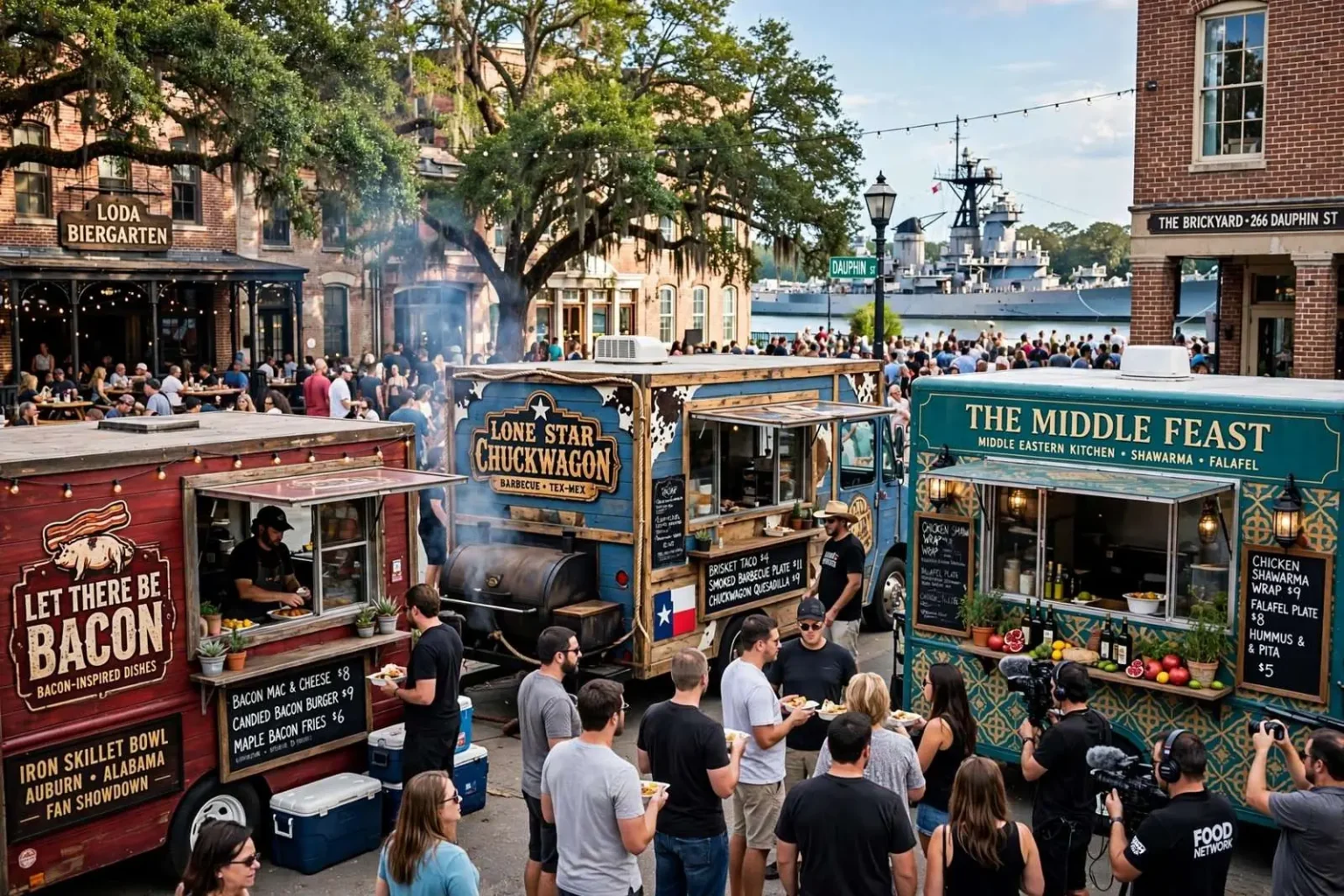
A national TV spotlight landed on Mobile’s food scene at the end of May 2014, when three trucks competing on the Food Network’s Great Food Truck Race parked in the city for a weekend of filming. The visit put downtown Mobile’s streets, bars and landmarks on a national broadcast and gave local food fans a weekend of tracking the trucks across the city.
Let There Be Bacon, serving bacon-inspired dishes, set up at the LoDa Biergarten at 251 Dauphin St. from noon Saturday, May 31, with its Sunday stop to be announced. The truck also used the weekend to sponsor its “Iron Skillet Bowl,” an Auburn-Alabama themed fan showdown that gave the Iron Bowl rivalry a bacon-flavored sideline during the truck’s Gulf Coast run.
Lone Star Chuckwagon, dishing out barbecue and Tex-Mex, started at Hayley’s on Dauphin Street at noon Saturday before moving to the USS Alabama battleship memorial park from noon to 4 p.m. Sunday and back to Hayley’s after. The itinerary gave the truck two of the city’s most recognizable backdrops — a Dauphin Street institution and the deck of one of the nation’s most decorated World War II battleships.
The Middle Feast, the caravan’s Middle Eastern kitchen, held down The Brickyard at 266 Dauphin St. on Saturday. The truck’s shawarma and falafel offerings added a contrasting flavor profile to the weekend’s bacon and barbecue, and its downtown perch kept all three trucks’ Saturday stops clustered along the Dauphin Street corridor.
How the trucks landed in Mobile
The Great Food Truck Race sends competing trucks across the country in a season-long gauntlet, with each city stop bringing selling challenges, head-to-head competition and elimination pressure. Filming in a city means the trucks park at announced locations and serve the public while cameras roll, turning each stop into a crowd-drawing event for the host city.
Mobile’s weekend fit the show’s format: three trucks, multiple stops and a fan base invited to show up, buy food and influence which trucks survive the leg. For a food scene that has grown alongside downtown’s revival, the visit amounted to a national camera crew documenting the city’s appetite.
The downtown locations became their own local story. When The Middle Feast asked followers where it should park — and polls, including one run by a local news outlet, came back strongly favoring downtown — some online commenters instead urged the trucks toward west Mobile intersections or out-of-town stops, grumbling that downtown would be too quiet on a summer weekend.
Local boosters pushed back, arguing that hosting a nationally televised food competition was exactly the moment to fill downtown streets rather than steer the cameras to a strip-mall parking lot. The exchange — played out in comment threads and poll results — became a proxy for the longer debate over downtown Mobile’s momentum and what it takes to keep it.
The venues that hosted the weekend
LoDa Biergarten’s name compresses its address into its brand — “LoDa” is the shorthand locals use for the Lower Dauphin entertainment district — and the biergarten’s beer list and communal tables made it a natural truck stop for a bacon-themed menu. The venue had already established itself as a downtown gathering spot, and pairing it with a national TV truck gave its weekend crowd an extra reason to linger.
Hayley’s, deeper into the Dauphin Street strip, brought Lone Star Chuckwagon’s barbecue and Tex-Mex into the heart of the bar district. The stop made sense for a truck whose menu pairs with a weekend crowd, and the Sunday relocation put the truck in front of a different audience entirely — the families and tourists who visit the battleship park.
The USS Alabama Battleship Memorial Park is among the Gulf Coast’s signature attractions, drawing visitors to the South Dakota-class battleship that earned nine battle stars in World War II, along with the submarine USS Drum and a collection of aircraft on the grounds. Hosting a food truck there put a national audience in front of one of Mobile’s most filmed landmarks — a backdrop the city rarely gets to exploit on a network broadcast.
The Brickyard, at 266 Dauphin, rounded out the Saturday lineup for The Middle Feast. The cluster of downtown stops meant visitors could sample all three trucks on foot, a structure that turned the filming weekend into something closer to a street festival than three separate television shoots.
The downtown-versus-elsewhere debate
The online argument over where the trucks should park reflected a discussion Mobilians have been having for years: whether downtown’s revival represents the whole city’s economy or just one district’s. The commenters urging west Mobile stops argued that the trucks would find bigger crowds and easier parking outside the central city; the boosters countered that a TV showcase is precisely when a city should show its most distinctive face.
The polls’ strong downtown preference suggested which way the public argument was leaning, even as the grumbling continued. Local media joined the conversation, with the news outlet’s poll becoming one of the data points in the trucks’ location decisions and the wider debate.
The episode also highlighted how food trucks have become part of urban marketing. Cities compete for show stops, food festivals and food-truck rallies because they generate foot traffic, social media visibility and a reputation for food culture. Mobile’s weekend delivered all three, with the national audience seeing the battleship, the biergarten and the Dauphin Street strip behind the competition.
What the weekend meant for Mobile food
Either way, the trucks’ arrival gave Mobile one of its most visible moments on national food television that year. The Food Network’s cameras framed the city through its food, its landmarks and its crowds — the kind of exposure that tourism budgets spend heavily to buy and that a weekend of filming delivered as a byproduct of the race.
For the local food community, the visit connected Mobile to a national truck culture that had grown rapidly in the preceding years. Food truck rallies had already found audiences in the city, and the show’s stop signaled that Mobile could compete as a venue in a touring format that selects its cities deliberately.
The Iron Skillet Bowl gave the weekend a local hook as well, letting the Auburn-Alabama rivalry play out in bacon form for a Gulf Coast audience that treats the matchup as a civic institution. Between the rivalry stunt, the battleship backdrop and the downtown debate, the trucks’ visit generated the kind of local conversation that outlasted the filming itself.
Following the trucks across the city
The weekend’s schedule rewarded dedicated followers. Fans who caught Let There Be Bacon at the biergarten Saturday could chase Lone Star Chuckwagon to the battleship park Sunday and still keep tabs on The Middle Feast’s downtown setup — a two-day scavenger hunt that turned the TV production into a participatory event for Mobile’s food crowd.
The show’s format depends on exactly that energy. Truck sales determine who survives each leg of the race, so crowds that show up and spend directly shape the competition, and the show’s producers count on host cities to deliver lines, transactions and on-camera enthusiasm. Mobile’s audiences, by all accounts, gave the trucks a Southern welcome with their wallets as much as their cheers.
Each truck brought a distinct identity to the weekend. Let There Be Bacon built its brand on a single indulgent ingredient; Lone Star Chuckwagon carried Texas barbecue traditions across the country; The Middle Feast introduced shawarma and falafel to markets that rarely see them from a truck window. The variety let Mobile diners sample the show’s range without leaving downtown.
Downtown as a stage
The choice of venues told a story about the city the broadcast would carry. A battleship, a biergarten and two Dauphin Street venues sketch a portrait of Mobile as a place where history and nightlife share a zip code — the image downtown advocates have worked to project, delivered this time by a production company’s location scouting.
That the argument over locations even happened was itself a measure of downtown’s progress. A decade earlier, the question of whether a national broadcast should feature downtown Mobile would have found fewer defenders; by 2014, the district’s restaurants, bars and events had built the case that the city’s showcase belonged in its center.
The boosters’ argument won the weekend: the trucks parked downtown, the crowds came, and the cameras rolled with Dauphin Street as the frame. Whatever grumbling persisted about west Mobile’s parking lots, the episode left the city’s central district holding the national spotlight.
A weekend in the show’s long road
The Great Food Truck Race’s seasons have carried competing trucks through hundreds of cities, and each stop leaves behind the same residue: a boost for the host venues, a crowd of fans who now watch the show to see their city, and a data point in the traveling argument about which American cities have real food cultures.
Mobile’s entry into that record came with the usual caveats of a single weekend — three trucks, a few stops, a couple of days of filming. But the visibility compounded the city’s other food-story assets, from its restaurant scene to its Gulf seafood traditions, in a national format that reaches an audience far beyond the region.
For the trucks, the Mobile leg was another round of selling, surviving and driving on. For the city, it was a weekend when the national food media parked in its downtown, filmed its battleship and argued — along with the locals — about exactly where Mobile’s food story should be told from.


