Greater Gulf State Fair shuts down early after disruptive behavior in Mobile
The Greater Gulf State Fair in Mobile closed early Saturday after disruptive behavior, with fairgoers trading conflicting accounts of what happened.
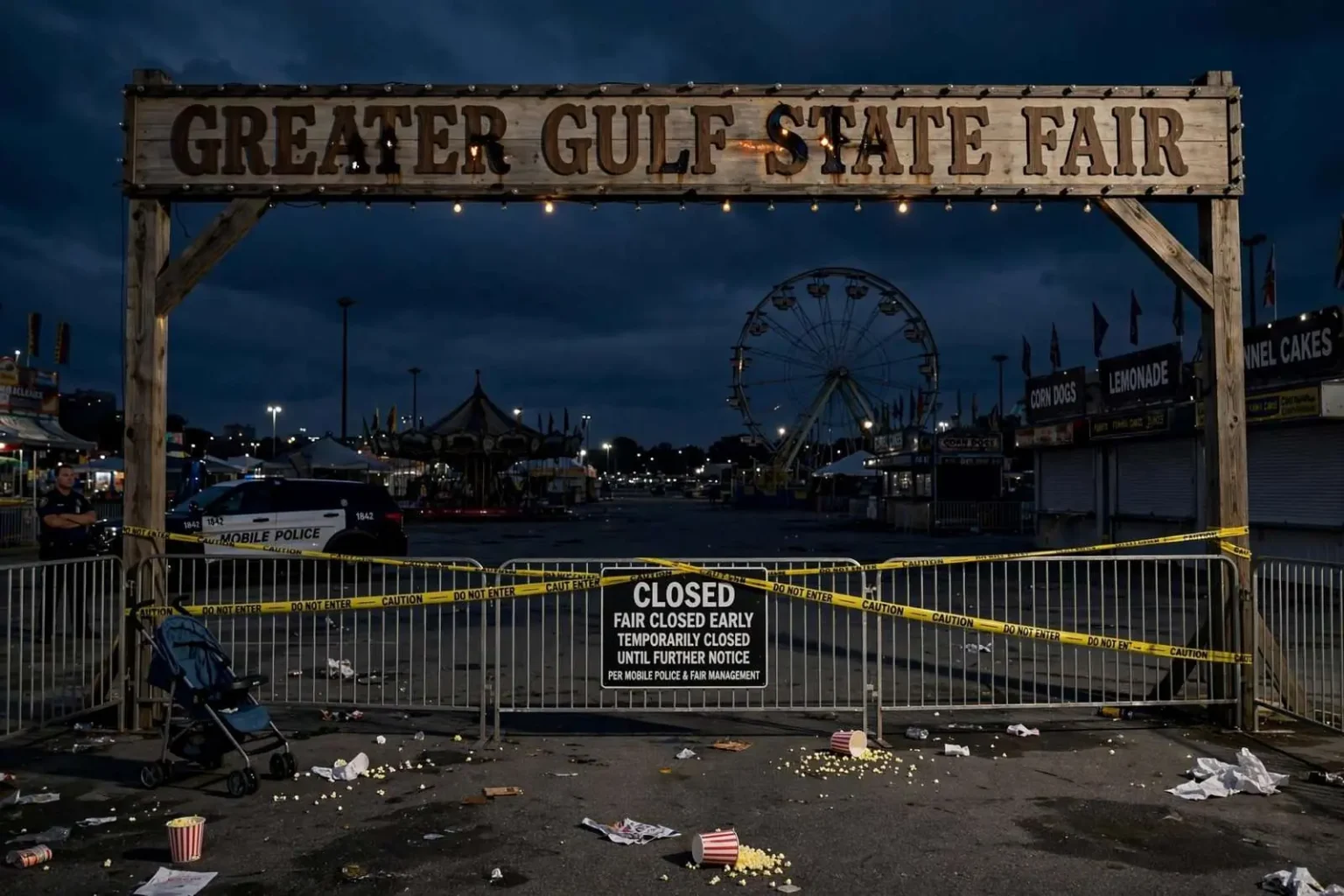
MOBILE, Ala. — The Greater Gulf State Fair closed abruptly Saturday night after officials cited disruptive behavior, and fairgoers took to social media to recount what had happened in the confusion. Video from the fairgrounds appeared to show teenagers fighting, and concern spread quickly online over whether a gun had made it onto the grounds — but Executive Director Josh Woods and the Mobile Police Department said no shooting occurred.
The reports that circulated during the shutdown were conflicting from the start. Attendee Victoria Reno said she heard what sounded like gunshots as her children prepared to board a ride, while another visitor, Taylor Mosley, said she never heard a shot. The diverging accounts reflected the chaos of the moment: a crowd of thousands, a sudden wave of movement through the midway, and the sound of rides shutting down and people shouting at the same time.
Woods said it was the first time the fair had experienced that kind of disruption. Mobile Police continued to review what led to the early shutdown, working through witness statements and the videos posted online as the fair’s final weekend went forward under a cloud of unanswered questions.
A sudden end to a fair night
The shutdown unfolded in the middle of one of the busiest nights of the fair’s run, when the midway is fully lit and operating and the grounds are at their most crowded. Fairgoers described the sudden appearance of confusion that spread faster than any official announcement — groups running, families pulling children out of lines, and the distinctive emptiness that follows when rides stop mid-evening. Within a short time, the decision had been made to close the grounds for the night, sending thousands of visitors home hours before they had planned to leave.
Social media became the primary source of information in real time, for better and for worse. Videos posted from the grounds appeared to show groups of teenagers fighting, and within minutes the clips were being shared alongside claims of shots fired — claims that police and fair leadership moved to knock down as soon as they could assess the situation. The gap between what attendees experienced and what actually happened on the grounds became the story itself, as official assurances of no shooting competed with the lingering unease of people who thought they had heard something.
That dynamic is familiar to police departments and venue operators across the country. Large crowds, sudden movements, and the sounds of a carnival — popping noises from ride machinery, game booths, and elsewhere — can produce acoustic confusion, and a single shouted warning of a gun can clear a midway in seconds. The resulting panic carries its own dangers, which is why officials at major fairs and festivals have increasingly invested in crowd management plans designed to slow the spread of false alarms and move people out in an orderly way when something does go wrong.
The fair and its place in Mobile
The Greater Gulf State Fair is a late-autumn tradition on the Alabama Gulf Coast, drawing hundreds of thousands of visitors to its grounds in west Mobile over its annual run. The fair features the standard complement of carnival rides, agricultural exhibits, livestock shows, concession food, and nightly entertainment, and for many families in Mobile, Baldwin, and the surrounding counties, attending is a generations-deep custom — children who were carried through the gates in strollers return years later pushing their own.
The event’s scale is what makes crowd management both essential and difficult. On weekend nights the midway packs shoulder to shoulder, lines for the marquee rides stretch long, and the noise floor is high enough to swallow announcements. Security presence is visible at the gates, where bags are checked and screened, and the fair’s leadership has historically pointed to that screening as the reason weapons have not been a problem on the grounds. The Saturday night incident tested that history in the most public way possible, in an era when a single viral video can shape perceptions faster than any statement from fair officials.
Fairs across the Southeast have dealt with similar incidents in recent years, and several have responded with changes to admission policies, adjusted hours, enhanced screening, and a larger police presence on weekend evenings. The measures reflect a broader challenge for large-scale family events: maintaining the open, welcoming character of a fair while controlling the small number of incidents that can define public memory of it.
What officials said — and didn’t say
The assurances from the two authoritative sources were consistent: Executive Director Josh Woods said no shooting occurred, and the Mobile Police Department said the same. But in the hours after the shutdown, much remained unresolved. Police continued to review what had led to the early closure, and the questions that mattered most to the public — what precisely triggered the disruption, whether the fights seen in the videos were connected to one another, and whether anyone was injured or arrested — awaited the results of that review.
Woods’ remark that it was the first time the fair had experienced that kind of disruption underscores how unusual the night was in the event’s history. Fairs of this size run on decades of accumulated operational routine — gate procedures, ride inspections, lost-child protocols, and the relationships between fair staff and the police details assigned to the grounds. A first-time disruption of this scale forces organizers to revisit all of it: how quickly word reaches the crowd, where families should go, and how to separate the rumor mill on social media from the facts on the ground.
The accounts from attendees illustrate why those reviews take time. Victoria Reno’s account — hearing what sounded like gunshots as her children waited to board a ride — describes an experience that was terrifying in the moment regardless of what the sound actually was. Taylor Mosley’s account — never hearing a shot — is equally honest to her experience of the same night. Both can be true in a crowd of thousands spread across many acres: sound carries unevenly around ride machinery and through dense crowds, and people’s attention and positions differ. That is precisely why investigators piece together video, witness statements, and physical evidence rather than relying on any single account.
The crowd psychology of a false alarm
Research on crowd behavior has repeatedly shown how quickly fear spreads through a packed venue and how hard it is to stop once it starts. A sudden movement by one group prompts movement in the people nearby, who cannot see the original cause, and within seconds large portions of a crowd are moving on rumor alone. The sights and sounds of a fair — dark pathways between bright midway islands, music from competing stages, PA announcements that struggle against the noise — compound the problem by limiting what people can see and hear of the actual situation.
Event professionals manage that risk in several ways: clear and repeated public-address messaging when incidents occur, trained staff positioned throughout the grounds rather than clustered at gates, lighting that keeps sight lines open, and pre-planned exit routing. Whether a fair the size of Mobile’s can fully inoculate itself against the social-media acceleration of panic is a harder question. By the time officials can confirm that no shots were fired, thousands of people may have already left, and the online record of the night may already be written.
For the fair’s leadership, the calculus is straightforward regardless: safety first, statement second, review third. Closing the grounds early — costing the fair a night’s worth of revenue and disappointing thousands of families — was the immediate, visible choice, and the willingness to make it sends its own message about priorities. Fair operators know that a night ended early is recoverable in a way that a crowd tragedy is not.
What comes next
With police reviewing the incident and the fair’s remaining nights going forward, attention turns to what changes, if any, follow. The options available to organizers mirror those adopted elsewhere after similar incidents: adjusted admission policies, earlier weekend hours, stepped-up screening, increased youth escort requirements during peak evenings, and a larger law enforcement footprint on the grounds. Each carries trade-offs in cost, convenience, and the fair’s traditional openness, and organizers weigh them against the knowledge that one viral night can affect attendance and public trust for years.
For the families who were there, the lasting impression is likely the simpler one — a night that ended in confusion instead of corn dogs and ride lights, and the relief that the scariest stories told afterward turned out not to be true. Police asked anyone with information or video from the grounds to share it with investigators, as is standard in reviews of this kind, and the fair’s leadership faces the familiar task of the morning after: reassure the public, learn what actually happened, and get the midway running again.