Gulf Breeze Businesses Fear They Won’t Survive Bridge Closure
Gulf Breeze business owners say the Three Mile Bridge closure could force them to close for good, months after Hurricane Sally damaged the span.
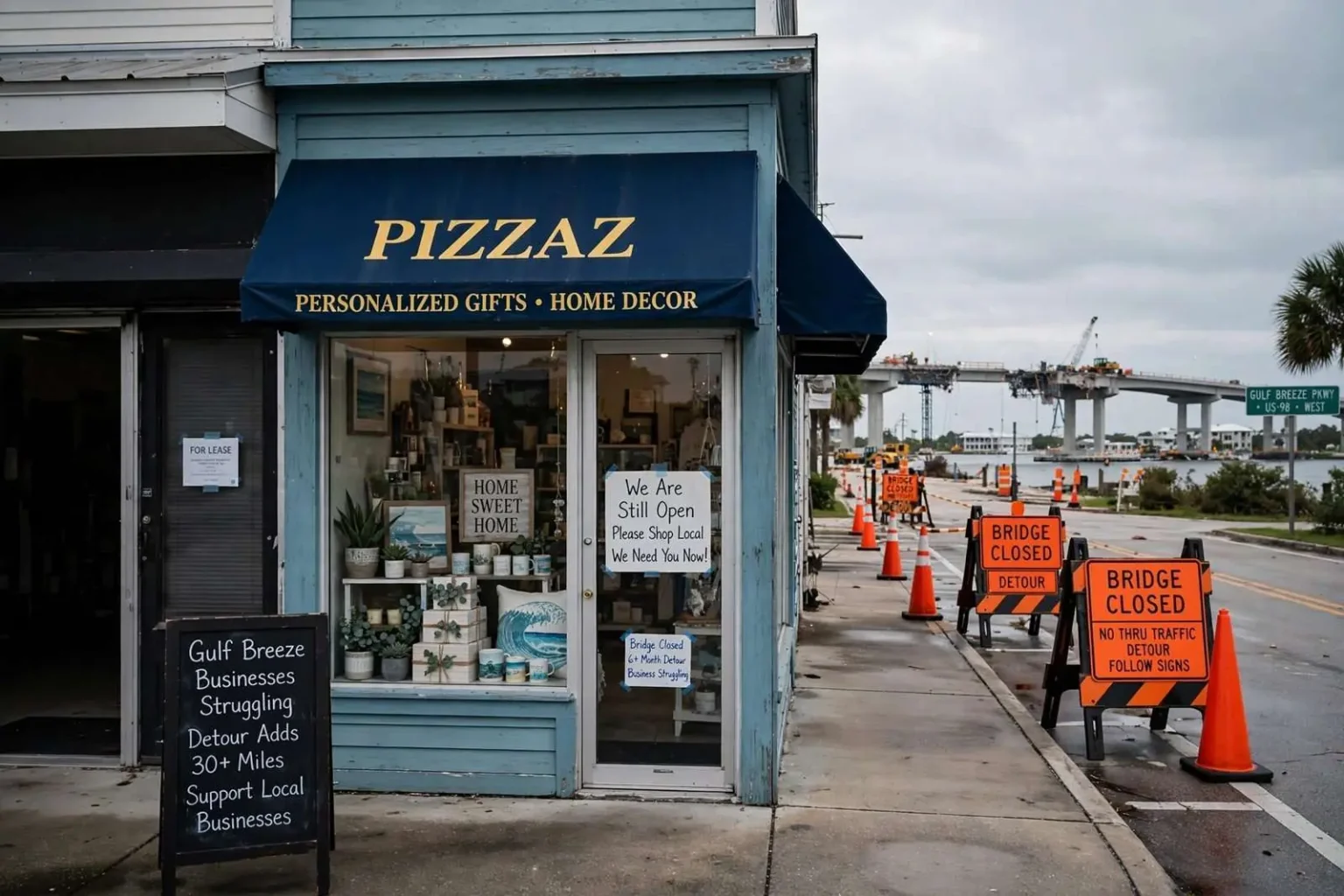
GULF BREEZE, Fla. — Business owners in this Santa Rosa County city say they are frightened the closure of the Three Mile Bridge could do what the COVID-19 pandemic could not: shut their doors for good. With the main link between Gulf Breeze and Pensacola out of service, customers who once arrived in minutes are staying away, and owners say the math on rent, payroll and inventory no longer works.
The Florida Department of Transportation has said the timeline to reopen the bridge is about six months, but many residents doubt the estimate. For merchants who lived through the shutdowns and slow recoveries of the pandemic era, another half year of depressed traffic feels like a threat the community may not survive intact.
“We just can’t survive six months,” said Viki Weir, who owns Pizzaz, a personalized gifts and home decor store in Gulf Breeze, with her daughter. “Even though they say it’ll be open in March. It’s not going to be.”
A town hall to connect owners with answers
Weir and other business owners attended a town hall Friday night organized by State Rep. Alex Andrade, the Pensacola-area Republican whose district includes Gulf Breeze. The gathering was aimed at connecting owners with resources and answers about the closure, from what assistance might be available to what the repair schedule actually looks like.
The format gave owners a chance to put names and faces on the problem for the officials in the room. Questions centered on the durability of the six-month estimate, the availability of state or federal relief, and what happens if the timeline slips, as so many on the barrier island and along the mainland waterfront expect it to do. The event reflected the pressure local elected leaders have been under since the closure began, with constituents demanding information as revenue falls.
Gulf Breeze’s retail base is built on a mix of residents and visitors, and Pizzaz is the kind of destination shop that depends on repeat customers and seasonal traffic. A personalized gifts and home decor store lives on foot traffic, and when the bridge that carries most of that traffic is closed, the customer base thins to the people who already live on the city side of the water.
How the bridge was damaged
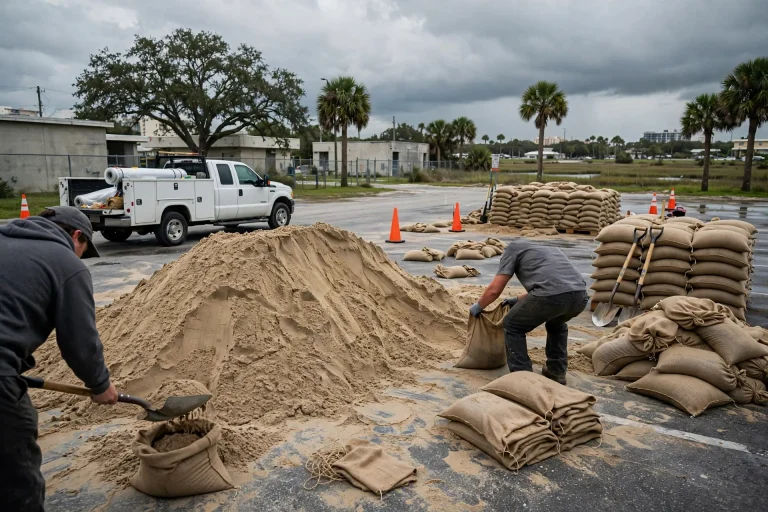
The bridge was damaged when barges owned by Skanska came loose during Hurricane Sally, the slow-moving Category 2 storm that ground across the Gulf Coast in September 2020 and punished the Pensacola area with catastrophic winds and storm surge. The barges struck the structure as they broke free, and the damage has kept the crossing closed while engineers and crews work through the repair process.
Hurricane Sally was the most consequential storm to hit the region in years, and its aftermath is still visible in places along Santa Rosa County’s waterfront. The Three Mile Bridge, formally the Pensacola Bay Bridge, carries U.S. 98 between Gulf Breeze and Pensacola and is the primary artery for commuters, shoppers, school runs and freight between the two sides of Pensacola Bay. With it closed, drivers must take long detours, and the extra time and miles are enough that many simply skip cross-bay trips altogether.
That behavioral change is what terrifies the business community. A store can weather a slow week or a slow season, but owners describe a structural shift in where people go and how often, with routines re-formed around the detour routes and the businesses along them.
A McDonald’s already gone dark
The strain is visible in the most mundane places. A McDonald’s near the bridge has temporarily closed, with a sign reading, “See you when the bridge reopens.” When a national chain with corporate backing makes the calculation that a location cannot carry itself during the closure, the smaller operators in town notice, and the message lands hard.
“It’ll just be a ghost town,” Weir said of the community she describes as caring and supportive. Her worry is not just about her own shop but about the cumulative effect of closures and shrinking hours on a business district that depends on density — enough open storefronts to make a trip into town worth the drive.
Gulf Breeze occupies a narrow peninsula between Pensacola Bay and Santa Rosa Sound, and its commercial corridors have long leaned on through-traffic between Pensacola and the beaches to the south. The closure of the bridge severed that flow in a way no storm-related detour had before, and the town hall was in part an effort to quantify the damage and push for help before more businesses follow the McDonald’s sign.
What a six-month closure means locally
Six months is an eternity in small-business accounting. Rent comes due monthly regardless of revenue, insurance premiums do not pause, and employees who lose hours quickly find work elsewhere. For a community that endured the pandemic by hanging on through federal relief programs and curbside adaptation, the irony that a bridge repair could prove more damaging than a global crisis is not lost on the people who lived through both.
The doubt about the Department of Transportation’s timeline is rooted in experience with post-storm repairs, where initial estimates have a way of stretching as inspections deepen and materials are sourced. Every month of slippage translates directly into another month of depressed sales for the stores along Gulf Breeze’s main corridors, and owners say they are planning for the worst even as they hope for the published schedule to hold.
Rep. Andrade’s town hall was one piece of that planning: an attempt to identify which businesses qualify for which programs, and to keep a public record of the economic stakes while the repair work proceeds. Owners who attended left with contact points inside state agencies and, perhaps more importantly, with the sense that their situation is being tracked in Tallahassee rather than assumed to be somebody else’s problem.
What residents can do in the meantime
For now, the merchants’ appeal to the community is straightforward: cross the detour anyway. Every purchase made in Gulf Breeze while the bridge is closed supports a storefront that has to survive on local loyalty alone until the spans reopen. Owners like Weir describe a customer base that has been caring and supportive through the pandemic and the hurricane, and they are counting on that same instinct to carry them through the bridge repair.
The alternative is the ghost town scenario Weir described — a business district that thins out one closure at a time and struggles to rebuild even after the bridge reopens. Communities along the Gulf Coast have seen after previous disasters that commercial recovery lags physical recovery, and Gulf Breeze’s owners are trying to shorten that lag by keeping their doors open long enough to welcome the traffic back.
Until the Department of Transportation reopens the crossing, the six-month clock runs on. The repair work continues on a structure that serves tens of thousands of crossings on a normal day, and the businesses of Gulf Breeze are measuring their survival in the same units of time.
The bridge’s role in daily life
Understanding the panic in Gulf Breeze requires understanding what the Three Mile Bridge does on an ordinary day. The crossing is the spine of the metro area’s eastern half, tying Pensacola to Gulf Breeze, Pensacola Beach and the communities of Santa Rosa County beyond. Workers cross it in the morning and again in the evening. Students ride buses over it. Deliveries, appointments, youth sports and family dinners all route across those spans, and the bridge’s closure converts each of those trips into a long drive around the bay through other crossings or a decision not to go at all.
When a whole metro re-routes, the effects cascade. Gas stations near the detour corridors do more business while everything behind the closed bridge does less. Restaurants in Gulf Breeze lose the lunch crowds that used to cross in fifteen minutes. Service businesses — salons, dry cleaners, medical offices — see cancellations stack up from clients on the far side of the bay. None of that shows up in a repair budget, but it shows up immediately in a small business owner’s bank account.
That is why the town hall crowd pressed so hard on the reliability of the six-month figure. The Department of Transportation’s estimate governs every projection the owners make: how much inventory to order for the spring season, whether to keep part-time staff on the schedule, whether to renew a lease. A business that budgets for a March reopening and watches the work drag into summer has a very different survival problem than one that plans conservatively from the start.
Lessons from the pandemic, applied to a bridge
The comparison owners keep drawing to COVID-19 is instructive. During the pandemic, the whole region slowed together — customers disappeared, but so did costs for many businesses, and federal programs put cash into the economy. A bridge closure is different: the hardship is asymmetric, concentrated on one side of the water, with no payroll-protection program pointed specifically at bridge-closure victims and no guarantee of a rebound when the structure reopens.
Owners also note that the pandemic taught customers to shop online, and a bridge closure pushes them further in that direction. A shopper who cannot easily cross the bay does not simply defer a purchase; she makes it on her phone. Winning that customer back after months of new habits is its own project, and it is part of why merchants describe the closure as an existential threat rather than a temporary dip.
The community character Weir describes — caring and supportive — is the asset the business district is banking on. Gulf Breeze has a long tradition of rallying around its own during hurricane recoveries, and the town hall response suggests residents understand that shopping locally during the closure is a form of mutual aid. Whether that instinct carries enough volume for six months or more is the question every owner on the corridor is now living through day by day.