Line by Line, Copeland Picked Apart the Gulf Coast Classic’s $188,000 Deficit
The council president questioned the promotion budget, the ticket printing, the mayor's luncheon and a step show with no revenue, and disputed the attendance count for a football game the city helped pay for.
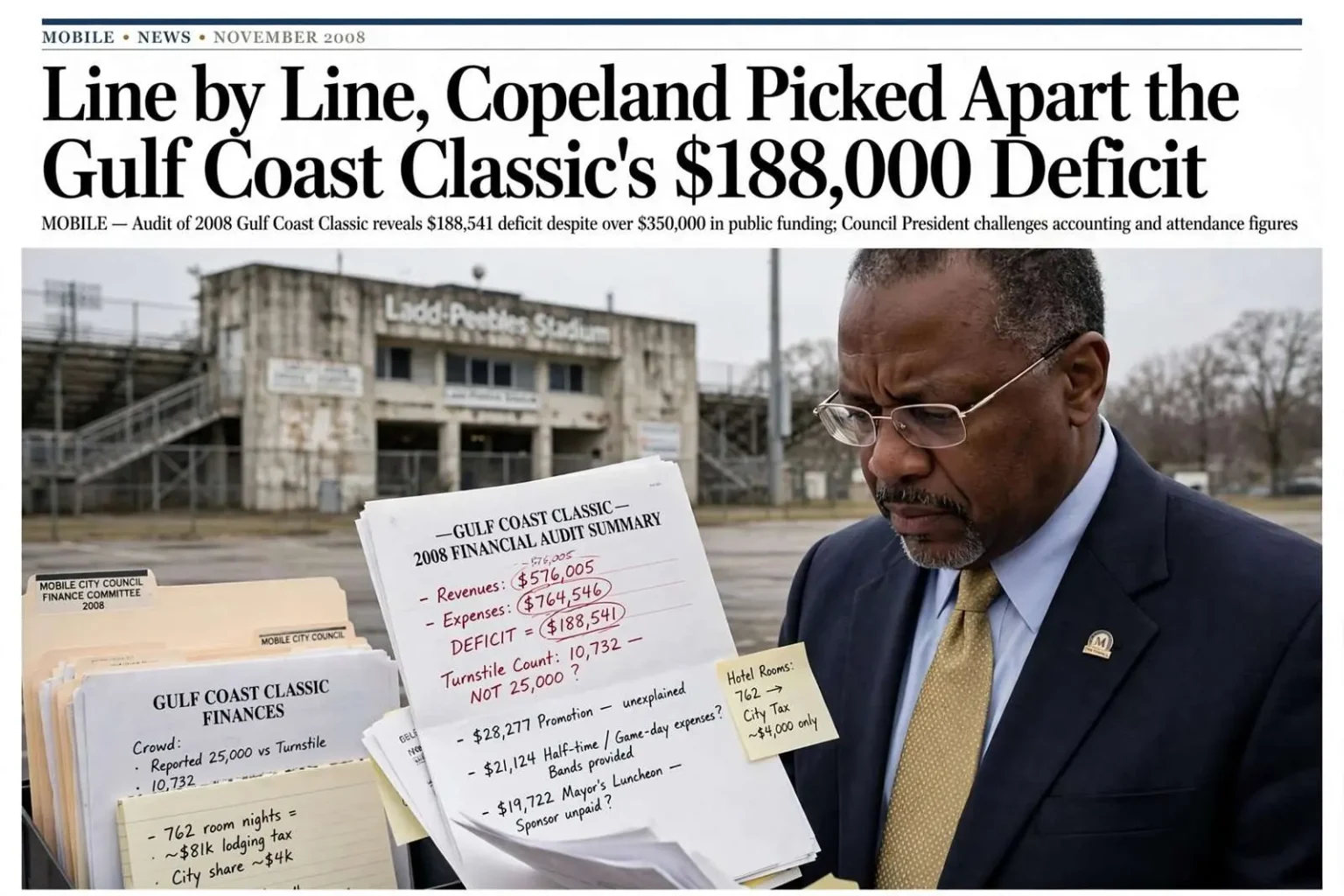
MOBILE — An audit of the 2008 Gulf Coast Classic showed the football game had lost more than $188,000 despite receiving over $350,000 in public support. Mobile City Council President Reggie Copeland read the audit closely, and he did not find it reassuring.
Copeland argued the audit was deficient — virtually meaningless, in his assessment, as a guide to what the venture had actually taken in and spent. Ray Lapierre, treasurer of the Gulf Coast Scholar & Sports Foundation, the game’s new managers, countered that the Classic’s finances were “transparent,” as attested by an audit performed by qualified, well-established accountants. The audit had not been conducted independently; it was commissioned by the game’s own management.
The dispute set up the classic standoff of a city money fight: a council president with a calculator against the event’s new operators with an accountant’s clean letterhead. Ladd-Peebles Stadium, the historic west Mobile venue that had hosted the Alabama State home game and its predecessors for decades, was by 2008 the recurring stage for one of the city’s most contentious civic arguments — whether Mobile could build a signature football event worth public money, and whether anyone was keeping an honest ledger while it tried.
The numbers in dispute
Copeland’s report, addressed “to whom it may concern,” cited the audit’s figures: $576,005 in revenues against $764,546 in expenses, for a deficit of $188,541. The contract, he noted, called for Southern University to receive $250,000 and Alabama State University $225,000 — nearly $475,000 committed to the two teams before a ticket was sold.
He also disputed the crowd. Against post-game reports of attendance exceeding 25,000, Copeland said the actual turnstile count for the Saturday, Nov. 15 game was 10,732, and said he had evidence to support the figure. Admission was $15. Had 25,000 actually come through the gates, he calculated, there would technically have been no deficit — though with significant taxpayer financing in the mix, any claim of breaking even would have been muddy water indeed.
The gap between the announced crowd and the turnstile number was more than a bookkeeping quibble. Stadium operators, promoters and event backers routinely publicize ticket counts that include comps, giveaways and blocks distributed to schools and sponsors, while turnstiles count only the bodies that actually passed through. At $15 a head, the difference between the two figures was roughly $215,000 of hypothetical revenue — nearly the size of the deficit itself — and Copeland’s insistence on the turnstile number was a challenge to the entire accounting culture around the event.
The game generated 762 hotel room nights, Copeland said, producing more than $81,000 in taxes — of which the city’s share was about $4,000.
That hotel number was the economic development case in miniature. The Classic’s backers had promised tourists, alumni and marching band entourages filling Mobile hotels for a weekend, and the lodging tax receipts told the story: 762 room nights spread across the city’s hotels, with the overwhelming share of the tax flowing to state and county coffers and the city’s slice coming to a rounding error against what the city had put in. For a council weighing future appropriations, it was the least persuasive number in the file.
The items he wanted explained
$21,124 for half-time and game-day expenses — the schools’ own bands provided the half-time entertainment, Copeland noted.
$28,277 in promotion expenses — “This mystery defies speculation,” he wrote.
$17,223 for printing tickets — “The original cost was $7,500 to print, but the audit claims $17,223 (worth) were printed. Why the difference?”
$19,722 for the Mayor’s Luncheon — “I was told there was a major sponsor. I’m still awaiting results on this matter.” The Classic’s own website credited Rayco Industrial, headquartered in Selma with offices in Mobile, as the luncheon’s sponsor. State Rep. James Buskey chaired the luncheon committee.
$12,563 for a step show at the Saenger Theatre — listed as an expense with no revenue shown. Of 873 tickets sold, Copeland wrote, 449 sold before the event; 300 were placed on consignment and 450 given to promoters, “yet no income was shown from these 750 tickets.”
Each line item carried the same question in different clothing: where did the money go, and who decided? Promotion spending of nearly $30,000 against a crowd that never materialized was the most glaring. The Saenger Theatre step show — a marquee event for a Classic weekend built around showmanship — had generated tickets in the hundreds rather than the thousands, and the audit recorded the cost without recording any income from the consignment and promoter tickets that were supposed to produce it. Consignment sales, in which tickets are left with vendors who pay later, are a notoriously leaky channel; the tickets are counted as distributed, and if the vendor never remits, the revenue simply evaporates from the books.
The Mayor’s Luncheon drew Copeland’s sharpest questions because it had been promised a rescue. A major sponsor, he had been told, would cover the event; instead the audit carried the full $19,722 cost. A Selma industrial contractor with a Mobile office was credited as the luncheon’s sponsor on the Classic’s own website, and a state legislator chaired the committee — a reminder of how much of the event’s story ran through relationships rather than transactions, and how little of it showed up as money in the bank.
How the city got involved
The Classic had been a lightning rod through the previous fall’s budget fight. Mayor Sam Jones’ proposed budget would have raised the city’s appropriation from $40,000 to $450,000, on the argument that the 40-year-old Alabama State home game at Ladd-Peebles Stadium was being converted into a true “classic” on the model of the Bayou Classic in New Orleans and Birmingham’s Magic City Classic — an event that, with seed money, could grow into a major draw like the GMAC Bowl or BayFest.
After acrimonious and racially charged debate, the council compromised at $275,000 on a 5-2 vote, with Copeland and Councilwoman Connie Hudson opposed. Councilmen Clinton Johnson, Fred Richardson and William Carroll each later pledged $25,000 from their districts’ discretionary accounts if needed. That $75,000 had not been released and would not be pending further legal review, according to Council Attorney Jim Rossler.
The comparison events hovered over every debate. The Bayou Classic in New Orleans had grown into a national television event filling the Superdome and pumping millions into that city’s hotels; Birmingham’s Magic City Classic drew tens of thousands to Legion Field for one of the nation’s largest HBCU games. The argument in Mobile was that the same market existed here — a large Alabama State alumni base, a Gulf Coast tourist draw, a stadium with history — and that it merely needed capital to ignite. The counterargument, which Copeland and Hudson made at every turn, was that classics are built by decades of returns and word of mouth, not by a single appropriation, and that seeding a loss-making event with public money invited precisely the ledger that now sat before the council.
The discretionary pledges added another layer of controversy. District accounts, funded to each council member for neighborhood projects, had been pledged to backstop a citywide event, and the council attorney’s ruling that the $75,000 would await legal review put those pledges in suspension — a quiet signal that even inside the council, the mechanics of the Classic’s funding were not entirely settled law.
Copeland’s prescription
He offered a list of changes he said would put the Classic on sounder footing and reduce public skepticism: land a major sponsor; move the parade from Saturday morning to Friday night; add a Saturday morning 5K; hold the Mayor’s Luncheon and the alumni golf outing on Friday; require both universities’ teams and bands to spend Thursday, Friday and Saturday nights in town participating in community events; require each university to buy or sell 5,000 tickets; and expect city support to mirror that given the GMAC Bowl.
The prescriptions were less a critique than a business plan — the standard architecture of a successful classic, assembled from what New Orleans and Birmingham had already proven. Friday-night parades feed downtown restaurants; weekend-long band and team commitments put hundreds of visitors in hotels for multiple nights; university ticket obligations guarantee a floor under the gate; and a title sponsor, of the kind the GMAC Bowl had secured, replaces public money with private branding. Copeland was telling the foundation that if it wanted a classic, it had to build the machine that classics run on.
There was time to implement all of it, Copeland said. But he also acknowledged the possibility that the Classic might not survive at all if the two universities were still owed substantial money from the 2008 game as the next one approached. The Classic, for its part, claimed long-term commitments from both schools. Neither Classic manager Steve Harrelson nor foundation board member Sydney Raine immediately returned calls.
The unpaid guarantees were the immediate crisis. If Southern and Alabama State were still carrying balances from 2008 into 2009, the event would be negotiating its second game while owing on its first — the position from which classics rarely recover. For Copeland, the audit’s bottom line and the schools’ unpaid contracts were the same warning shot: an event that had spent the city’s money faster than it earned its own, run by a foundation whose first independent act would have to be proving it could count.