Gulf Coast congressmen press for study of foreign-owned U.S. farmland
Reps. Jerry Carl and Steven Palazzo joined 130 House Republicans calling for a federal study of foreign-owned U.S.
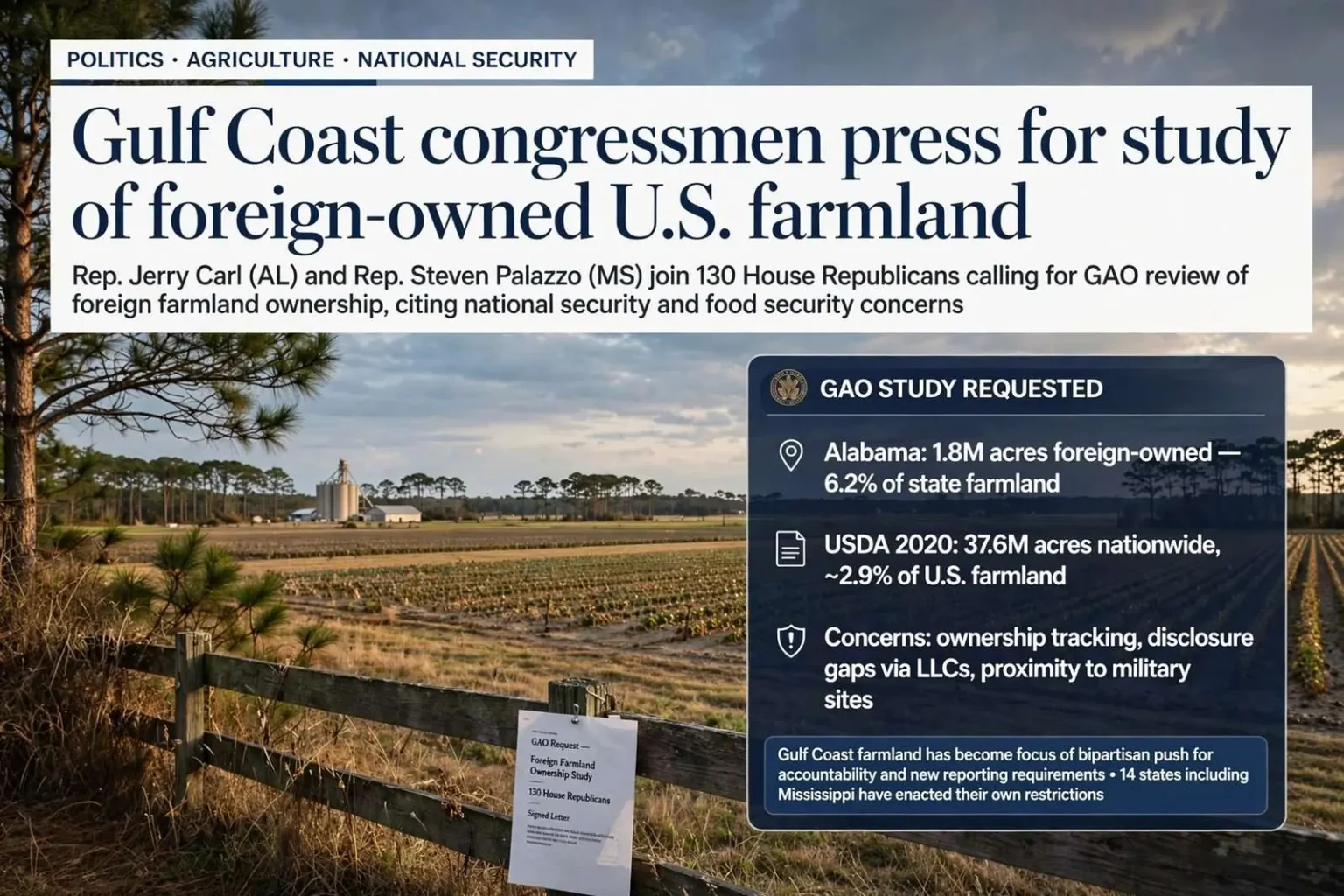
Gulf Coast lawmakers are turning their attention to a question that rarely surfaces in day-to-day policy debates but touches millions of acres of American soil: how much of the nation’s farmland is owned by foreign entities, and how well is that ownership actually tracked? Rep. Jerry Carl of Alabama’s 1st District and Rep. Steven Palazzo of Mississippi’s 4th District have joined a letter signed by 130 House Republicans asking the U.S. Government Accountability Office to study foreign investment in American farmland and its effects on national security, trade, and food security. The request reflects growing unease in Congress that federal record-keeping has not kept pace with the scale of foreign acquisitions, particularly in rural districts along the Gulf Coast where agricultural land remains a cornerstone of the local economy. The letter asks the GAO, Congress’s independent investigative arm, to assess both the current landscape of foreign ownership and the reliability of the federal systems meant to document it.
What the Federal Data Shows
The push for a formal study follows a U.S. Department of Agriculture report that put foreign holdings of American agricultural land at 37.6 million acres in 2020, roughly 2.9 percent of all privately held farmland in the country. While that share may sound modest on paper, the distribution is anything but even. Alabama ranks third in the nation for total foreign-owned acreage, with 1.8 million acres in foreign hands and 6.2 percent of the state’s entire agricultural land base under foreign ownership. For a state where timber, row crops, and poultry operations anchor rural economies from the Tennessee Valley to the Gulf Coast, that concentration has drawn scrutiny from lawmakers who represent some of the most affected counties.
The same USDA data shows that the most frequent foreign investors in American farmland come from Canada, Germany, and the United Kingdom, countries with long-standing alliances with the United States. But the congressional letter notes that China and Saudi Arabia have increased their holdings in recent years, and it is that trend line rather than the current snapshot that has alarmed members of both parties. Concerns center on the possibility that ownership deals could translate into foreign influence over food production and prices, a vulnerability lawmakers argue the country cannot afford to leave unmeasured. Food security has taken on renewed urgency since supply chain disruptions during the pandemic showed how quickly shortages can cascade from one commodity to the next.
North Dakota Purchase Intensifies the Debate
A specific incident has become shorthand for those concerns: the purchase of North Dakota farmland by a Chinese company near an Air Force base. Lawmakers cite the episode as an example of how an agricultural transaction, routine on its face, can raise national security questions when the parcel sits near sensitive military infrastructure. The purchase prompted state and federal officials to re-examine how such deals are reviewed, and it has fueled legislative proposals in Congress to tighten review of foreign acquisitions of land near military installations. Critics of the current system point out that agricultural land purchases generally do not pass through the Committee on Foreign Investment in the United States, the interagency panel that screens acquisitions of American companies for national security risk.
States have not waited for Washington to act. At least 14 states, including Mississippi, have imposed their own restrictions on foreign ownership of agricultural land. Alabama, despite ranking near the top in foreign-owned acreage, has been part of a broader conversation among Southern legislatures about whether similar statutory guardrails are needed. The patchwork of state laws is one reason the requested GAO study matters: without a consistent federal accounting, lawmakers say, it is difficult to know whether the existing rules are being followed at all. State registers and federal filings can diverge, and enforcement in most states amounts to little more than self-reporting by the buyers themselves.
Disclosure Gaps and the LLC Loophole
The tracking problem itself came into focus in a 2020 Auburn University study, which found that the federal Agriculture Foreign Investment Disclosure Act does not guarantee that all foreign entities report their holdings. The law, enacted in 1978, requires foreign persons who acquire U.S. agricultural land to report the transaction to the Secretary of Agriculture, but the Auburn researchers documented widespread use of limited liability companies as a mechanism for avoiding disclosure. Because ownership layered through LLCs can obscure the ultimate foreign buyer, the reporting requirement can be satisfied on paper while the practical picture of who controls the land remains murky. The study’s findings have circulated widely on Capitol Hill as evidence that the disclosure regime needs structural repair, not merely better enforcement.
That gap has direct consequences for the Gulf Coast. More than 547,000 acres in the local viewing area are listed by the federal government as foreign-owned, a figure that covers timberland, pasture, and cropland across south Alabama and the Mississippi Gulf Coast region. Much of the foreign investment in the Southeast has historically gone into timber, where long holding periods and corporate structures make reporting compliance harder to monitor. Forestry is among Alabama’s largest agricultural industries by acreage and economic value, so even a small reporting gap translates into a substantial number of unaccounted acres. Timberland investment vehicles managed on behalf of overseas institutions have acquired large tracts across the coastal plain for decades, often through U.S.-registered subsidiaries that can be difficult to trace back to their foreign owners.
What Happens Next
A GAO study would not change the law by itself, but it would give Congress a verified picture of the scale of foreign ownership, the effectiveness of current disclosure requirements, and the adequacy of USDA’s enforcement apparatus. Lawmakers from agricultural districts have argued that the country lacks basic answers: whether reporting violations are penalized, whether state and federal databases can be reconciled, and whether foreign acquisitions cluster around assets critical to food supply chains. The letter from Carl, Palazzo, and their colleagues frames those questions as matters of national security, trade policy, and food security at once. GAO studies of this kind typically take a year or more to complete, but their findings often become the basis for legislation and oversight hearings.
For residents of south Alabama, the debate lands close to home. The region’s farmland and timberland have long attracted outside capital, and the prospect of additional federal scrutiny could shape how future transactions are structured and reported. Farmers and landowners watching the effort will be looking for two things above all: that any new rules do not burden domestic buyers, and that the public finally gets a reliable accounting of who owns the ground beneath the region’s agricultural economy. County officials who track land sales for tax purposes, lenders who finance farm purchases, and rural development groups all have a stake in the answer, and the congressional letter signals that the era of loose accounting for foreign-owned land may be coming to a close.
The political coalition behind the letter is notable for its breadth. One hundred thirty House members signed on, spanning agricultural districts in the Midwest, the Southeast, and the Plains, a sign that foreign land ownership has moved from a niche concern of a few rural representatives to a mainstream Republican priority. Carl, who represents Mobile and the southwest corner of Alabama, and Palazzo, whose south Mississippi district runs along the Gulf, both serve constituencies where timber and agriculture remain economic anchors, and both have made federal overreach and foreign influence recurring themes in their congressional work. Their joint participation underscores that the issue crosses state lines along the Gulf Coast, where land markets, timber companies, and investment flows do not respect the border at Perdido or State Line roads.
How Neighboring States Are Responding
Mississippi’s existing restrictions give the Gulf Coast a working example of what state-level control looks like. Statutes there have long limited the ability of non-citizens and foreign entities to acquire certain categories of land, provisions that date back decades but have drawn renewed attention as acquisitions accelerate. Legislators in several Southern states have introduced bills in recent sessions to add disclosure requirements, raise penalties for unreported holdings, or bar ownership outright for entities tied to adversarial governments. The constitutionality and practical effect of such bills vary, but the direction is clear: statehouses are no longer willing to rely on a 1978-era federal statute as the only backstop.
Agricultural economists caution that the policy debate needs better data precisely because foreign ownership is not inherently harmful. Overseas capital has, in some regions, kept working farms and timberland in production when domestic buyers were scarce, and exports of agricultural products depend on open trade relationships with the very countries that invest here. The question the GAO is being asked to answer is where the balance lies, and whether the current disclosure system can even support an informed answer. Without reliable reporting, officials cannot distinguish between a Canadian pension fund holding timber acres in south Alabama and an entity with links to a foreign military acquiring land near a base.
Meanwhile, the numbers behind the debate continue to grow. USDA’s annual reporting on foreign holdings has shown steady increases year over year, driven largely by renewable energy interests, timber investment, and food companies securing supply chains. Each annual report has become a fresh data point in the congressional argument, and Alabama’s position near the top of the acreage list guarantees that the state’s delegation will remain involved as the GAO study and any resulting legislation move forward. For the Gulf Coast’s landowners, the practical takeaway is to expect closer documentation requirements on future sales, and for the region’s congressional representatives, the issue has become a fixture of the agriculture and national security agendas alike.