
Gulf Coast Ducks ending Mobile tour operations in 2019
Gulf Coast Ducks will halt its Mobile duck boat tours in 2019 after failing to secure insurance following the deadly Branson, Missouri accident.
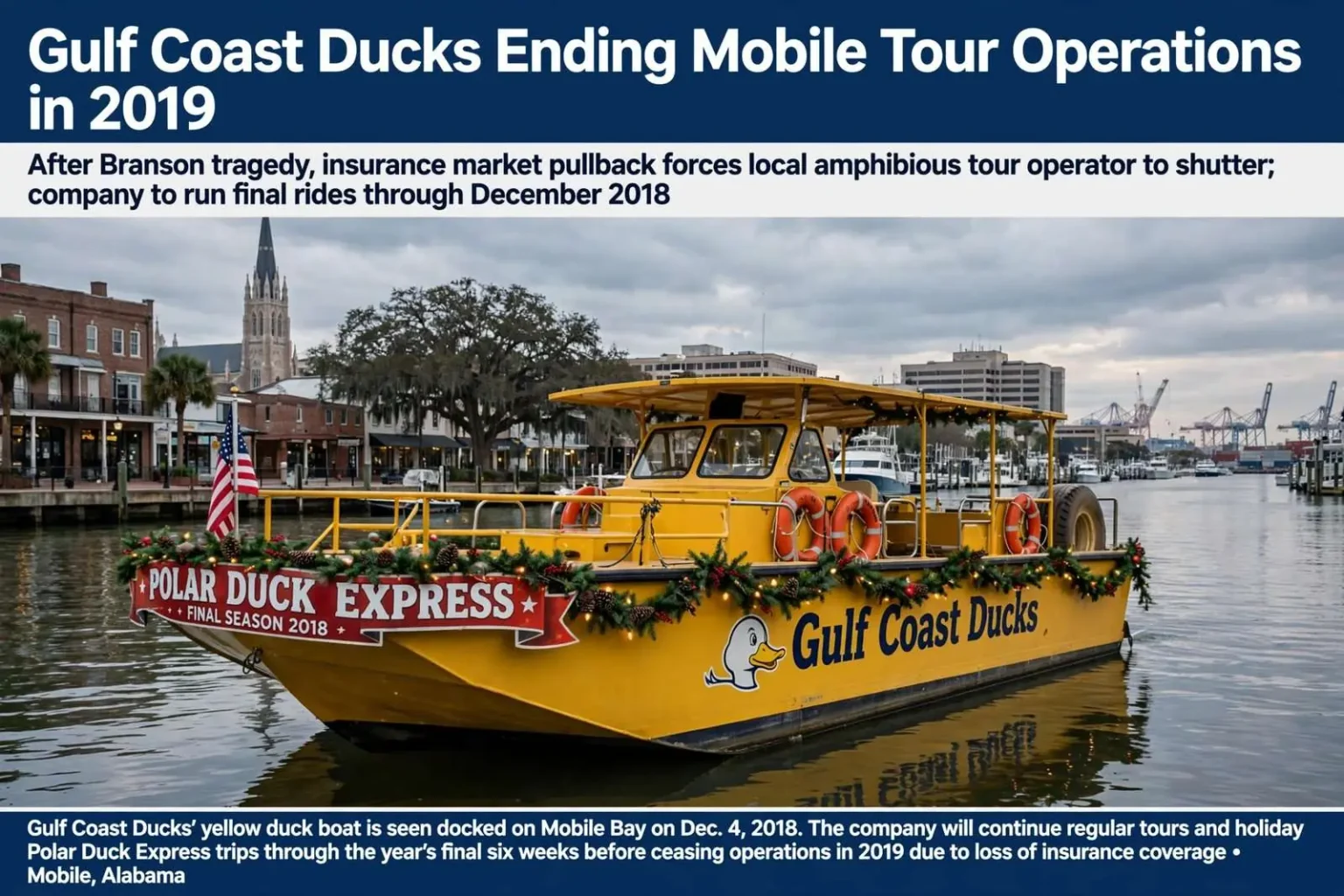
Gulf Coast Ducks, the amphibious tour company that has given visitors a splash-and-drive look at downtown Mobile, will not operate in the Port City during 2019. Owner Scott Tindle said the company has been unable to secure insurance coverage for its duck boats next year, a direct consequence of the deadly July accident in Branson, Missouri, in which 17 of 31 passengers died when a duck boat sank on a lake during a storm.
The Branson tragedy reshaped the entire duck boat industry in a single afternoon. On the evening of July 19, 2018, a Ride the Ducks vessel carrying 31 people was caught on Table Rock Lake by a severe thunderstorm that swept across the Ozarks with little warning for passengers already on the water. The boat sank in rough conditions, and 17 people — including children and multiple members of the same family — lost their lives. It was the deadliest duck boat accident in modern American history, and it came two decades after a 1999 sinking in Hot Springs, Arkansas, that killed 13.
The aftermath was immediate and industry-wide. Federal investigators opened an inquiry, regulators examined whether the vessels’ canopies and drainage systems contributed to the loss of life, and insurers across the country began repricing — or declining outright — coverage for duck boat operations. For a small tour company like Gulf Coast Ducks, which runs a handful of vessels in a single market, the insurance market’s reaction proved decisive. Without a policy, an amphibious tour operator cannot legally or responsibly put passengers on land routes or the water, and Tindle’s search for 2019 coverage came up empty.
What Mobile loses when the ducks leave
The duck boats had become a recognizable part of Mobile’s tourism scene. The tours worked as a two-part show: passengers boarded a vehicle that looked like a hybrid of a boat and a truck, rolled through the streets of downtown past historic districts and landmarks, and then splashed into the water for a circuit around the Port City’s waterfront. For visiting families, the novelty of a vehicle that drives on land and floats in water is a durable draw — and for Mobile, the tours added a distinctive option to a downtown attractions lineup built around the USS Alabama Battleship Memorial Park, the history museums and the riverfront.
Amphibious tours serve a specific role in a city’s tourism mix. They are orientation tools: in a single hour, a first-time visitor gets a driving tour of the downtown grid and a water-level view of the skyline and working port. That matters in a city like Mobile, whose identity is tied to its waterfront — the birthplace of Mardi Gras in America, home to one of the nation’s busiest ports, and a city whose downtown revitalization has leaned heavily on its relationship to the water. Tour operators, hotel concierges and the attractions themselves all benefit when a signature experience gives visitors a reason to spend another afternoon downtown.
The loss will be felt most in the niche the ducks filled: family-friendly, narrated, active tourism. Museums and historic sites reward the curious, but the duck boats reached travelers — especially children — for whom a vehicle that splashes into Mobile Bay’s waters is the memory of the trip. Replacing that draw with a conventional bus tour or harbor cruise changes the flavor of the city’s offer, even if visitors adapt quickly.
The final six weeks: regular tours and a Polar Duck Express
Gulf Coast Ducks will not disappear from Mobile’s streets quietly or immediately. Tindle said the company will continue running its regular daily tours through the final six weeks of this year, giving residents and visitors a last chance to take the land-and-water circuit. The company also plans to offer a holiday-themed specialty ride, the Polar Duck Express, during that window — a seasonal send-off that turns the fleet’s farewell into part of the city’s Christmas-season festivities.
Specialty rides have been part of the company’s playbook throughout its Mobile run, with themed departures timed to holidays and downtown events. The Polar Duck Express, arriving as it does in the final weeks of the operation, doubles as a grace note for a business that became part of the downtown streetscape: regulars will get one more seasonal tradition, and the company closes its Mobile chapter on its own terms, serving passengers until the insurance calendar — not customer demand — ends the run.
For travelers planning ahead, the arithmetic is simple. Once the final six weeks pass and the calendar turns to 2019, the duck boats will be gone from downtown. Anyone who has meant to take the tour, or to bring out-of-town guests on it, has a closing window — and a holiday-season excuse — to do it.
The company’s departure also removes a small but steady economic contributor from downtown. Amphibious tour operations support drivers, deckhands, ticketing staff and maintenance workers, and their ticket booths send foot traffic past neighboring restaurants and shops. Every departure begins and ends at street level, which means every tour funnels customers through the same blocks that downtown Mobile’s revival has worked hardest to activate. Multiplied across daily operations in peak season, the loss is measurable for the businesses immediately around the boarding point.
Duck boats: a long history with a hard edge
Duck boats themselves are among the most unusual vehicles on any American road. Derived from the DUKW, a General Motors-designed amphibious transport built for the U.S. military during World War II, the vessels hauled cargo and troops from ships to shore at Normandy and across the Pacific. After the war, surplus DUKWs were converted for civilian sightseeing, and duck tours spread to cities with waterfronts — Boston, Philadelphia, Seattle, Branson and, along the Gulf Coast, Mobile among them. Modern operators typically run purpose-built or refurbished vessels that pair a road drivetrain with a marine hull, a captain at the wheel and a Coast Guard-compliant safety outfit on the water.
That history has always come with hard edges. The vehicles operate in two regulatory worlds at once — highway rules on land, Coast Guard rules afloat — and the transition between them is where risk concentrates. Water ingress, canopy entrapment and weather exposure have driven the industry’s worst accidents, and each has prompted safety recalls and procedural changes over the decades. The Branson sinking has already forced another national reckoning, with operators, regulators and lawmakers debating canopy design, drainage, life jacket requirements and stricter weather thresholds for departing or recalling vessels on the water.
For the traveling public, the practical effect is a shrinking map. Gulf Coast Ducks’ exit from Mobile is one part of a broader contraction as small operators across the country confront insurance premiums that have climbed steeply, or find that no carrier will write the policy at all. Whether the industry emerges with stronger vessels and clearer standards — and whether insurance markets eventually stabilize for operators who adopt them — will determine if amphibious tours return to cities like Mobile in the years ahead.
What the ducks meant to Mobile’s tourism scene
Mobile has invested heavily in recent years in presenting itself as a walkable, waterfront destination: the cruise terminal, the riverfront and downtown parks, the history museums, and a festival calendar anchored by Mardi Gras. The duck tours slotted neatly into that pitch. Their downtown routes doubled as moving advertisements for the city’s historic architecture, and their water legs gave passengers a view of the skyline and the working port that no land tour can match.
The tours also served locals in ways that are easy to forget. School groups, birthday parties and out-of-town relatives all ended up on duck boats, and the sight of one wallowing down a downtown street with a load of waving passengers became a small piece of Mobile’s everyday character. Cities lose more than ticket revenue when an attraction like that departs; they lose a little of the texture that makes downtown feel lived-in and visited at the same time.
Whether a successor operator eventually takes up the amphibious niche will depend on the same forces that ended this one: insurance availability, vessel safety standards and the economics of a seasonal, single-market tour business. For now, Mobile’s 2019 attractions calendar goes on without the splash-and-drive circuit, and the company’s final weeks are the city’s last chance to ride one.
Gulf Coast Ducks will run its regular daily tours through the end of the year, with the Polar Duck Express holiday ride offered during that same window. After 2018, the duck boats will be gone from the Port City — a casualty, ultimately, of Branson.
Tindle’s message to the city has been straightforward: the tours end because coverage cannot be found, not because Mobile stopped showing up. Passengers who ride the final departures will close out an era of downtown tourism that began with a horn blast, a splash and a route that no other attraction in the Port City could copy.


