Gulf Shores Completes First Resident Satisfaction Survey, Publishes Full Results
Gulf Shores has completed its first Resident Satisfaction Survey. The full report on how residents rate city services is now available to the public.
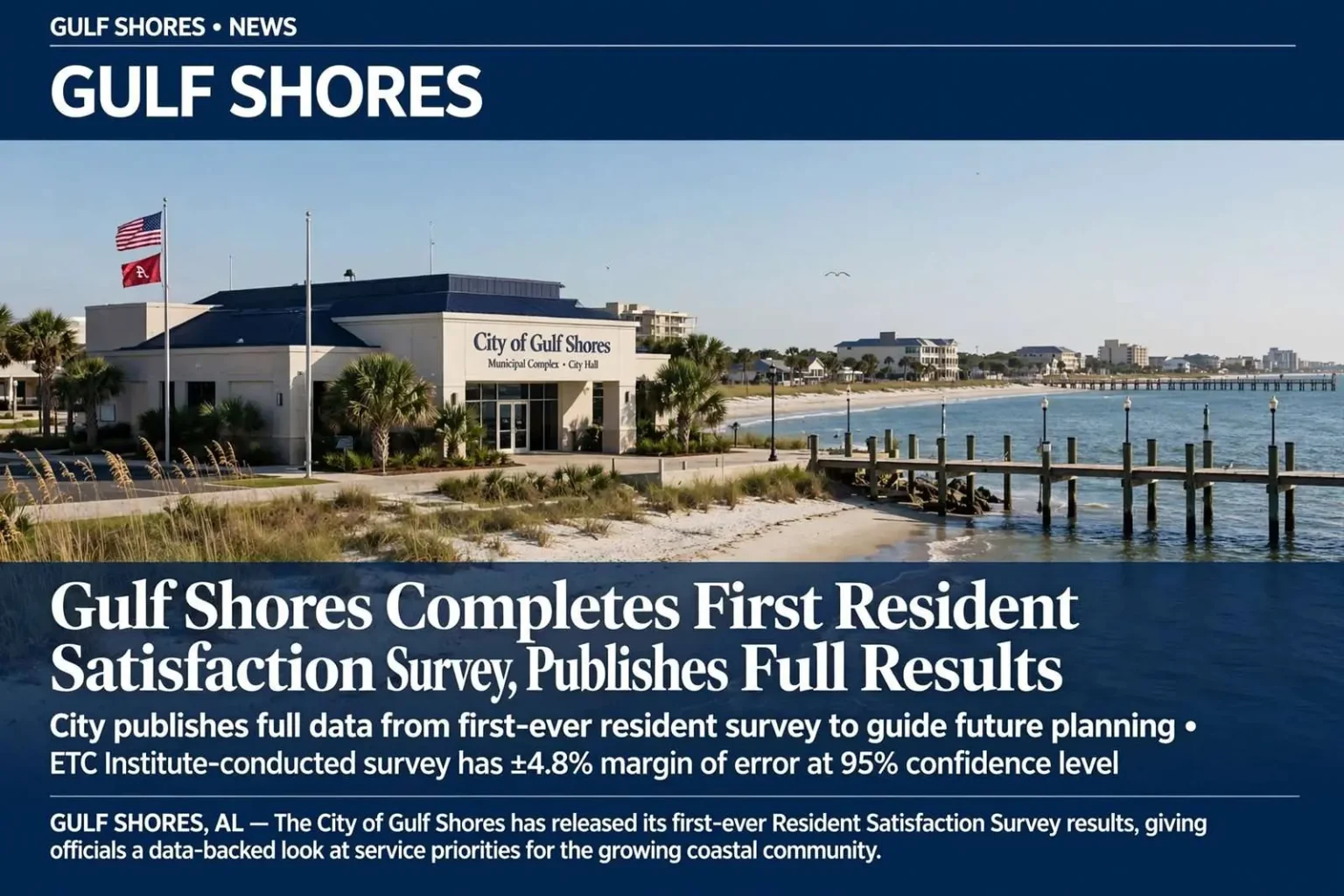
The City of Gulf Shores has finished its first-ever Resident Satisfaction Survey and made the complete report available to the public, giving city leaders a data-backed picture of how residents rate local services and where they want improvement. The survey marks a methodological step forward for a city that has grown from a small beach town into one of Alabama’s fastest-developing coastal municipalities, replacing anecdote and complaint volume with a statistically structured measurement of what residents actually think.
The survey gathered feedback from full-time residents on what the city does well, which services need work, and what should be prioritized in future planning. That focus on full-time residents is significant in Gulf Shores, where the seasonal population swells by multiples each summer and where city services — from beach safety to traffic management — serve two very different publics. By weighting the survey toward the people who live in the city year-round, officials aimed to capture the priorities of the residents who pay the taxes, vote in the elections and experience the municipal government every day of the year.
Mayor Robert Craft said the city’s top priority is continually improving residents’ quality of life through strong municipal services, and that the survey data will be critical as officials enhance those services and plan for the city’s future. The mayor’s framing positions the survey not as a one-time study but as a baseline — a first measurement against which future surveys and budget decisions can be compared, in the way that cities with mature performance-management programs operate.
How the Survey Was Conducted
Research firm ETC Institute administered the survey. The company, based in Olathe, Kansas, specializes in government market research and conducts resident satisfaction studies for municipalities across the country, making it one of the most widely used firms for exactly this kind of local government benchmarking. Hiring an outside research firm rather than building a survey in-house gives the results a methodological credibility that city officials and residents can both rely on — and allows Gulf Shores to compare its numbers against the national datasets such firms accumulate.
The survey was sent by mail and offered online to a random sample of households, and it was designed for a precision of plus or minus 4.8 percent at a 95 percent confidence level. In practical terms, that means the results from the random sample can be treated as representative of the city’s full-time households: if 60 percent of respondents rate a service positively, the true figure for all residents is likely within about five points of that number. The confidence interval is a standard target for municipal surveys of a city Gulf Shores’ size, balancing statistical reliability against cost.
Beyond the random sample, the city kept an open online version available for three weeks so other residents could weigh in as well. The open version serves a different purpose than the scientific sample — it cannot be projected onto the whole population, because respondents who opt in are self-selected — but it gives every household a voice and often surfaces specific complaints and suggestions that a shorter statistical instrument would miss. Together, the two tracks provide both a defensible measurement and a broad listening exercise, a combination local governments increasingly favor.
The decision to publish the complete report rather than a summary of favorable findings is itself notable. Full transparency lets residents examine the same numbers the city council will use in budget planning, including the services that scored poorly and the demographic breakdowns behind the topline results. It also creates public accountability for follow-through: once the data is in the open, residents can measure future decisions against it.
Why It Matters for a Growing Coastal City
Gulf Shores has transformed over recent decades from a seasonal fishing and tourism town into a year-round city with a permanent population spread across inland neighborhoods as well as the beachfront. Growth of that kind strains municipal services — roads, drainage, public safety, parks — and forces city officials to make spending decisions that pit the needs of new subdivisions against those of the older communities. A resident satisfaction survey gives those decisions a data foundation, showing which services residents consider strong and which they want prioritized as the city plans its future.
The timing matters as well. Cities along the Alabama coast have absorbed hurricanes, a pandemic-era tourism surge and rapid residential development in quick succession, and the demands on Gulf Shores’ budget have never been more complex. Survey data of this kind helps a council answer the question every growing city faces: when residents say the city should do more, do they mean public safety, drainage, traffic, or the quality-of-life amenities that make a beach town livable year-round?
Mayor Craft’s administration has emphasized quality of life as the through-line of city policy — the idea that the same municipal services that serve tourists well must also serve the families who live in Gulf Shores through every month of the year, including the quiet off-season when the economy leans on its permanent residents. A first-ever survey aligned with that philosophy gives the city a way to test whether its investments are being felt at the household level.
How Residents Can Review the Results
The full survey report is available to the public through the city, and residents with questions about the survey or its findings can contact the city’s public engagement manager, Lindsey Hart, by email at [email protected] or by phone at 251-968-3401. The existence of a named contact point reflects how Gulf Shores structured the project — not as a study that disappears into a filing cabinet, but as an public document the city intends residents to read, question and use.
For residents who participated, the published report closes the loop: the mail questionnaire or open online form they completed now exists as a documented, city-commissioned record of what full-time Gulf Shores residents want from their government. For city officials, the harder work begins now — turning a statistically sound snapshot of public opinion into budget priorities, service improvements and a planning agenda that the next survey, whenever it comes, can measure against this first baseline.
The Value of a First Baseline
First surveys of this kind carry a practical value beyond their topline numbers. When a city measures resident satisfaction once, it has a snapshot; when it measures repeatedly using the same instrument, it has a trend line — and trend lines are what allow councils to judge whether a new investment actually moved public opinion. ETC Institute’s methodology, used identically in hundreds of municipalities, is designed for exactly that repeat use, which makes Gulf Shores’ first survey a foundation for comparison in future years and even against peer cities nationwide.
The random-sample design also protects the findings from the biases that usually distort local government feedback. City halls everywhere hear loudest from the residents who show up to complain; a mailed survey to randomly selected households captures the quieter majority, including the residents satisfied enough never to attend a council meeting. The plus-or-minus 4.8 percent precision means that when the report says residents rate a service a certain way, officials can act on it without wondering whether a vocal minority has been mistaken for the whole city.
The open online comment period, meanwhile, serves the community-building side of the exercise. Three weeks of open participation lets the city advertise the survey, and participation itself tends to increase residents’ sense that their government listens. Municipal research consistently finds that the act of asking — and then publishing what was heard — improves public trust even when the results include criticism.
For Gulf Shores, a city that must balance a tourism economy with a growing permanent community, the first Resident Satisfaction Survey establishes the discipline that growth demands: measure, publish, act, and measure again. The complete report is now in residents’ hands, and the city’s stated intent — from the mayor’s office through the public engagement office — is that the data shape what comes next.
Residents reading the report should pay attention to how the numbers are cut, not just the topline ratings. Satisfaction scores that vary between the beachfront districts and the inland neighborhoods, or between long-tenured households and newer arrivals, tell the council where growth pressures are actually being felt. Services that rate well citywide can be maintained with confidence; those that rate well in one area and poorly in another point to service-delivery gaps that budget formulas alone would never reveal.
The survey also gives Gulf Shores a rhetorical tool in its dealings with the county, state and federal partners whose funding decisions shape coastal infrastructure. A statistically valid resident-verified statement of what the city’s priorities are carries weight in grant applications and intergovernmental negotiations in a way that staff assertions cannot. Cities that can document what their residents want are better positioned to win the resources to provide it.