Gulf Shores weighs $2.4 million in FAA airport grants and a plan to double water plant capacity
A rescheduled Gulf Shores work session put three federal aviation grant offers worth $2,458,953 alongside a conditional use permit that would double the output of Water Treatment Plant #05. The airport money would fund Phase 4 passenger boarding ramps and terminal infrastructure with no municipal tax dollars. The utility expansion would lift capacity from 4.3 to 8.6 million gallons per day.
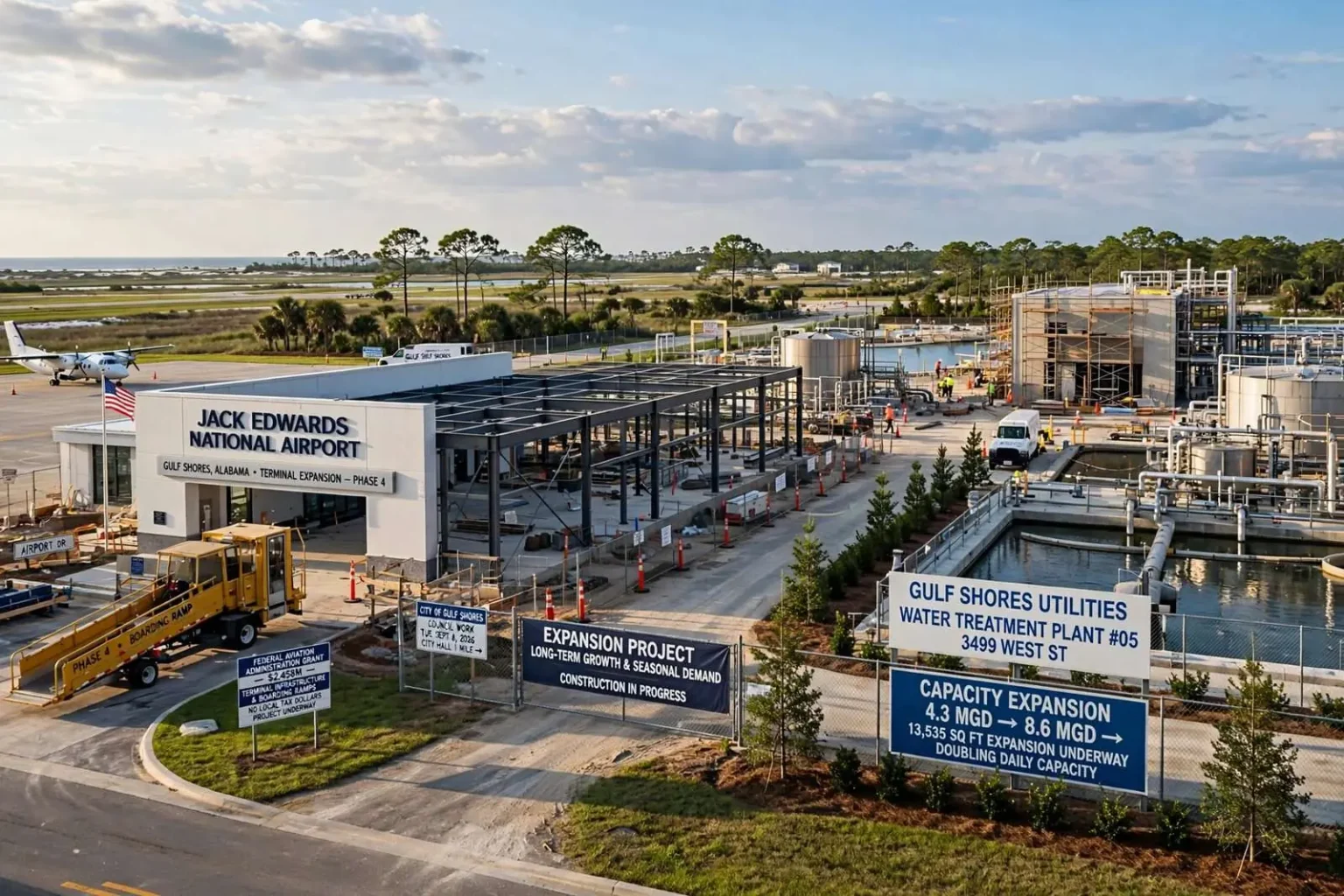
GULF SHORES, Ala. — Two projects that rarely draw a crowd but quietly determine how a fast-growing beach city functions — an airport terminal expansion and a water treatment plant — sat at the top of the Gulf Shores City Council’s agenda for a rescheduled work session this week, together representing millions of dollars in federal aviation money and a proposal that would double the amount of drinking water the city can produce in a single day.
The session was set for Tuesday, Sept. 8, 2026, at 4 p.m. in the Council Chambers at Gulf Shores City Hall. On the docket were more than $2.4 million in federal grants tied to terminal work at Jack Edwards National Airport and a conditional use permit request for a substantial expansion of Gulf Shores Utilities Water Treatment Plant #05.
Neither item is the kind of thing that generates a headline on its own. Taken together, though, they describe the position Gulf Shores finds itself in: a coastal city whose permanent population is only part of the story, and whose infrastructure has to be built for the weeks when visitors far outnumber residents.
Three FAA grant offers, no local tax dollars
Airport Director Jesse Fosnaugh brought forward three Federal Aviation Administration grant offers with a combined value of $2,458,953. According to the presentation before the council, the awards require no municipal tax dollars — the funding is federal, and the city’s role is to accept the offers and administer the projects they pay for.
The money is directed toward two related purposes at Jack Edwards National Airport. Part of it is earmarked for acquiring Phase 4 passenger boarding ramps. The remainder is tied to the construction of terminal-related infrastructure.
For readers unfamiliar with how federal aviation funding reaches a local airport, the terminology matters. An FAA “grant offer” is not the same thing as a check. It is a formal written offer extended to the airport’s sponsor — in this case the City of Gulf Shores — for a specific, previously identified project. The sponsor has to accept the offer through official action before the money can be drawn down, and acceptance carries obligations along with it. That is why grant offers appear on council agendas at all: the governing body, not the airport staff, is the entity that formally takes on the commitment.
Federal aviation grants are typically reimbursement-based, meaning the local sponsor pays invoices and then seeks repayment of the federal share against approved costs. They also generally come attached to a set of standing conditions covering how the funded facilities are operated and maintained, how long they must remain in aviation use, and how the sponsor procures the work. Those conditions are the practical reason airport projects tend to move on longer timelines than a comparable private construction job.
What passenger boarding ramps actually do
Passenger boarding ramps are the equipment that gets travelers between the terminal building and the aircraft door. At airports without enclosed jet bridges — which describes most general aviation and smaller commercial facilities — boarding is handled at ground level, and the ramp equipment is what makes that transition safe, level and accessible for passengers who cannot manage stairs.
The description of the purchase as “Phase 4” indicates that this acquisition is one step in a sequence of terminal improvements rather than a standalone project. Phased construction is standard practice for publicly funded airport work, in part because federal money arrives in annual increments and in part because a working airport cannot shut down while it rebuilds itself. Breaking the program into phases lets each piece be designed, funded, bid and built while the facility stays open.
The second category in the grant package — terminal-related infrastructure — is broader. In airport construction, that phrase generally covers the supporting elements a terminal needs to function: the paving, utilities, drainage, lighting and circulation improvements that surround a building rather than the building itself. It is unglamorous work, and it is frequently the most expensive part of a terminal program.
A water plant built to double its output
The second major item came from Planning Director Scott Stephens, who presented a conditional use permit request for Gulf Shores Utilities Water Treatment Plant #05, located at 3499 West St.
The proposal calls for a 13,535-square-foot expansion of the plant. The stated purpose is capacity: the project would take the facility from 4.3 million gallons per day to 8.6 million gallons per day, an exact doubling. The stated justification is long-term growth combined with seasonal demand.
Millions of gallons per day, or MGD, is the standard unit for rating a drinking water plant, and it describes sustained treatment capacity rather than a one-time maximum. A plant rated at 4.3 MGD can reliably treat and deliver that volume day after day. What that rating cannot absorb is a sharp, sustained spike — and a spike is precisely what a Gulf Coast beach city experiences.
Water demand in a resort community does not track the census. It tracks occupancy. Condominium towers and rental houses that sit largely empty in January fill up during spring break, summer and festival weekends, and every one of those units draws water for showers, laundry, kitchens, pools and irrigation. Restaurants that serve a modest local crowd in the off-season run at capacity for months. The result is a utility that has to be engineered for its busiest weeks, not its average ones.
Why capacity is planned years ahead
Utility planning runs on long horizons because the alternative is unacceptable. A water system that reaches its treatment ceiling during peak season has few good options: pressure drops, conservation orders, or moratoriums on new connections that halt development until capacity catches up. Because designing, permitting and building treatment capacity takes years, the decision to expand has to be made well before the need becomes visible to customers.
That is the logic behind the phrase used in the presentation — supporting long-term growth and seasonal demand. Doubling capacity at Plant #05 is not a response to a current shortage described in the agenda materials. It is a forward-looking move, sized so that the system has headroom as the city continues to grow.
The 13,535-square-foot figure refers to the footprint of the expansion itself. In water treatment, square footage translates fairly directly into process capability: additional filtration, additional chemical feed and storage, additional pumping, and the electrical and control systems to run it all. Doubling output generally requires substantially more than doubling a single piece of equipment.
What a conditional use permit is — and why the plant needs one
A conditional use permit is one of the more commonly misunderstood tools in municipal zoning. It is not a variance, and it is not a rezoning. It is a mechanism that allows a specific use on a specific parcel where the zoning code lists that use as permissible only with review and approval.
Zoning ordinances typically divide uses into three tiers. Some are permitted outright and need nothing beyond a building permit. Some are prohibited entirely. In between sits a category of uses that a community accepts as necessary or appropriate but that carry impacts worth examining case by case — things like noise, traffic, lighting, or visual presence. Public utility facilities frequently fall into that middle tier.
The conditional use process is where a city attaches site-specific requirements. Rather than approving or denying in the abstract, the reviewing body can approve subject to conditions that address the particular circumstances of the site and its neighbors. That is why the buffer question appears in the same item as the capacity question.
Wax myrtles, screening and the utilities underneath
Along the plant’s northern boundary, the application asks for altered landscape buffers. Wax myrtles and trees would be used there, an arrangement intended to keep the screening intact visually while leaving critical underground utilities protected.
That trade-off is worth unpacking, because it is a recurring conflict on utility sites. Landscape buffer standards in a zoning code typically require a planted screen of a certain width and density along the edge of an industrial or utility property, so that neighboring parcels and passing traffic see greenery rather than tanks, pumps and fencing. The standards often specify canopy trees at set intervals.
The complication at a water treatment plant is what lies below ground. Large-diameter mains, electrical conduit, control lines and appurtenances run through and around the site, and the root systems of large trees are a genuine hazard to buried infrastructure. Roots seek moisture, and pipe joints are where moisture is available. Planting a standard buffer directly over a critical main can create an expensive problem years later — and repairing that main means excavating through the buffer that was planted to satisfy the code in the first place.
Wax myrtle is a practical answer to that conflict along the Gulf Coast. It is a native evergreen shrub, salt-tolerant and well adapted to sandy coastal soils, and it grows dense enough to screen at eye level without developing the deep, aggressive root structure of a large shade tree. Using it in the sections of buffer that sit above utilities, while placing trees where there is room for them, is the kind of site-specific accommodation a conditional use permit exists to authorize.
A work session, not a final vote
The meeting on the calendar was a work session, and the distinction matters for residents trying to follow the process. Work sessions are where a council receives presentations, asks questions of department directors and works through the substance of an item without the procedural formality of a regular voting meeting. They are the venue in which the actual discussion tends to happen.
The session had been rescheduled from its ordinary slot. Municipal calendars shift regularly around holidays and conflicts, and a rescheduled meeting is easy for the public to miss — which is one reason residents who care about a specific agenda item are generally advised to confirm the date and time with the city clerk’s office rather than relying on the usual pattern.
What to watch next
Several threads are worth following from here.
- Formal acceptance of the FAA grant offers. Presentation at a work session is a step, not a conclusion. The offers totaling $2,458,953 have to be accepted through council action before the airport can move forward with the boarding ramp acquisition and the terminal infrastructure work.
- Action on the conditional use permit. The Plant #05 request, including the modified northern buffer, is subject to approval. Any conditions placed on that approval will shape how the expansion is built and screened.
- Construction sequencing at Jack Edwards. Because the boarding ramps are identified as Phase 4, the timing of that work relative to the terminal infrastructure will determine what airport users notice and when.
- The gap between approval and water in the pipes. Doubling treatment capacity from 4.3 to 8.6 million gallons per day is a construction project measured in seasons, not weeks. The permit is the beginning of that timeline rather than the end of it.
For residents, the practical takeaway is straightforward. One item brings federal dollars to a city-owned airport without drawing on local tax revenue. The other prepares the drinking water system for a Gulf Shores that is larger than the one it serves today — and for the summer weeks when that system is asked to do the most work.
Inside the $15 Million Terminal Expansion
The grant ratification on the council’s agenda sits alongside a construction project already well underway. Following a groundbreaking ceremony on July 21, 2026, general contractor TripTek Construction LLC was awarded the $15 million build contract to fast-track the terminal expansion, and the project remains on schedule for a grand opening on May 21, 2027.
Vertical structural steel is scheduled to go up within weeks. The parking lot nearest the terminal is temporarily closed for utility integration and heavy construction work, and will reopen to passengers when that work is complete.
What the Three Grants Cover
The Airport Authority Board is seeking council ratification for three federal grants totaling $2.6 million in federal funding, backed by $130,000 in local matching funds from the airport:
- Airport Infrastructure Grant: a $324,800 award representing the final installment of a five-year federal initiative that has delivered $1.5 million in total support.
- Airport Improvement Program Grant: $253,353 earmarked explicitly for ongoing terminal construction costs.
- Airport Terminal Program Grant: a competitive federal award bringing total program funding to $7 million, following a previously secured $5 million award.
Since the terminal expansion project began, it has secured between $10.5 million and $10.7 million in state and federal funding. Major contributions include a $5 million federal grant in 2024, $215,000 from the Alabama Department of Transportation for parking infrastructure, and an initial airport infrastructure grant of $448,000.
What Passengers Will Find
The expanded facility is engineered to process two simultaneous commercial aircraft operations. Phase 1 delivers a gate area with two operational gates; Phase 2 will completely renovate the interior of the existing terminal building.
Planned amenities include an outdoor patio beyond security screening, a quiet mothers’ nursing room, an expanded baggage claim carousel, larger curbside drop-off zones, expanded rental car queuing, and upgraded food, beverage and retail offerings. Lucy Buffett’s LuLu’s is already serving passengers in the terminal.
The Growth the Building Is Chasing
The case for spending $15 million on a terminal in a city of Gulf Shores’s size rests on what has happened since commercial service arrived.
Allegiant Air began flying from the airport on May 21, 2025. Since then, approximately 176,000 total passengers have moved through the facility. Traffic reached historic highs in the summer of 2026: June set an all-time record with more than 34,000 passengers and a 78 percent average load factor, and July followed with 18,000.
A recent survey found that 43 percent of airport passengers had never visited Alabama’s beaches before commercial flights began — a figure that reframes the airport as a tourism acquisition channel rather than a convenience for existing visitors. Replacing a 14-hour round-trip drive from a market like Nashville with a flight under 75 minutes changes who can reasonably take a long weekend on the coast.
Thirty Weekly Flights to 13 Markets
During peak season, Gulf Shores International Airport offers 30 weekly non-stop flights connecting to 13 markets: Huntsville; Louisville, Kentucky; Omaha, Nebraska; Springfield, Missouri; Oklahoma City; Cincinnati; Appleton, Wisconsin; Des Moines, Iowa; Belleville/St. Louis; Northwest Arkansas/Bentonville; Knoxville, Tennessee; Kansas City, Missouri; and Nashville.
The Huntsville route is Alabama’s only intrastate commercial flight path, letting North Alabama residents trade a lengthy highway trip for a one-hour flight that frequently costs less than a tank of gas.
Airport authorities expect flight frequencies on existing routes to increase next summer from twice weekly to three or four times per week — which is precisely the capacity pressure the two-gate expansion is designed to absorb.